Cara-Michele Nether: Aikido, wellness, and honesty

How can personal experiences with Aikido and wellness practices be used to help others improve their lives through self-awareness, physical health, and personal growth?

Unexpectedly inheriting an Aikido school may sound overwhelming, but Cara-Michele Nether took it in stride. She sits down to share her journey in Aikido and acupuncture, and what she’s learned from both. Cara-Michele unpacks her views on overall health, and how she helps people improve their lives by focusing on their ‘why.’ She discusses her grandmother, the importance of self-awareness, and her thoughts on Aikido’s usefulness.

Nobody wants to do something that they feel awful about. So you have to make it easy and smooth for them and give them small reasons to celebrate and have a good time and feel like they want to come back.

~ Cara-Michele Nether (38:42)

The discussion focuses on personal growth and the impact of martial arts, particularly Aikido, on physical and emotional health. Aikido serves as a tool for self-awareness and developing resilience, as Cara-Michele shares her journey from discovering the practice to inheriting and leading a dojo. The themes of humility, connection, and navigating challenges in teaching and practice are explored in depth.

Health and wellness are central topics, as Cara-Michele integrates practices like acupuncture, nutrition, and functional movement into their work. She emphasize the importance of understanding personal motivations, or “why,” to make meaningful changes in health and lifestyle. Stories of overcoming challenges and helping others through tailored approaches highlight the transformative power of these practices.

Takeaways

Functional movement — Emphasis on exercises that enhance daily life skills like lifting, climbing stairs, or squatting.

Humility in practice — The necessity of maintaining an “empty cup” mindset for growth in martial arts and personal development.

Health connections — The integration of acupuncture, nutrition, and movement to improve overall well-being.

Legacy and impact — Encouraging others to recognize their unique contributions and preserve family histories.

Community and belonging — The importance of fostering connections and seeing oneself as valuable to others.

Resources

Strength and Vitality Wellness Center — A wellness center offering acupuncture, nutrition, and movement classes, designed to help clients achieve overall health and vitality.

Falls Road Aikido — A dojo founded by Cara-Michele Nether that emphasizes Aikido practice with a focus on personal growth and connection.

Kinokawa Aikido — An Aikido organization that strongly influenced Cara-Michele’s martial arts journey, known for its emphasis on martial and philosophical aspects of Aikido.

(Written with help from Chat-GPT.)

ɕ

Mindful communication

With few exceptions, e-mail use arose organically within organizations, with little thought applied to how digital communication might best serve the relevant objectives.

~ Cal Newport from, The E-mail Productivity Curve – Cal Newport

slip:4ucabo41.

As usual, this is an interesting article from Newport. He proposes a productivity curve for email—how productive we are without, with-some, with-more, with-too-much—which explains perfectly why some people love email and some people hate it.

The key point about email is to use it intentionally. Not simply one’s own use; not simply, “I only check my email twice a day,” or, “I’m always at ‘inbox zero.'” The key is to deploy email wisely, in a way which increases productivity of a team, (family, community, whatever.) If adding email into the mix is going to increase productivity, then do so. Then zoom out and look at all your other communication tools, and perform the same calculus. Email is simply one example of a tool which initially [hopefully] increases productivity, but too-soon becomes a detriment.

ɕ


Do it yourself

Nobody cares. Do it yourself.

~ Hugh MacLeod

slip:4a288.


The faculty of choice

What else does the eye do, when it is opened, than see? But whether we ought to look upon somebody’s wife, and in what manner, what tells us that? The faculty of choice. Whether we ought to believe, or to disbelieve, what is said; or whether, if we do believe, we ought to be moved by it or not; what tells us that? Is it not the faculty of choice?

~ Epictetus

slip:4a397.


The impulse to blame

Small-minded people habitually reproach others for their own misfortunes. Average people reproach themselves. Those who are dedicated to a life of wisdom understand that the impulse to blame something or someone is foolishness, that there is nothing to be gained in blaming, whether it be others or oneself.

~ Epictetus

slip:4a283.


Carl Reiner

But, for me, one of your qualities stands out that is not often cited in the legacies of the famous: decency.

~ Steve Martin from, Carl Reiner, Perfect – The New York Times

slip:4unymo2.

Hear! Hear!

ɕ

P.S.: Carl Reiner, Multifaceted Master of Comedy, Is Dead at 98 – The New York Times

slip:4unyae2.


Know when to punt

25 days ago I started a wee challenge: Trying to train every day for 100 days straight. I’d done this challenge in 2017 to mixed results. Physically it was mixed; training every day is too much and I ended up defining some recovery days as “training.” Mentally it was also mixed; I wasn’t trying to build a new habit, so the “daily” part didn’t work towards that, and it became a serious drag forcing myself to train every day.

When I finished the 2017 challenge I knew it sucked and definitely didn’t want to make that a thing I did often, nor even yearly. When 2020 rolled around—my physical activity was exactly as usual, with me outside doing various things just as much as 2019—but I started thinking about doing some more rock climbing (outdoors, on real mountains.) That prompted me to think about getting into better shape. For me, that’s primarily removing fat. For the first couple months I concentrated on diet, which means focusing on when and how much I’m eating.

After I peeled off 10 pounds of blubber, that’s when I had the idea to take on a fresh 100-days-of-training challenge. It was exactly what I remembered it was like: It sucks. In years past I would have just embraced the suck and pushed through the thing. Note that I would have constantly considered myself to be failing. Entirely missing a day here and there, realizing I need a rest day and defining recovery as training, and just generally nagging myself with, “I should go train.” Instead I simply punted on the whole thing and deleted it entirely.

…aaah, yes, the power of “no” when you have a bigger “why” burning inside you.

When’s the last time you punted on something?

ɕ


A few years ago

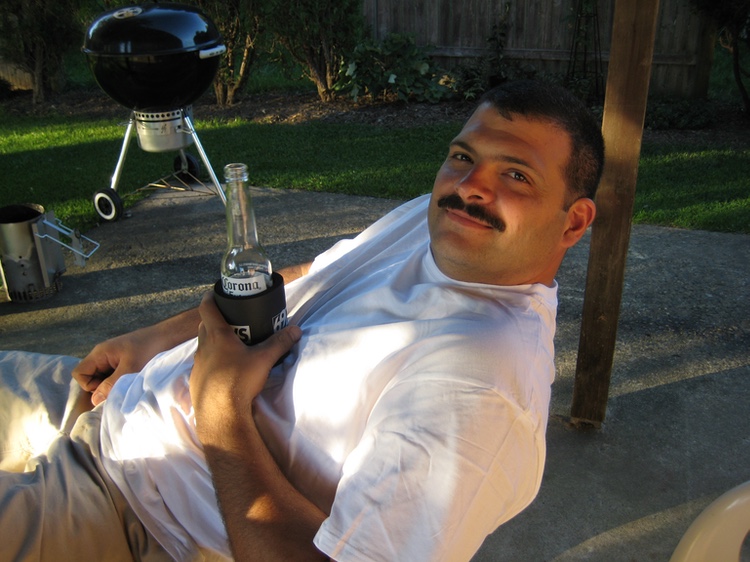
Can’t remember the last time I had a beer—not that I quit specifically, and I’d be surprised if it’s been more than a year, but at one time beer was a thing… and now, not so much. I’m not sure if that’s because my life went to shit and I feel I never have time to relax, or if I’m simply no longer interested in beer. Anyway. Also: Mustache.


Expectations

All outcomes are manifestations of forces that are at work to produce them, so whenever looking at specific outcomes, think about the forces that are behind them. Constantly ask yourself, “What is this symptomatic of?”

~ Ray Dalio from, 17 Management Lessons from Ray Dalio

slip:4ufoma1.

This is pretty much the zero-th rule of being a rational agent. (But that doesn’t mean it doesn’t bear repeating.) The post from Parrish is simply a long list of quotes from Dalio. It’s a great list, and it’s assembled in the context of leadership skills. This one, (quoted above,) in particular speaks to me; speaks to me like a drill sergeant. “What is your dysfunction?!” Anyway.

Once I started practicing being rational—yes, emotions are real, they are important, they get their due… But once I started intentionally practicing using rationality as a tool I made huge strides in self-improvement.

ɕ


Commitment

People who are interested in doing something will do it when it’s convenient. People who are committed will do it no matter what.

~ Bob Proctor

slip:4a399.