Philosophy does not promise to secure anything external for man, otherwise it would be admitting something that lies beyond its proper subject-matter. For as the material of the carpenter is wood, and that of statuary bronze, so the subject-matter of the art of living is each person’s own life.
Just as with job-related admin, “life admin” represents some of our least favorite, and most procrastinated on, to-dos. And yet completing them is essential to keeping our lives organized, functioning, and moving ahead.
A couple years ago I simply threw my hands up in the air and picked one day of the week which I’ve literally labeled as my “admin” day. On that day each week, I tackle everything related to life admin. It’s awesome; Stuff gets done.
But even better than that: It frees me on the other six days of the week. During the other six days each week, whole swaths of things are trivially lobbed onto the pile for the next admin day.
Try this: Pick a day of the week to be admin day, and start lobbing stuff to that day. Laundry, housecleaning… hell, I don’t even open postal mail until admin day. Pay bills, schedule things, shopping, errands…
I have playlists for this exact thing. Hundreds of individual songs selected and shuffled, for very specific purposes.
Sometimes I go “hunting” to find new tracks for these lists; My Mac says my music library has 9,121 items, 26.5 days, 77.96 GB, and I have a “smart” playlist which grabs 250 least-recently played. It avoids some genres (like “Spoken Word” so it doesn’t pick out French lessons, etc) and it avoids any track I’ve one-starred (my way of saying omg no)… It’s basically an endless series of, “I forgot about that!” I often flip over to the original album, start from the front, and sometimes I add a track to one of my play lists.
What? Why? …best of both worlds. I have playlists that do what I need—hide the world, hide everything. And I’m continuously startled with delight by my tiny music collection.
The greatest crime is the overlooking of who you really are in favor of the story of who you think you are. This preoccupation with your personal drama is the cloud that masks the sun.
A short and startlingly insightful idea about— …well, no. I’m going to make you click.
Also: Cue my misty-eyed nostalgia. That’s what the web looked like in ’96. Back when I proudly wielded the self-selected job title of “spyder.” (Do I have to explain that? Please tell me I don’t have to explain that.)
As we leave childhood, we unwittingly dial down our imagination and our ambition, because an ancient and out-of-touch part of our minds tells us they are dangerous. Creativity suffers, and so do our prospects for personal greatness and happiness. […] The purpose of this book is to illustrate this great discrepancy — between what is normal and what is possible — and give you some stepping stones to begin crossing the rift.
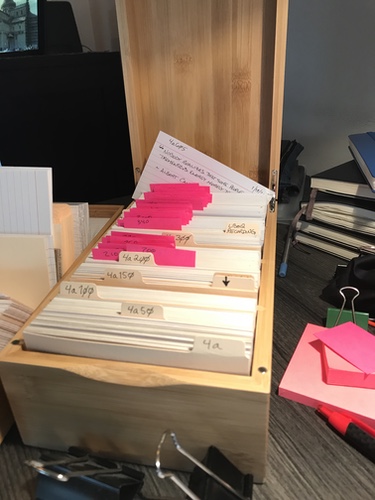
Recently my “little” box of quotes outgrew its original little box. The collection now exceeds 600 cards and continues to grow at an accelerating pace.
…and it has expanded conceptually far beyond simply being a box on my desk. The Little Box of Quotes podcast has surpassed a year of daily episodes. A precious 10 or so of the quotes were the original seeds for what became my personal sequence of daily reminders for reflection. My personal sequence then inspired my series on Practicing Reflection which ran during the opening days of 2021.
I’m curious to see where I’ll be with this in another 5 years.
I know I’ve been off on two long tangents recently: The long series of posts about practicing self reflection kept this blog busy for two months, and before-and-after that I’ve been doing a deep rabbit hole exploration of Slipboxes. I’m still yappin’ about Slipboxes, but I think we’ll be seeing more random things here in April.
But before that happens here’s another thing related to the Slipbox: I found this really detailed summary of Ahrens’s, How to Take Smart Notes. I’ve been reading and studying these notes, as I’m reading and studying the book. Take a look at this post, How to Take… —the site is literally named The Rabbit Hole. You’ve been warned.
ɕ
slip:2ho1a.
Craig Constantine: Experience, pruning, and benefit →
What motivates and defines meaningful conversations in podcasting, and how does preparation and intentionality shape these interactions?
Doing the ‘same’ thing over 100 times seems like a lot, but feels like much less when each time is a unique and valuable experience. Craig discusses the process he uses to create space and have authentic conversations with each guest. He unpacks the idea of ‘pruning’ your projects and how reflection is integral to the process. Craig shares his personal reasons for creating the podcast, why video is not on the agenda, and changes we may see moving forward.
If you think about how… This is actually really hard to do, I think. If you think: ‘I am going to go over to my friend’s house at three o’clock on Tuesday, and I’m going to have a good conversation!’ With that, I mean, that’s basically what we’re trying to do.
~ Craig Constantine (14:17)
This conversation navigates the dynamics of podcasting, emphasizing the intentional shift from traditional interviews to organic conversations. Key points include the importance of preparation, balancing listener needs with authentic dialogue, and creating a space where guests feel seen and heard. Insights into reflective practices reveal how curiosity and follow-through shape meaningful exchanges.
The discussion also touches on challenges in managing creative projects, with pruning as a metaphor for intentional decision-making. The process of saying no to certain projects to create room for impactful endeavors highlights the speaker’s philosophy. Other topics explored include the importance of diversity in guest selection and the iterative process of refining the podcast’s mission.
Takeaways
Creating meaningful conversations — Preparation and curiosity play a crucial role in fostering organic and reflective discussions.
Balancing dual roles — The host must navigate the tension between serving listeners and maintaining an authentic connection with guests.
Pruning projects — Intentionally saying no helps streamline focus and manage creative energy.
Diversity in voices — Amplifying marginalized and diverse perspectives enriches the depth of storytelling.
Reflection as growth — Journaling and structured self-reflection can lead to personal and professional efficacy.
Intentional guest preparation — Taking time to “load” the guest into the host’s mindset enhances the quality of the exchange.
Crafting spaces — The physical and emotional setup influences the dynamics of conversations.
Celebrating milestones — Recognizing achievements provides opportunities for both reflection and forward momentum.
Resources
Constantine.name — Craig’s personal blog serves as a reflective space for exploring project insights.
Art of Retreat — Referenced as another platform tied to recorded discussions.