The theory about big decisions is that they require a tremendous amount of thought, and that investing in all these thought results in better decisions. There are many classes of decisions where there is a right move. Deliberate planning around complex issues involving different people with varied goals is essential to making a correct decision.
I say “start walking” not only because that’s the only way to get where you need to be. It’s also the easiest way to begin. Far too often I overthink things when simply taking action would get me what I truly want to know: Will it work?
Three words matter much: Not me, I’m certain I am uncertain. I’m not simply uncertain. Not simply indecisive, beset by unknowns, nor stymied by possibilities.
The virtue of intellectual humility is getting a lot of attention. It’s heralded as a part of wisdom, an aid to self-improvement and a catalyst for more productive political dialogue. While researchers define intellectual humility in various ways, the core of the idea is “recognizing that one’s beliefs and opinions might be incorrect.”
But achieving intellectual humility is hard. Overconfidence is a persistent problem, faced by many, and does not appear to be improved by education or expertise. Even scientific pioneers can sometimes lack this valuable trait.
The compass for me is, “so what?” When I’m certain of something, I ask myself: So, what? Connecting that which I’m certain of, out into the world via, “so, what?” challenges me to look at the underpinnings of my beliefs, and the integration with my knowledge in total.
What are the key principles and ideas behind the “Open and Curious” project, and how do they apply to fostering meaningful conversations and personal growth?
Explore how curiosity, complexity, and personal growth intersect in the journey of crafting conversations and podcasts.
But a lot of us get this memo—who didn’t get it early in life—begin to get it in middle age. I’ve never had this thought before, but the middle age thing… what [our culture calls] the midlife crisis. Well the midlife crisis is really getting […] I’m not supposed to keep trying to be perfect.
~ Tom Huntington (5:11)
Craig and Tom engage in a thoughtful conversation about curiosity, control, and personal growth, touching on how these ideas intersect with podcasting and everyday life. Tom expresses his excitement about Craig’s project, Open and Curious, seeing it as a principle of life and an approach to understanding healthy human nature. They discuss the tension between trying to control outcomes, especially in conversations and creative work, and allowing curiosity to guide the process. Craig reflects on how developing curiosity can help podcasters move conversations in meaningful directions without forcing control, while Tom emphasizes the importance of being open without slipping into chaos.
Another theme is the challenge of balance in life and learning. Tom shares his personal experience of trying to manage too many ideas, leading to a feeling of being out of balance, and describes the importance of self-awareness in recognizing the problem as internal rather than external. They also touch on midlife revelations, where people begin questioning the pursuit of perfection and the pressures of society. Tom’s reflections on mental health and how openness affects both individual growth and relationships add depth to the discussion, bringing in insights from neuroscience and attachment theory.
Maybe I’m just a big sentimental softie, but I bet if you peer deep into your past, you don’t see a list of names, dates, and places. Instead, I bet you get a hodgepodge of images and events, and I bet that some of the details are hazy or mixed up, like who was there, what they were wearing, or whether it happened when you were six or when you were eight. But I bet the feelings are clear. You’re probably not confused about whether you felt proud or afraid, welcomed or rejected. And I bet that although you could describe these memories to me—a golden-hued day at the zoo, the last fight your parents had before they got divorced—the words would leave a lot out. To really get me to understand, you’d need to hook your brain up to mine, Avatar-style, so I could feel what you felt.
Mastroianni’s article is about learning. In particular, how and why and when we forget, and what might we try to do about that fact. I go through cycles of grasping at trying to remember, and leaning into the forgetting. At the end, I expect I’ll forget everything. (Just sayin’.)
My life improves when I realize that my happiness is relative to where I set my sights. If my goal is to remember as much as possible, I’m going to fall short and be disappointed. If my goal is to be pleasantly surprised when I’m reminded of things (experiences, ideas from others, and my own ideas) which I had already discovered, then that suggests a different course of action. Rather than strain to hold on to everything, I try to release everything from within my mind, and try arrange the world around me to bring me joy.
What a ridiculous thing it is to trouble ourselves about taking the only step that is to deliver us from all trouble! As our birth brought us the birth of all things, so in our death is the death of all things included. And therefore to lament that we shall not be alive a hundred years hence, is the same folly as to be sorry we were not alive a hundred years ago.
The History of Philosophy is an interactive tool enabling users to dig into a visual timeline of 2,500 years of philosophical thought and discover lines of agreement and divergence.
I glanced at this when it appeared in my RSS feed and I had two simultaneous thoughts: “Wow, I should really dig into—” And, “RUN AWAY!” Because, this is exactly the sort of maximally complicated data visualization that I would create.
A short and startlingly insightful idea about— …well, no. I’m going to make you click.
Also: Cue my misty-eyed nostalgia. That’s what the web looked like in ’96. Back when I proudly wielded the self-selected job title of “spyder.” (Do I have to explain that? Please tell me I don’t have to explain that.)
It’s Einstein’s principle of relativity: all points in the universe are created equal. “There’s no need,” Patricia teaches, “to find the right starting place.”
After considerable consideration, I remain unsure what to think of, “start before you are ready.” I agree with it, in the sense of one’s needing to avoid the opposite behavior: Never actually starting because one is busy preparing procrastinating. If Pressfield’s admonishment to, “start before you are ready,” gets you around procrastination, terrific!
However, I have a different problem: Taking on too much. At this point in my insanity, I’m desperately trying to insert an emphatic “wait, no, don’t!” in front of any urge to start any project. But my thinking becomes circular. What if all the things I’m doing—which I’m trying to avoid starting… What if all the things I’m doing are actually just me procrastinating. What if there’s some other thing that I do need to “start before I am ready,” but I just don’t see what that is yet?
Are you starting? Are you procrastinating? …how do you tell the difference?
The separation of talent and skill is one of the greatest misunderstood concepts for people who are trying to excel, who have dreams, who want to do things. Talent you have naturally. Skill is only developed by hours and hours and hours of beating on your craft.
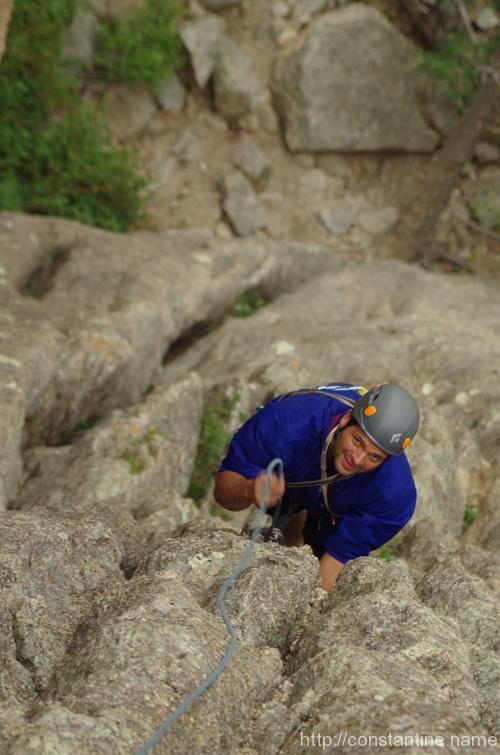
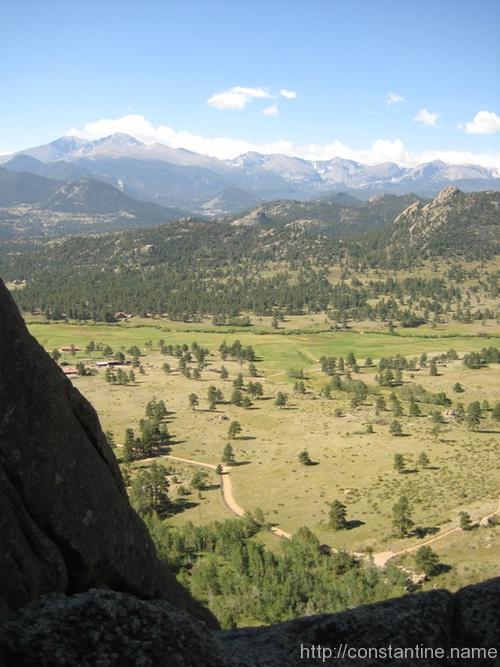
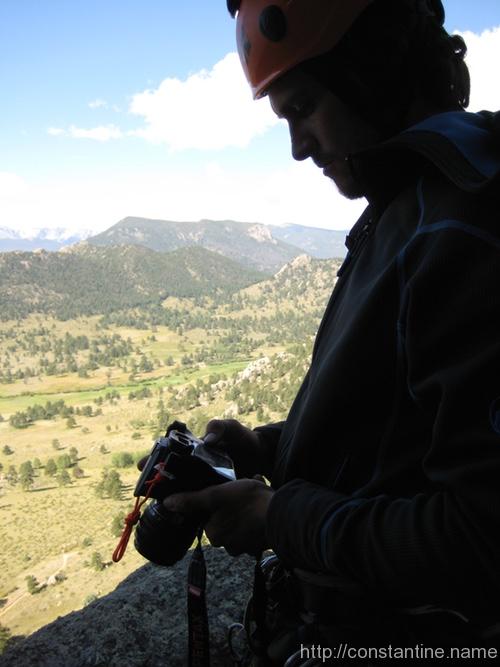
We picked Organ Pipes to be our last climb on Lumpy Ridge. This was our last day in Estes Park Colorado. We had been camping just inside the Rocky Mountain National Park at the Aspen Glen campground and it was a short drive to the Lumpy Ridge parking area.
As we approached the parking area, the Twin Owls are impossible to miss. They look exactly like two roosting owls. Below them, just in front of them, is a light colored triangle of rock. It actually took us a bit of hiking around to find our climb. But as we drove away, we realized Organ Pipes is tucked in the shadow, just to the left of the big triangle of light-colored rock. When we reached the top of the climb, we were at the base of the Owls.
Let’s re-read the statement: “This supports the idea to take humans out of the loop (because they are unreliable and inefficient) and replace them with automated processes.”…which are designed by humans, who are assumed to be unrelia…oh, wait.