For many, the first step on a spiritual journey is to become lost. The final step is losing one’s self.
~ Wu Hsin
Elsewhere, this is 4a327. — slipbox
Why do great writers write?
~ Shane Parrish from, Why Great Writers Write
Why, indeed. I write—and this reason is one of many mentioned in that article—because it’s the only way I know to be sure I actually understand a concept. I used to think that, at least some of the time, I was writing because I had something which I found interesting, and I’d wanted to share it. But I now realize that, no, what makes me want to share it is that I don’t want to forget it [the interesting thing.] Wait, sorry. I’m not explaining this very well. I write because the act of pinning-down my thoughts, to create concise— no wait, it’s not really about concision. (Score! It’s a rare day in mixed metaphors that I get to use that one.) The act of choosing one idea, from my usual flurry of thoughts, forces me to evaluate them; Choosing forces me to decide which of these thoughts is the most important— *derp* I was talking about why I write, and now I’m talking about how I write. I’ve gone astray. With word play. Clearly then, I am not a great writer, and actually I never claimed to be one, nor have I ever, truth be told—interjections be interjected… Do you know the difference between using—these guys—or these guys, to delimit an aside, (versus going full-on into parenthesis)? Swimming. Dashes are when you expect the swimming reader to duck their head under water, and commas—but never comas—are for a brief dive in the shallow end, (and we get out the parenthesis when our swimmer needs the warning that a deep breath will be required before we dive to the bottom of the deep end to investigate something sparkly spotted therein.) Quite proud of that ridiculous, previous sentence which uses as it espouses the variations thereof. *glancing up* Wait no, I’ve written a rambling wall of text.
Why, indeed, do I write? CLEARLY I have no frickin’ clue.
Perhaps I should settle for: Why did I write this post? Why did I use that linked article, combined with a title hinting that I learned something over which I’d tripped? Because It contains a larger block of context around a quote which I already, very much liked about the Muse.
ɕ
PS: The title is a reference to, Sometimes I look stuff up.
The Wolfram Physics Project: A One-Year Update—Stephen Wolfram Writings
Elsewhere, this is 4usete3. — slipbox
I think you should click through on that, just to see the really really long amount of text. You’re back? …good.
I have no idea what he’s talking about. I mean there are large sections of it—to be clear, I did not read all of it—that I understand what it’s saying, but I cannot follow the discussion. But he’s quite literally talking about how their research project (it’s computing software they’re running simulations within) is apparently making steady progress towards solving all of Physics. My undergrad degree is in Physics, I was a Physics grad student (but didn’t finish my Masters, to be fair about it.) This stuff from Wolfram—his writing, the software, physics research—is my wheel house. Or it used to be. I haven’t been in the wheelhouse for a while as I’ve been working on much other stuff for decades.
My reaction to this sort of research, (from Wolfram and other soruces,) is always to get sucked into it; Drawn in to try and understand how and where mankind was pushing back the curtains of the unknown. It’s exactly the sort of thing I always lived to deep-dive into. “Understands, and is into, Physics,” was a big part of my identity…
Why is this post titled, “Something different?”
It was a big part of my identity, until—so it seems—one day it was no longer. My reaction is now different.
I’ve got all these other cool projects that light me up, but physics? meh.
And that made me think: That’s something different.
ɕ
The existence of evil does not harm the world. And an individual act of evil does not harm the victim. Only one person is harmed by it—and he can stop being harmed as soon as he decides to.
~ Marcus Aurelius
Elsewhere, this is 4a500. — slipbox
I [generally] hate the Internet. I wanted to start this post with a reference to a little children’s TV skit I saw many (many) moons ago, on Sesame Street or maybe it was the Muppets… about a guy named Henry with a bucket with a hole who tried to fix it based on another character’s—named Liza—ministrations, but which eventually lead him to need the hole-y, original bucket to haul water to complete the bucket-repair process. If you’re not yet grabbing your head, try reading: “There a hole in my bucket. Dear Liza. Dear Liza.” Fortunately, Wikipedia, and a pile of YouTube clips I managed to not watch, have me covered. Long live the Internet!
“Holey-bucket-fixing” is a long chain of tasks which turn out to be circularly dependent. Obviously, I don’t realize it’s holey-bucket-fixing at the start of the side quest. I start off on some simple problem. To do A, I need B. To do B, I need C. To do C, I need… A? Where’s the Tylenol?!
But sometimes, I start off on some simple problem and it goes very well. As in . . .
Your merry band enters the dimly lit inn, glad to find shelter from the stormy night. The rogue among you sticks to the shadows to the left, the dwarf angles right, (in both senses of the word,) towards the bar, and the elf-archer, with the balance of the band in tow, strides for a long table against the doorless, far wall. The dwarf orders the first round of whatever-it-is-they-serve-around-these-parts, and the bartender strikes up a conversation. “Haven’t seen you folks around before. You look like you might be up for an adventure.” If you want to go on an adventure, turn to page 42. If you just want this idiot to shut up so you can drink your whatever-it-is-they-serve-around-these-parts in peace, continue reading.
And so, with a hole in my bucket, or a simple question in mind, or—challenge-loving dwarf-at-the-bar that I play so well—just too curious for my own good… I almost always turn to page 42.
ɕ
Walking is a deliberate, repetitive, ritualized motion. It is an exercise in peace.
The Buddhists talk of “walking meditation,” or kinhin, where the movement after a long session of sitting, particularly movement through a beautiful setting, can unlock a different kind of stillness than traditional meditation.
~ Ryan Holiday from, Take A Walk: The Work & Life Benefits of Walking – RyanHoliday.net
Elsewhere, this is 4urybe1. — slipbox
Running is also a deliberate, repetitive, ritualized motion.
But gosh do I hate running. There’s no peace at all. At the very least, I’m glad that I can run (in the shoes I like to wear, for the general health of my feet,) without injury. I can go a good mile—where “good” refers to the length, I’m not cheating calling the distance “a mile”… I emphatically do not mean the running of said mile is A Good Thing. I digress. I can go a good mile and I’m confident that the next day I will not be in agony. I know that running is exceedingly good for me. I sleep better that night, am in a better mood the next morning, and something about that level of effort just turns the volume down on the rest of the world for a good day or even two.
But I know people who swear that running is peaceful. …that running is meditative. …that running is an enjoyable part of their life. …something they even look forward to.
I sure wish I could figure out how to reconcile those two alternate realities.
ɕ
How can podcast hosts ethically navigate sensitive conversations while protecting their guests’ vulnerability?
Creating a safe space for guests involves mindful preparation and ethical guidelines.
Vulnerability is okay. Nakedness is not.
~ Jule Kucera (3:52)
The conversation explores ethical storytelling in podcasting, focusing on the host’s responsibility to protect their guests while crafting engaging stories. The discussion highlights moments when personal content felt too raw and decisions were made during editing to maintain respect. The concept of “vulnerability versus nakedness” is introduced as a guiding principle for ensuring sensitive topics are handled appropriately.
The discussion touches on the impact of post-production choices and the host’s editorial power, emphasizing the importance of maintaining trust and authenticity. Strategies for preparing guests, understanding their boundaries, and creating a safe conversational space are discussed as integral to fostering meaningful and ethical interviews.
(more…)The difficulty, my friends, is not in avoiding death, but in avoiding unrighteousness; For that runs faster than death. I am old and move slowly, and the slower runner has overtaken me, and my accusers are keen and quick, and the faster runner, who is unrighteousness, has overtaken them. And now I depart hence condemned by you to suffer the penalty of death, and they too go their ways condemned by the truth to suffer the penalty of villainy and wrong; And I must abide by my award—let them abide by theirs.
~ Socrates
Elsewhere, this is 4a401. — slipbox
Sometimes, programming feels like magic: you chant some arcane incantation and a fleet of robots do your bidding. But sometimes, magic is mundane. If you’re willing to embrace the grind, you can pull off the impossible.
~ Jacob Kaplan-Moss from, Embrace the Grind – Jacob Kaplan-Moss
Elsewhere, this is 4ujaae2. — slipbox
I’m not 100% a programmer, but that’s a big part of what I do. I’ve been grinding so long that the impossible… accomplishing the impossible isn’t even interesting any more. I command an army of robots— but I’ve no idea what would be worth doing with them.
It’d be as if I did a magic trick and no one noticed. After doing that show six-days-a-week for a while, that got old. And so now I’ve become a sort of tottering crazy wizard. “Strange sounds and lights, and sometimes odd smells, arose from the tottering fool’s workshop at the top of the tower. No one dared go there any more, and few even thought to wonder at the long shut oaken door.” You know, that sort of crazy.
I do so love Alice’s take: Curiouser and curioser.
ɕ
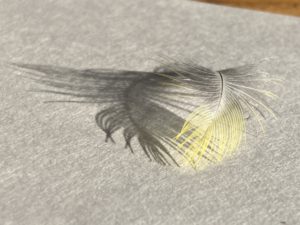
Sitting on the patio one morning, in the cool humidity and calm air of what was going to be a blazing-hot summer day, this single down feather drifted down. It skimmed along the tabletop and disappeared off the edge taunting me to chase it.
ɕ