I only wish for more hours in the day and a clone to do adulting chores while I enjoy [insert speaker’s preferences here] without interruption.
Who hasn’t expressed such a sentiment at one time or another? I certainly have, and it’s a pleasant diversion to imagine being unloaded of all the small stuff that seems to weigh me down. There’s plenty that can be said—and which I and others have already said—about the importance of the smaller things and “adulting chores”. But today I’m going in a different direction.
When that sentiment comes to mind, I use it as a thought experiment: If I had a clone, that would then obviously be me. It would be literally this same me that I am today. This same me, who doesn’t want to do those small things and adulting-chores. How do I expect to be able to convince the clone to do all the stuff I don’t want to do? If I could convince the clone, I’d be able to convince myself. So I set about thinking about how to convince the clone.
Because then I’d be happy to get that stuff done, wouldn’t I?
My title refers both to my doing of such, and is a suggestion that you should as well. It’s been a long time since I added a post to this beloved series, Changes and Results. But, today just happens to be—meaning I’ve been waiting for many months for this date :) —exactly nine years from my first daily journal entry.
What would you wish to be doing, then, when death finds you? For my part, I would wish it to be something that befits a human being, some beneficient, public-spririted, noble action. But if I cannot be found doing such great things as these I should like at least to be doing that which cannot be impeded and is given me to do, namely, correcting myself, improving the faculty that deals with impressions, toiling to achieve tranquillity, and rendering to the several relationships of life their due; and, if I am so fortunate, advancing to the third area of study, that which deals with the attainment of secure judgements.
Each morning I spend significant time in reflection. Without going too deeply into specifics, I don’t get up at precisely the same time, and I do take the occasional day off from my morning reflection. But beginning my day by reflecting—not on my yesterday, nor recent events per se, but generally reflecting on my self—is second in importance to me only to getting a good night’s sleep.
My process is, well, mine. I use software synced across multiple computers and mobile devices and so on… I also have physical books, and journals, and paper and pen… I’ve some 3×5 cards, physical boxes, etc.… The specific “how” is unimportant. You’ll find your own methods. But, simply to give you some ideas, here’s an outline of my morning reflection as of late 2020:
An item prompting specific self-reflection — From a series of self-reflection prompts I’ve accumulated over the years.
An item of inspiration — These come from a second series of prompts which I’ve developed, and are meant to get me to keep my shit in order. The quote at the top of this post from Epictetus is one of these prompts. They’re not sunny platitudes, but rather they are I’m-not-kidding-around-here-serious prompts to get me focused in what I’ve assessed to be the right direction.
Reading — I have a stack of books which are specifically Philosophical. Not simply non-fiction, but works by Epictetus, Marcus Aurelius, Stoicism and Philosophy in general. Some mornings I’ll study just one page from one of these books. Some mornings I’ll spend over an hour in this reading.
Journaling — After thus limbering up my brain and exposing it to that carefully curated collection of ideas, I pick up my pen and open my journal.
Exactly how much time does that take? It varies, but usually hours. This morning, I stopped short to do this writing. I was about 2 hours into this morning’s reflection when I switched to working on this post. Unusually, this morning I have a hard stop for something that has a specific time. (I’ve cleared from my entire life anyone’s ability to interrupt me, summon me, demand my attention, etc..) If you are aghast at this arrangement of my life… If you are thinking, “I could never do that,” I can only say:
To abstain from all information about the world at this current moment would be a betrayal of your civic duty. On the other hand, to monitor every developing story in real time, like a breaking news producer, is a betrayal of your sanity.
This tension is not only real, it’s necessary. You need to have this tension; it’s a critical component of how you assess the world by choosing what to filter in and what to filter out. The difficult part, of course, is if you don’t intentionally manage this balance.
How many things just pop in front of you each day? Are you happy with that amount?
So you want to achieve greatness. You’ve decided that ho-hum mediocrity is not for you. Alrighty then. Well, if you’re going to do that, you have to make a choice: whether to take The Big Road or The Little Road.
It turns out that this rhymes with my vision and mission. (Please start here if you just thought, “what vision and mission?”) I was deep in the workshop trying to find my vision and mission, when this post from MacLeod drifted through my sphere of awareness. I think if I hadn’t already been in the middle of doing the hard work of orienteering, this post would have tipped me into starting the hard work.
So my question for today is: If you don’t feel like you have a clear vision and mission, what would you have to expose yourself to which would be likely to make you tip into being compelled to find them?
Fewer are aware that the PC wasn’t IBM’s only internal-politics-driven value giveaway; one of the most important software applications on those mainframes was IBM’s Information Management System (IMS). This was a hierarchical database, and let me pause for a necessary caveat: for those that don’t understand databases, I’ll try to simplify the following explanation as much as possible, and for those that do, I’m sorry for bastardizing this overview!
I’ve read, (technically I am in the process of reading,) everything Thompson has written. I skimmed through this long article since it wasn’t news to me. However, if you take about 10 minutes to read this, you’ll know more about Databases and the Big Kids who made the things which became the things you now use every day, than pretty much everyone else on the planet.
I maintain that, while the number of bugs and problems users experience is linear, their understandable frustration is exponential. It’s no wonder they have learned to tolerate poor-quality work.
I maintain that this is a symptom of the rise of “good enough.” The rise of, “just ship it and fail faster,” has created a culture where “shipping it” is valued over doing something well. The only thing harder than the first 90% of a project is the second 90% of the project. To create something that is a delight to use requires an enormous effort.
Our culture is currently being reshaped by companies who are training us via the fast dopamine hit. In that arena, creating things is a vicious competition. It feels as if there is no time to do something well and bring it to market. In the time it takes to do it well (for example, create 85 episodes of a podcast, write 2,500 blog posts, fill a bookshelf with journals) you will expend an enormous amount of time, energy and money. Sometimes, what you create will be so perfectly in time with the culture that the capriciousness of the market will reward you. Sometimes it will not.
But you must do the hard work. Not because you will necessarily be rewarded, but because other people need to see you doing the hard work. That will encourage and inspire them to try something harder than their current efforts. And that ratchets the culture up, rather than down.
I’m process oriented. I want to figure something out once, and then move on to having other interesting thoughts or experiences. That leads me to a sort of, “do one, cross off two,” mentality; I try to do more work up front—do the more complicated things first—in an attempt to reap a larger gain in the long run. I’m a tool builder you could say.
But my power of process, can also be a problem. There is, of course, an XKCD for this lesson: https://xkcd.com/974/. I digress.
Today, I wanted to share a bit of the process that I use to distill the things I find, and to focus my thinking. (I’m not going to go into how I find things, nor how I ensure a fresh “stream” of those things is brought to my attention.)
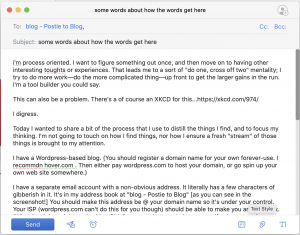
I have a WordPress-based blog using my own domain name. I also have a separate email account with a non-obvious address. It’s in my address book at “blog – Postie to Blog” [as you can see in the screenshot].
Whenever I see, read, or find something that inspires an interesting train of thought, I fire off an email to this special address. I simply brain dump my thinking. I insert bare URLs into the email. I put a “>” in front of blobs of text I want to show quoted. But I don’t bother with any formatting; it’s all just basic text.
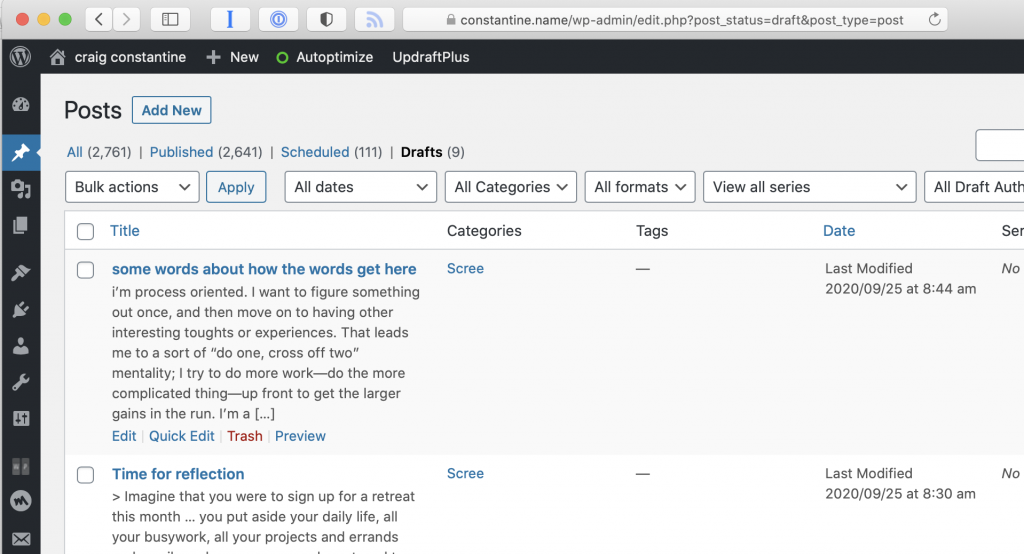
I use the Postie plugin for my WordPress site. It’s an email client which periodically looks in my special mailbox and creates draft posts on my site. It deletes the emails as it creates the drafts.
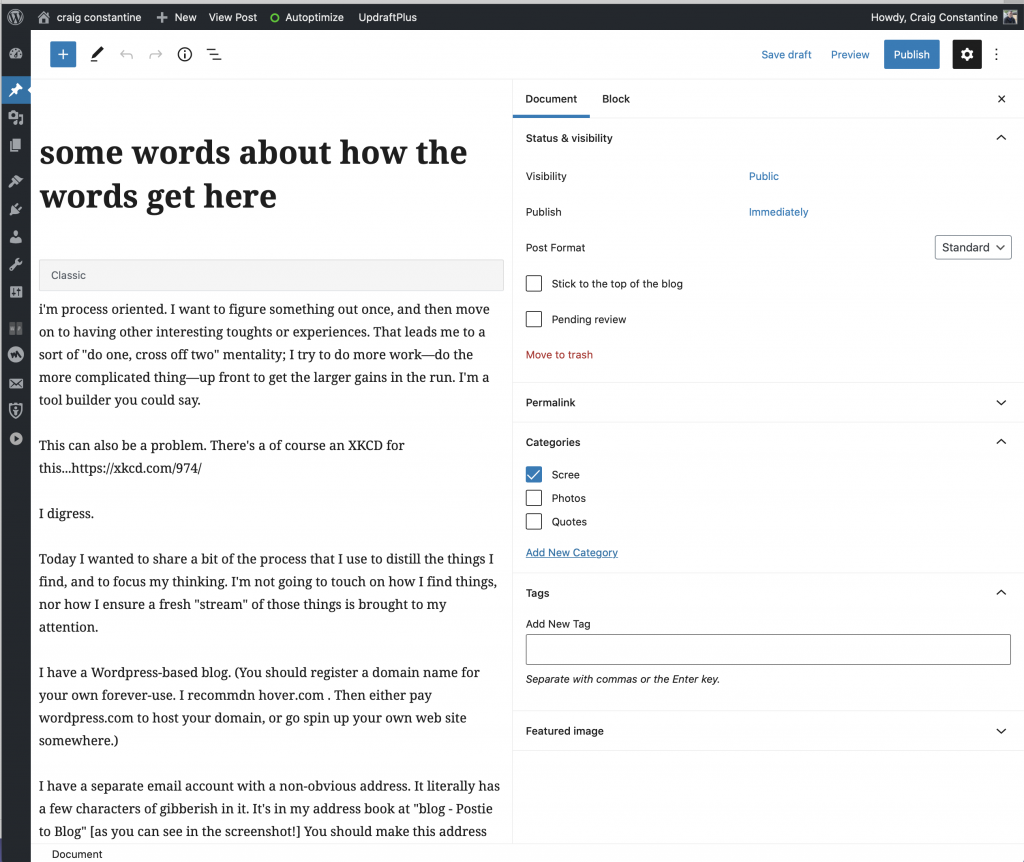
When I want to work on blog posts, I go into my WordPress site and look at my drafts. I clean up the draft—fixing anything that I couldn’t stand having out on the internet. I dress up the links, organize the quoted parts, season it with my personal style, etc.. Very rarely, I’ll simply delete a draft. This has the advantage of giving me a chance to review my ideas for posts at some distance from when I initially captured it. Most of the time, I can see ways to drastically improve the post, but I don’t bother preferring instead to post the snapshot I had originally captured. I schedule the post for whatever day I want it to go out on. I’m writing this blog for my own benefit—it’s part of my process of reflection. So it’s not usually important when any particular post goes public.
Finally, I have a Mail Chimp account that has a recurring Campaign. It follows the RSS feed from my site, and emails whatever it finds to be new at 11am every day.
Why? Well, that’s probably best left for another day.
Imagine that you were to sign up for a retreat this month … you put aside your daily life, all your busywork, all your projects and errands and emails and messages … and you travel to another place. In this place, you remove yourself from the busy world and find space for quiet. For reflection. For contemplation, setting intentions, reviewing how things have gone. For gratitude and appreciation for life.
Not only does hyper-connection alter our social relationships, it also makes us dumber, as pointed out as early as 2005. It threatens our health too. Twenty-first-century afflictions include digital fatigue, social media burnout or compulsive internet use. Cures for these rising internet-related disorders include such radical solutions as rehab centers, or disconnection.
Babauta’s take is from the Zen perspective of simply—as in: this is the only thing you have to do, and don’t overcomplicate it in the doing—creating space in your life. Lefeuvre’s is from a nuts-and-bolts perspective of facts and tactics.
I feel called quite often to take more time to reflect. I was going to write, “sit and reflect,” but it’s not quite always sitting. I believe this is also true for everyone else; some people are early on in their journeys and their need for reflection is small in total, but it is more than they are currently doing. With precious few exceptions, we could all use more time for reflection.
Do you have time for reflection built into your life?
When I arrived at the atelier, the canvas was blank and I simply began poking at making little pin-points of color. Poking just to see each little point. Sure, I avoided some entire areas of the canvas. That top-left corner didn’t interest me, but that area above the center caught my focus. Then my gaze wandered a few inches and I found I was putting points down in another, new-to-me, blank area. Day by week by month by year by decade I wandered up to the canvas. Curiously, I now realize I never looked each day at the canvas as I walked up—or walked away or simply past. I just headed to this atelier and— Although, come to think of it, I’m pretty sure I thought it was a video game Arcade at one point, and it looked like a snowy ski slope too for a while, and I recall breaking waves and some sea smells. That’s… interesting. When exactly did I realize that this place is a true Atelier? Sure sure yes yes, the particular dots are still very [very!] interesting; the minutia seems fractal and the more closely I peer, the more interested I become.
But just the other day—although, it quickly became a couple weeks ago, soon to be a couple months, a couple years, a couple decades…
But just the other day I peered over my glasses and looked at the whole canvas for what might have been the first time ever. Holy shit, it’s a Georges Seurat painting of some afternoon on some island! I mean: The overall composition is so blindingly freakin’ obvious and banal that I’m tempted to chuck the whole thing as trivial— …until I pear closely and see all the infinitely intricately interconnected dots and—bam!— VERTIGO!
My vision is a world where everyone can flourish.
My mission is creating better conversations that spread understanding and compasion.
Philosophers became insignificant when philosophy became a separate academic discipline, distinct from science and history and literature and religion.
Which is worth sharing just because it’s Freeman Dyson—I’m quoting a quote—in all his zany glory.
…but also, yeah. Why isn’t STEM today thought of as a branch of philosophy, (“love of truth” after all)? STEM degrees remain Ph.D.s, but beyond that vestigially appendix . . .