Reading for ‘hunh’

But if you only remember six things after reading this article, it should be the following truths about reading:

~ Shane Parrish, from How to Remember What You Read

slip:4ufore2.

Those six points are right near the top, too. It’s a great article about reading. —about a certain kind of reading. I’m not certain what to call the type of reading, but for today “reading to learn” will do as a label. Well, there’s another type of reading which I’ll call “reading for ‘hunh‘”.

There’s deep value in a ‘hunh’. When you find one, you can be sure you have just learned something. I spend a lot of time every day reading for ‘hunh’. I cast a wide net and then haul the contents up onto the fishing boat deck. I shuffle through the contents in muck boots; you don’t want to get this arbitrary stuff really on you. Using a squee-gee I push some of it around in an only vaguely interested fashion. I’m not super-focused. I’m paying attention for sharp edges but I’m not expecting any particular outcome. If I find a ‘hunh’ it’s just that; no more and no less than something simply interesting for the time it’s in my realm of awareness. And then I drop it back on the deck. Soon enough I wash it all overboard.

What kind of reading is that?

ɕ


Urgency

As always, I continue my project of self-improvement. I’ve long been aware that I take on too much— and yet, all efforts to “take on less” only seem to lessen the problem; Like pulling Dandelion weeds but not getting the entire root out. I’ve made an insane effort in countless ways over several decades to make progress towards “take on less.” I’ve long known there must be something underlying.

I love to use a tool I refer to as a “wedge”, to affect changes by altering the normal sequence of things. A wedge can be used to create a space for consideration, to divert my thinking, or to initiate (or change) an activity. It works because the presence of the wedge alters the mental context. My mind proceeds from idea to idea, with an evolving context for that thinking. As the context changes, it constrains—or maybe, “helps select” is a better description—what ideas are going to come to the fore of my mind next. Trains of thought develop this way. The inserted wedge causes, (if it’s done right,) enough of a shift in my mental context.

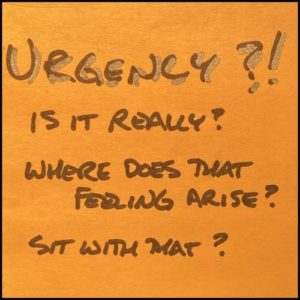
It’s really difficult to have the wedge be a thought. But orange sticky notes work well. (Until you no longer notice them, of course.)

The action of this wedge is to make me think about why I’m about to do this next thing that feels so urgent.

“Is it really [urgent]?”
…like, how a smoke detector sounding off is urgent? Okay, so it’s not that urgent.

“Where does that feeling [of urgency] arise?”

And that is where my train of thought shifts. (So far it has been every time I’ve felt urgency to do something.) Because the feeling comes from my desire for control; There are countless examples. That explains why I’m forever taking on too much.

“Sit with that?”
Sit with that realization that the urgency is a reaction to a desire for control. Sit with the knowledge that every attempt at control—all types, all sizes, all shapes, all degrees… attempted control of anything external—has never ended well for me.

That’s not hyperbole.

ɕ


Naica

The aim was to detect the possible presence of ancient bacteria encapsulated inside fluid and solid inclusions present in the calcium sulfate matrix from its formation. […] At the 2017 meeting of the American Association for the Advancement of Science, researchers, including Dr. Boston, announced the discovery of bacteria found in inclusions embedded in some of the crystals. Using sterile methods, the researchers were able to extract and reanimate these organisms, which are not closely related to anything in the known genetic databases.


~ Wikipedia from, Cave of the Crystals

That sounds like the first paragraph from a newspaper article appearing about three days before the world ends. It’s been four years though, so I guess it’s okay?

How did I stumble on that… I found Podcast: The Naica cave in one of my RSS feeds. I didn’t listen, but I did quickly find the Wikipedia page for the Naica Mine. And from there it’s just one click to the Cave of Crystals.

This all reads like something the Dwarves would do, leading to their eventually having to abandon Khazad-dûm. Or the beginning of The Andromeda Strain.

ɕ


Language

It’s incredible—meaning not credible, not something one would think one should take as true—that we can push air through a tube, finely modulate tension of some fibrous bands attached to flaps, manipulate the shape of a bunch of things it seems were designed for eating . . . and presto! some idea appears in your mind, generally, in the way I intended. It’s incredible but so blasé, right?

And it’s not even incredible, at this point, that the whole “process” has different “languages,” with dialects, jargon and local slang. No. That’s all yawns-ville.

It’s not even interesting that I can smashcrastically make up “words” and it still works. The right idea still appears in your head. And a word can have multiple meanings. Does it have the same several meanings in another language? Meh, interesting, but not brain melting.

What explodes my noodle every time is the thought of homonyms. Words in one language that sound the same that have different meanings. To. Too. Two. Homonyms! …why aren’t those words also homonyms in another language? (‘au’ or is it ‘a’? …and ‘deux’?) Are there in fact any homonyms in one language that are also homonyms in another language? If so, or if not, does that tell us anything about language itself? …or about the origins of language? …or about the common ancestry of those particular languages, or about those particular words? …or . . .

yeah no sorry wat? Mrs. Peters just always thought I wasn’t paying attention in French class.

ɕ


Water pump

Have you ever worked a hand-operated water pump? I mean the outdoor, permanently installed ones for pulling up drinking water. There’s a lot of varability to them, but generally there’s a bit of pumping before there’s any fruit to the labor. In my mind, there’s also a particular sound that goes with the initial machinations.

Sometimes, when I want to create a blog post from nothing, I hear that sound. You start on that pump. Then you’d hear the sound change, you’d feel the water make the action of the pump more leaden as the amount of effort changed.

But still, no water yet. You’d lean into it a bit more. Some sounds of water now. A gurgling rising in pitch which you instinctively know means the space for air is dwindling rapidly. And at a hard to predict moment . . .

You get a blog post about water pumps when you were expecting drinking water.

ɕ


Gateway to possibility

Why is play so powerful? Johnson explains that “humans — and other organisms — evolved neural mechanisms that promote learning when they have experiences that confound their expectations. When the world surprises us with something, our brains are wired to pay attention.”

And the whole point of play is to be surprised. The unknown factor is part of what entertains us. Play is a gateway to possibility.

~ Shane Parrish from, The Value of Play As a Driver of Innovation

slip:4ufova2.

Have you seen the movie, Inception? There are a pile of mind-bending perspective shifts in there… something like a dolly-zoom, a long music descent, a rotating set that obliterates our sense of reality as the actors fall to the ceiling, that look on their face, M C Escher learns to use modern CGI for a city street scene . . . you get the idea.

surprise
unknown factor
gateway to possibility…

My understanding of what play is, and why we’re drawn to it, has fundamentally shifted.

ɕ


refine refine refine

There are lots of places—but two in particular are top of mind—where I’m storytelling these days. There’s this very difficult form of storytelling where you have to craft an experience of discovery for someone. You have a project, and it’s on the Internet. Someone comes to some part of it. From somewhere. Maybe someone told them something about some part of it; What they were told may be correct, incorrect, useful, or distractionary. (Is that even a word?) And every single one of those variable things would be different for each person.

And I have my ideas, my wants, (what I may want this new person to do,) and my way of seeing and understanding the world and this thing this other person is experiencing. I can use language, colors, design (esthetics, affordances, familiarity, etc.,) audio, video, gamification, revealed complexity, feedback, and more.

I create something, and release it into the world. Let’s say, for the sake of argument, it is the best thing I can possibly create. Later, I look at it—perhaps after seeing someone encounter it for their first time and their having a flawed experience, perhaps after asking someone to review the thing, whatever… Later, I look at it and omgbecky I suddenly see several serious, glaring flaws. Not spelling error type “flaws” — no, this whole story is told backwards, or this isn’t the right thing to tell at this point in their journey type flaws.

I used to get petulant when that happened. I’d worked so hard on it, and now it’s clear that my best wasn’t very good after all.

But today, my reaction is the opposite. I get really execited! “Wait— slow down— I’m scribbling notes as fast as I can,” excited. I used to think, “where were you when I worked so hard on this,” and now I’m thinking, “being able to see that this thing actually sucks, is awesome because now I can make it better.”

ɕ


Random please

I’m a process process process person. The second time I have to do something, I’m trying to figure out how to either never have to do that again, or how to automate it. (And failing those two, it goes into my admin day.) But being process oriented also means I like to build tools to enable doing things that weren’t previously possible.

Recently, I installed a little bit of code on my site that will bounce one to a random post. This means I can now have a link, which takes me to a random quote. I collect all the quotes because I want to read them. A big portion of the enjoyment comes from their discovery. So any time I can mange to re-discover a quote, by stumbling over it some how, that’s a bonus. So now, each morning, I bounce myself to a re-discovery…

https://constantine.name/?redirect_to=random&tag=quotes

Which is great to bookmark— Except, if you click that, you land on a quote; and making a bookmark is then of that specific quote. Instead you have to manually create a new bookmark—so that’s your homework for today, go figure out how to do that in your fave web browser. In that new bookmark, you can copy-and-paste that URL as the address for the bookmark. Then, any time you go to that bookmark, my web site will bounce you to a random quote.

ɕ


Paralysis

I’ve been up for more than two hours today. I’m completely paralyzed by too many things to do. At this point—this point right here where I’ve opened the text box to write a blog post—I’m simply flailing. Simply grasping at any action.

Where’s the actual problem though? The paralysis isn’t from external pressures; it isn’t that I cannot figure out how to get things done in time, or on budget, to meet other’s expectations. All the expectations come from myself. This is a theme which has come up previously here multiple times.

Luke 4:23 springs to mind. What would I suggest if someone came to me with these exact symptoms, and asked me for help? I’d suggest visualizing what would success look like.

“It would be not this feeling!”

Yes, okay. Can you describe the current feeling?

“It’s a frenetic, cacophony of ideas and options, making me feel like progress—progress is clearly possible upon each idea and option, but progress upon any idea or option feels pointless.”

I notice you said, ‘feels pointless’, … why use ‘feels’ rather than ‘is’?

“Because I know that I could easily finish, at an awesome level of execution, any one of these things. So just picking one of them, arbitrarily, for discussion, progress on that one would move it towards completion.”

Are you saying that working on any of one of them— when you focus on that line of action alone— that actually feels like a good idea?

“Well, yes.”

If considering one feels okay, but considering all of them makes working on them feel not okay…

“But how do I choose? How do I be sure that I can finish all of them— all of these projects?”

You are aware that you cannot be certain to finish anything. This last thing you’ve said is a fact of life, because of the dichotomy of control. If you’ve only chosen to work on virtuous things— let’s take that as a given— then all these things you’re struggling to pick among… they’re all nothing more than preferred indifferents. Pick one, since they are all equally awesome. Chop wood. Carry water.

ɕ


Motivation with Oliver Thorpe

What motivates and shapes the personal experiences and practices of someone who navigates both the parkour and climbing communities?

Exploring mindfulness in movement reveals deeper insights into personal and communal growth.

It’s interesting how it somehow reveals our own thought process. So the exact sequence of my feet in some stride up to something— or the exact way that I place my hands, reveals how I think about movement.

~ Oliver Thorpe (15:07)

The conversation touches on the intersection of culture, movement, and personal growth. Reflections on moving between Denmark and Australia explore themes of adaptation and community, with emphasis on how cultural differences shape human connections. Denmark, with its initially reserved people, becomes a home through its parkour community, providing both camaraderie and a sense of belonging.

The discussion also delves into the relationship between mindfulness, training, and motivation. Experiences in parkour and climbing illustrate how challenges provide motivation and how iterative attempts help in overcoming fear. There is also a reflection on how personal habits, like coffee preparation, tie into broader practices of mindfulness and intentionality.

(more…)