I used to think I wrote because there was something I wanted to say. Then I thought, “I will continue to write because I have not yet said what I wanted to say”; but I know now I continue to write because I have not yet heard what I have been listening to.
A writer—and, I believe, generally all persons—must think that whatever happens to him or her is a resource. All things have been given to us for a purpose, and an artist must feel this more intensely. All this happens to us, including our humiliations, our misfortunes, our embarrassments, all is given to us as raw material, as clay, so that we may sharpen our art.
I imagine one of the reasons people cling to their hates so stubbornly is because they sense, once hate is gone, they will be forced to deal with pain.
I write because it requires me to think. There’s no particular reason why I need to publish what I write. Having targets for what to write, and on what schedule to publish it, simply keeps me accountable. I am certainly better off for having done the writing and the thinking.
Make your point, make it clear, and get out of the reader’s way.
We are not nouns, we are verbs. I am not a thing… an actor, a writer… I am a person who does things… I write, I act… and I never know what I am going to do next. I think you can be imprisoned if you think of yourself as a noun.
Individually and collectively, men have always been the victim of their own words […] Taken too seriously, symbols have motivated and justified all the horrors of recorded history. On every level from the personal to the international, the letter kills. Theoretically we know this very well. In practice, nevertheless, we continue to commit the suicidal blunders to which we have become accustomed.
I was reading a single post, Waste time, from Mandy Brown’s aworkinglibrary.com. It’s worth reading just to realize there are two, contradictory suggestions for how to live a life depending on how you interpret this deceptively simple sentence:
There is so little time to waste during a life.
And then Brown led me to her reading notes from a book by Mary Rueflé where this left me gobsmacked:
I used to think I wrote because there was something I wanted to say. Then I thought, “I will continue to write because I have not yet said what I wanted to say”; but I know now I continue to write because I have not yet heard what I have been listening to.
It warms my heart any time I discover someone writing on the open web. But boy howdy is it a good day when it’s also someone I know, who I think more people need to hear from.
I’m biased, of course. Most people don’t write out in the open (I’m not criticizing.) Being a someone who does simply means I understand the urge, and the challenge (and the fear) that goes into the pensive from which writing ensues.
First a hat tip to Austin Kleon. His most-recent post, Do you have a nemesis? included a mind map, which is the most-recent of the countless times I’ve encountered mind mapping. I’m a fan of Kleon for many reasons, not least of which is that he, like me, flouts the usual guidelines for the capitalization of one’s titles.
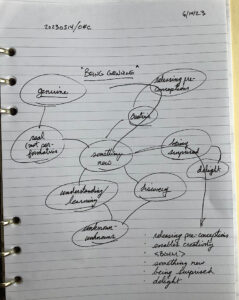
I’ve tried mind mapping a few times. (What’s that? Did I overdo it with software and processes? …yes, of course!) Today, I was feeling unmotivated to write for Open + Curious. I thought, “Just start. JUST START!” But I simply didn’t want to face the blank screen of the digital document.
Instead, I opened my idea garden wherein I capture interesting nuggets to be seeds for future writing. In my garden, I rarely (I first wrote “never,” but I don’t want to jinx myself) have trouble finding a nugget to write about. I grabbed my favorite pen, and flipped to a blank sheet in the little binder I keep. So much action! I felt like I was already writing. /s
On that mind map I wrote the “something new” at the center. It’s not a meaningless bit of meta; it’s the central idea from a captured nugget. At this point, staring at the paper with my pen in hand felt great, versus facing a digital document which always feels too structured for me to think in. (ref. Sönke Ahrens.) In just a few minutes of thinking and scribbling I had all those bubbles. Then I had a title. …then a route. …an outline. And from there the writing felt doable.
Lately I’ve been struggling with setting. As many people have noted, excessive fiddling with getting things ready, or “just so”, before feeling one can begin to do something is simply a form of procrastination. It’s a form of hiding from doing the work. Steven Pressfield describes this as the “resistance” which shows up just when you are finally facing the real work that you are called to do.
I tell this story not because I think a method approach, in which you inhabit your characters and their behaviors, is the best way to write fiction. (If this were true, a lot more authors would take a swing at romance novels.) But instead because it’s an extreme example of a more general point that I’ve been emphasizing recently: when it comes to cognitive work, setting makes a difference.
Setting is real, and it is important. But there’s a second part to finding (or creating) the optimal environment: Scene. Where are the others who are also doing the same work? It could be the other painters or authors like you, and you’re all living in a neighborhood and regularly gathering and conversing at the local cafes. (The archetypical writers scene of the 1900s was in Paris.) If I’ve imagineered a certain niche of work that I want to do, how do I find (or create) the scene?