Podcasts and good old RSS

Once I started seriously listening to podcasts, I quickly reached the point where there are more podcasts, (entire shows, not just episodes,) than I can possibly keep up with. I’m left with the choice between staying subscribed to podcasts where I want to listen to only some of the episodes, or unsubscribing and knowing that I’m missing some gems.

…and then I remember this is all just RSS.

In my podcast player, (which is Overcast,) I now keep only the shows that are my dedicated favorites; shows that I generally listen to every episode. I moved all the other podcasts into my RSS reader, (which is Reeder.) I even added a bunch of shows which I had completely given up hope of being able to even follow them looking for gems.

This had two huge benefits:

First, it improved my podcast listening experience: Not keeping all of those podcast shows subscribed in my podcast player, means less downloading and less skipping. I don’t like having to wait, so I have everything set to pre-download, and removing a lot of podcasts makes a big difference. But even more important, there’s now much less distraction. When I’m in the mood, (or the time, or the place,) to listen to podcasts, I tend to continue listening by default. I’m more likely to listen “just a bit farther” to see if this episode is going to be good, whereas if I had read the summary I might have skipped it altogether. So my podcast listening experience winds up having far more great episodes because it’s just the shows I love.

Second, it actually leads to me finding more gems: When I open my RSS reader, (as I do every day,) I’m in “skimming mode.” I’m looking for things to queue for later reading. (Pocket and Instapaper for the win.) There’s very little effort for me to skim the episode descriptions, and when I find one that looks good I add it to my podcast player. This does require me to switch apps, search, and then add a specific episode. But this small effort helps ensure that the episode is likely to be one I would really like to listen to.

There’s one detail that is a slight snag: How do you find a podcast’s feed URL? We’re all so used to searching in our podcast player apps, but you need the actual podcast feed URL to add it to your RSS reader. You’ll discover that none of the podcast player apps, and none of the directories, (Stitcher, Google, Apple, etc.,) make it easy to find the shows’ underlying podcast URL. The easiest way to do it is to use the handy search on James Cridland’s, Podnews.net (no relation/benefit to me.) It pulls the show’s information from the directories, and explains all the details about that show’s configuration including a handy RSS link icon that has the URL.

So, unpacking this idea a bit more, with some visuals we have…

Feedbin

If you don’t already have a favorite RSS reader, the easiest way to start is to use a web site which will corral all your RSS subscriptions. It will show you a nice web front end with all your feeds together. Later, if you want to run a dedicated RSS reading application on your phone or computer, any of the good ones will let you say, “I have my subscriptions in Feedbin,” and boop! you have all your feeds: Feedbin.

RSS in action

Here’s an example of what it looks like when I encounter an updated podcast feed in my RSS reading application.
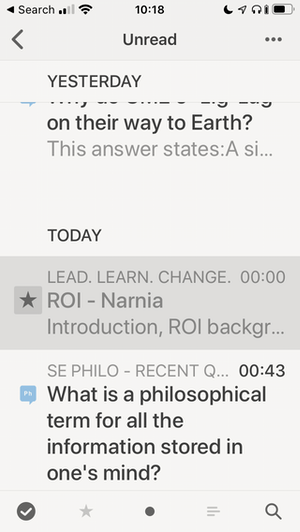
Here’s the “stream” of RSS items. Sorry, I have the font size on my phone super-huge; so this only shows a few items. But the first one, under “Today”, is from a podcaster friend’s show.
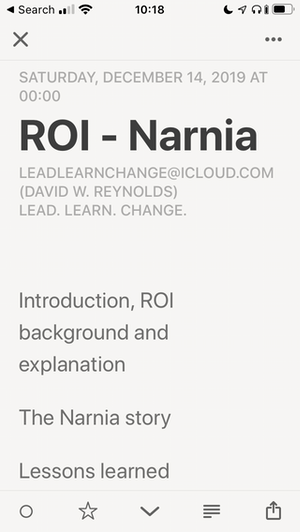
 

Touching it leads me to the full RSS item’s view. Exactly what you see in this view depends on exactly what each RSS feed chooses to include.

I’m still not on the web here—still simply looking at the data in the RSS feed.
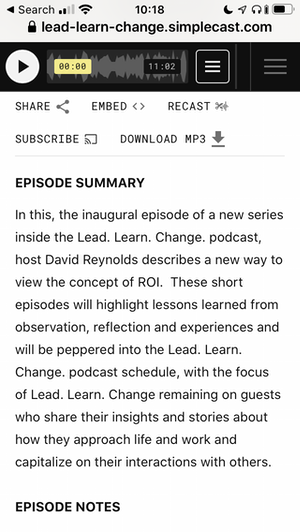
 

At this point, my brain goes, “oh yes! David put out his next episodes!” Let’s see what he’s written up… (swiping left) I get an in-app web browser view of the item from his web site.

I could even press play, right here, if I had 11 minutes.

If this were an episode I wanted to listen to—in my “I’m listening to podcasts” mode, as I described above—then I’d flip over to my podcast app and search for this episode and add it to my listening queue. In reality, it’s even easier: My podcast player app remembers the shows I’ve listened to before, so I can just touch the show, scroll to the episode and hit ‘download’ for later listening.

You can keep an eye on a LOT of podcasts this way—looking at their descriptions—without piling up more in your podcast player than you can possibly listen to.

ɕ


Fifty years ago: ARPANET was born

Many realize that 50 years ago, on October 29, 1969, the first message was successfully sent over the ARPANET, which eventually evolved into the Internet. But few know the story that led up to that message.

~ Leonard Kleinrock, from The First Message Transmission

slip:4uiane1.

The Internet as we know it today was really born in the early 90’s. I remember when web sites—”The Web”—was invented. I was a graduate student in Physics back then. There used to be a web site at UIUC where someone kept a list of all the web sites. (People would email them when they added a web site to the Internet.) I used to check that site every day—and get excited on the days when a new web site had appeared.

…at least, that’s how I remember it. ;)

Anyway, great little read about some of the people who started it all, and the very first message across the Internet v1.

ɕ


Website obesity

Let me start by saying that beautiful websites come in all sizes and page weights. I love big websites packed with images. I love high-resolution video. I love sprawling Javascript experiments or well-designed web apps.

This talk isn’t about any of those. It’s about mostly-text sites that, for unfathomable reasons, are growing bigger with every passing year.

~ Maciej Cegłowski from, The Website Obesity Crisis

slip:4uieta1.

This is so true that it makes me laugh and cry at the same time. I weep. I weep for the Internet. The Internet we know today was made possible by advertising, because too many of us don’t understand how reality works. That’s a good thing—that the Internet happened and grew to be as pervasive as it is—but the current trajectory does not lead to the best possibilities.

ɕ


Factory work, Round 2

My fear—or maybe it’s better written, as “my lament”?—is that for every made-it-big tech person who represents the worst of avarice and greed, there is a sea of regular tech people who are being ground up by the works. Countless pasty faces staring at screens, drinking diet soda, trying to live in the bites of life they can grab after hours, (taking their phone so they can be summoned, of course!) stressed-out, burnt-out…

So when I hear people talk about “tech people” as if we’ve collectively done something wrong and messed up the world, I look around and all I see are people who’ve been broken and smashed. The grass is no greener on the inside-tech side of the fence. To everyone outside-tech, what gets done inside tech is magic—it’s not, it’s factory work, round two.

I don’t mean this as a repost to what people say when they lament what has happened to the world, but as a commiserating plea: “Yes! Yes! The problem is everywhere.”

ɕ


Technology in my formative years

I was exceptionally lucky to be born into this moment. I got to see what happened, to live as a child of acceleration. The mysteries of software caught my eye when I was a boy, and I still see it with the same wonder, even though I’m now an adult. Proudshamed, yes, but I still love it, the mess of it, the code and toolkits, down to the pixels and the processors, and up to the buses and bridges. I love the whole made world. But I can’t deny that the miracle is over, and that there is an unbelievable amount of work left for us to do.

~ Paul Ford, from Why I (Still) Love Tech: In Defense of a Difficult Industry | WIRED

slip:4uwiso2.

This hit me right in the feels. I think I’ve had a larger share of the upsides and a smaller share of the downsides than Ford. But this feels like a good overview of my formative years in tech.

Somewhere I read, “the messiness cannot go into the computer.” That summarizes what I believe is the cause of my neurosis; I’ve spent so many years now taking real-world problems, and real-world interactions with people, and factoring them into computers—and I’m left with the messy parts of the problem stuck in my mind. I’m not sure one can even understand what I’m talking about until you’ve spent 30 years, daily, working on refactoring the fuzzy of the real world into the binary of the computer world. Maybe I can reword it this way:

Computers and brains are very different. I’ve spent decades using my brain to understand computers, work with computers, and program computers.

What if that has fundamentally changed my brain?

How can I possibly pretend that, “what if,” is not utter bullshit…

That has fundamentally changed my brain.

ɕ


Deep dive about podcast feeds

This article got out of hand, and is 3,000 words.  I encourage you to skip around; There’s more discussion of specific tools and how-to material in the last third.

In the beginning

In the beginning, podcasts were simply audio files which people shared directly either by emailing them to each other, or by providing download links on their web sites.

RSS technology has been around for a while and provided a way for a web site to publish a “here’s what’s new” feed. It was soon realized that RSS could be used to provide a feed specifically of podcasts. Software able to retrieve and understand a podcast feed, could then automatically download the podcast files, and alert you of new episodes. Sharing a new show with friends then meant simply giving them the “feed URL” which one would “subscribe to” by adding it to your feed reader.

(more…)

Irrelevant

At the dawn of the internet, posting a commercial message was the indicator used by everyone to point and say, “that is spam.”

This was a huge mistake. Because it led to a deep rabbit-hole of requiring us to answer the question: Is this message commercial?

I think it’s commercial? …do you? Wait what is “commercial” is it any time we exchange any amount of value? That’d be two people talking! “Commercial” isn’t inherently bad… Ok, but we need to agree so we can make a decision! Is “we” a few of us in this space, or does the poster’s opinion matter? Does their “street credit” in the space affect how much we value their opinion? Maybe we can rate-limit how many border-line-commercial messages each person can… Oh, wait, I know! Let’s appoint someone to be the arbiter of this space and… deep. deep. rabbit. hole.

And we went to great length to try to place (move, cajoul, beg, etc) the commercial stuff into designated areas.

It’s not commercial that is the problem. SURPRISE is the problem. If something is unexpected, it better be perceived as desired. It’s not the content of the message (post, email, phone, whatever) that matters, it’s the recipient’s REACTION that matters.

That phone call at dinner from the caller ID you do not recognize—unexpected and undesired—spam!

The garage that fixed my car that later robo-calls me to beg me to 5-star rate them—unexpected and undesired—spam!

The web site pop-up dialog talking about…—spam!

So the first challenge is to get control of the channels. I’ve moved away from anything where random people can easily interrupt me. (Where “moved away” means everything from literally eliminate said thing, to change or reconfigure how it works, etc. My “inner circle” of people can easily surprise me, of course!) This drastically reduces surprises, and so drastically reduces spam.

Then the second challenge is to locate the channels that contain the information—including commercial information—which I want to receive. My favorite clothing retailer has learned that I like to be surprised with email from them. Commercial? …absolutely. Spam? …yes, please.

ɕ


Desperate to sign anything

They just assumed I must be just like all the other people they represent- hungry and desperate and willing to sign anything.

~ Jason Korman from, «https://www.gapingvoid.com/content/uploads/assets/Moveable_Type/archives/000896.html»

slip:4ugaco1.

People sometimes ask, when the Movers Mindset podcast isn’t available in their favorite podcast-player app, why not?

tl;dr: odious clauses in click-wrap contracts.

You should see some of the things! Obviously, there are “hold harmless” clauses obsolving them of any possible responsibility—sure, ok, that’s fine, I am deriving benefit from having our podcast distrbuted through your thing. But some of them want the right to insert ads—not just run ads before or after. Sure, ok, again, you need to pay for your thing; I get that. But insert ads in the middle? Or how about clauses that bind me to defend them in any lawsuit. Not even just related to the content we created—but any lawsuit. Or how about my not being allowed to mention in our advertising that we’re being carried by their thing . . .

sorry
i digress

These odious cases have arisen because it’s a lovers’ triangle: The thing/app convinces the users that everything is rosy. The users lean on me because they can’t hear the podcast, and then the thing/app extorts me. Which is all very closely related to Jaron Lanier’s comment about “our society cannot survive, if…” (And that’s a link to the web site where you can always listen to the podcast, for free, because we control our web site.)

Please—you reading right now—please start paying for things. Choose a podcast player app which is not free. That makes you the customer, and enables them to build a great app. Then they don’t have to strong-arm me. Choose a messaging system, choose a source of information, choose everything(!) by being part of a fair trade with another party.

If you find yourself in a position, where you’re thinking, “this is great and free!” please look around and try to figure out who is actually being taken advantage of… it’s clearly not you, but I assure you, it’s someone else.

ɕ


Too close to the machines

The programmer, who needs clarity, who must talk all day to a machine that demands declarations, hunkers down into a low-grade annoyance. It is here that the stereotype of the programmer, sitting in a dim room, growling from behind Coke cans, has its origins. The disorder of the desk, the floor; the yellow Post-it notes everywhere; the whiteboards covered with scrawl: all this is the outward manifestation of the messiness of human thought. The messiness cannot go into the program; it piles up around the programmer.

~ Ellen Ullman from, Close to the Machine

slip:4ubaco2.

“The messiness cannot go into the program.”

I’ve never thought of it quite that way before. Every once in a great while, you feel the ground move beneath your feet. That sentence moved the ground for me.

I spent an enormous amount of time being a thorn in people’s sides as I clamored to get them to resolve the messiness so I could then manipulate the machines. I tried explaining the machines. I tried explaining the messiness and what I thought might be ways to resolve it. None of that turned out well for the machines, the people or me. Along the way, I realized that dealing with that every day has fundamentally changed how I think. Up until that sentence at the top, I didn’t have a good way to explain my predicament. I only had this fuzzy idea that reality is one thing, computers work this other way, and here I am stuck in the middle.

The messiness cannot go into the computer.

Maaaaybe, I can use that to remind myself that some particular bits of messiness are okay to ignore?

ɕ


Crowding us out

If chatbots are approaching the stage where they can answer diagnostic questions as well or better than human doctors, then it’s possible they might eventually reach or surpass our levels of political sophistication. And it is naïve to suppose that in the future bots will share the limitations of those we see today.

~ Jamie Susskind, from Chatbots Are a Danger to Democracy

slip:4unyoi7.

This is an interesting read surveying a variety of ways that chatbots might crowd humans out of the very spaces we created.

It struck me that while, yes, chatbots are primitive (compared to “real” AI), they are still having a real affect on our social spaces. Not simply, “it’s noisy in here with all these chatbots,” but rather that our social spaces are in danger of being lost to chatbots.

ɕ