If you’re trying to get to the beautiful lake or beach and you’re caught in the weeds, ignoring the weeds and their constraints will produce nothing but desperation and angst. You first need to know what weeds you’re in, and how to get unhooked from them.
Of course this insight is blindingly obvious once you see it.
…and I distinctly remember what it was like when I hadn’t yet seen it. I can’t quite put my finger on an exact year, but I remember a feeling—or rather a few feelings and things which kept happening to me:
I was often late. I was often tired. I was often bored …and then suddenly realized I’d forgotten to do something that I had felt was important. Chaos. Disorder.
Detaching from all the stuff is a linchpin behavior for me. Wherever I go, there I find myself; if I want to not be swept away by all the stuff on my mind I have found exactly four things which work:
Sleeping — This however is cheating. This is being unconscious and is simply a form of escape. Depending on what’s on my mind, and how poorly I’ve physically set myself up, (alcohol, caffeine, food, etc.,) sleep may even not be an option.
Distraction — Visual entertainment switches off my brain. Movies, streaming TV, etc.. 100% waste of my life… but it’s an escape which does work.
Focus — I can sweep away the crush of things on my mind if I’m sufficiently focused. Rock climbing, (not just the time literally climbing, but the entire day and experience of it,) is great for this. Lots of other activities indoor, (reading in various mediums and writing,) and outdoor, (walking and biking for example.) This is in fact, still a form of escape from the things on my mind.
Capture and process — This is the only thing I’ve found which works for me. To be clear, a single idea had in a flash might require two full waking-hours days of capture and processing for me to fully flesh out the idea. If there’s even the slightest nook or cranny left unexplored, my broken mind will snag on that like a nick in a fingernail. Harmless, but very very repetitive redundant and repetitive.
I really hope you have no idea what I’m talking about here. If you do, I offer my sincere condolences.
Jot down every loop that opens; whether it comes via email, or a phone call, or a Zoom meeting, or Slack. Because these loops might emerge rapidly, use a minimalist tool with incredibly low friction. I recommended a simple plain text file on your computer in which you can record incoming obligations at the speed of typing (a strategy I elaborate in this vintage post).
Then, at the beginning of each day, before the next onslaught begins, process these tasks into your permanent system. In doing so, as David Allen recommends, clarify them: what exactly is the “next action” this task requires? Stare at this collection before getting started with your work.
This two part process is the backbone of how I get things done. When I find I have too many ideas rattling in my head it’s time to do a bunch of “capture.” One’s mind is for having ideas not for holding them. I prefer to write things down rather than using a digital device. Yes, my phone [at least] is very often at hand—but I’m a digital import, not a native, so thumb-typing is torture.
Everyone agrees that capturing everything—whether digital or analog, notes, meeting minutes, thoughts, doodles, lists, everything… Capturing everything is important and useful.
But almost everyone has not fully apprehended that second part: Process that collection from yesterday. Every day review all the “captured” stuff and brutally assess it. Can I just ignore it/cross it off as done? Can I put that onto some other list (groceries, errands, etc.)? Why did I capture this? …is it a dream, a flaming urgency, something I want to think more about?
Here’s my uneducated hypothesis: the childhood politics of trying can leave adults with the habit of sometimes engaging in tasks without a real intention to complete them.
My attention has been drawn to “intention.” I’ve now read and heard, from several sources I consider fonts of great information, that intention is the key to having your efforts yield what you actually want. I’ve started trying to figure out what actually is my intention in conversations, blog posts (meta!) emails, coaching, etc.. I’m definitely onboard the intention bandwagon.
There’s a fine hair to split—in my opinion—regarding what exactly does setting, (and then remembering and staying true to,) one’s intention accomplish? Let that sink in for a second. When we talk about intention, we’re talking about something I decide in my mind before I take action. What exactly is that historical decision supposed to do? I don’t think it creates motivation, nor does it sustain motivation I get from somewhere else.
I think it is simply a compass. Once I’m neck-deep in the swamp of doing the thing and the alligators are sliding from the banks into the glassy water… it gets hard to remember why I was draining the swamp. (Feel free to craft your own metaphor if you don’t like my alligator-laden negativi-tea.) A glance at my compass— A glance at my intention instantly reminds me: Alligators be damned, I was intending to … and by George I shall so endeavor!
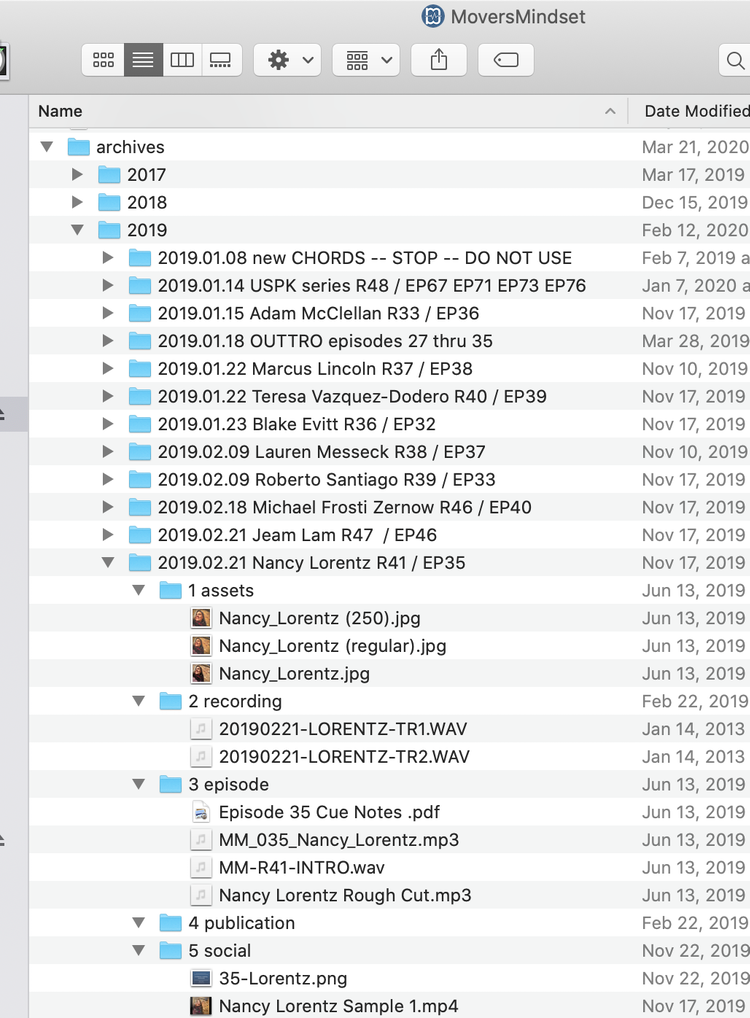
Within the team that creates the Movers Mindset podcast, we assign numbers to our projects. We use “R42” for our 42nd recording project, then R43, and so on. This enables us to start naming things from day one, in a way that we don’t have to change later. If you’re putting your files in a folder, what would you name it, that you could be sure wouldn’t change?
We also use our podcast’s initials on file names, “MM.” When we see files whose name contains, MM-R42… we know what it belongs too. It’s part of the Recording-42 project for Movers Mindset.
We also exclusively use people’s family names on files. So a raw WAV file from an interview is 20200423-MM-SMITH-TR1.wav … April 23, 2020 recording for Movers Mindset, of someone named “Smith”, and this is track one [a recording from one microphone.] 20200423-MM-SMITH-TR2.wav is track two, and so on. No matter where you toss that file, it’s going to make sense.
Eventually, a recording project might lead to one (or more!) episodes of our podcast. They get assigned episode numbers, EP56, EP57, etc. Then we have filenames like MM-EP57… and it’s always clear what that is.
Sometimes we have a dozen files to keep track of in a podcast episode and we end up with 20200423-MM-SMITH-TR1.wav 20200423-MM-SMITH-TR2.wav MM-EP56-INTRO.wav (introduction recorded after interview) MM-EP56-OUTRO.wav (outro recorded in post production) MM-GCORD.wav (a little music ‘button’ used when joining bits of interview) …the final episode is then MM-EP56-SMITH.mp3
Since I’ve typed this much, here’s another thing we do: We use consistently numbered folders to store the files. Every project has a folder, 2020.04.23 Bob Smith R42/EP56 — we create 2020.04.23 Bob Smith R42 in our archives when we do the raw recording, and at the very end we add the /EP56 to make it easier to find things. In side each project we create five folders 1 assets, 2 recording, 3 episode, 4 publication, and 5 social — the leading number ensure they sort in nice order in various displays. 1 contains anything the guest gives us (photos, writing) or any photos we take during recording. 2 is the raw original recordings, 3 is everything to make a podcast episode (intro, outro, whatever we have to assemble, AND the finished MP3), 4 is anything we create as part of publishing the episode (transcript, articles, highlights ) and 5 is anything that’s ok for social media and sharing. And then we have a multi-terabyte file server with a “few” files on it:
Ever since I first read these words, they stuck with me as useful for understanding the working world in particular. The whole edifice that we now call “productivity advice” distills, I realized, to instructions for cajoling the elephant. If you’re not firm, it’ll do what it wants to do.
Plan? Do? Chaos? I get so swept up in systems that sometimes I just bridle and rebel. I think the problem comes up when I have too many systems that don’t have an end goal. My systems are supposed to make the space for me to get real things done. But if all I have is ongoing systems of the busy-work that’s supposed to make space, then I rebel. Because I also need real projects. I want to spend as much of my time as possible getting real things done. Real things for which I have real reasons for wanting to do them. And those real things require real planning.
Generally, I don’t have a problem with over-planning; I can do a tremendous amount of planning, but experience shows that I always do better if I resist the urge to begin… start now! Take action! It’s always better if I resist action, instead doing a brain-dump session and then setting the whole thing aside. When I return later, more ideas flow and more planning ensues. Maybe a third session. Maybe even a fourth.
Meanwhile, the elephant dozes as I plan surreptitiously.
Ever notice that the “doze” in bulldozer is the exact opposite of the elephant’s? Eventually, the planning reveals a beautiful domino setup, and it’s time to awaken the elephant who easily bulldozes them one by one.
The full definition of leadership that Badaracco gradually unfolds through literature in the course is: “Leadership is a struggle by flawed human beings to make some important human values real and effective in the world as it is.”
I’ve mentioned bias to action previously, but I don’t recall having every connected it to one of Machiavelli’s best-known quotes, that fortune favors the bold. (Click through for more context.) Here I’m struck by Badaracco’s choice of, “effective,” as a critical feature of leadership. Certainly without action, there can be no efficacy. (And, yes, using my words totally counts as action, thank you.) Leaders are by definition out in front. That means acting first, and that presumes being capable of acting. If my bias is towards inaction, (gather more data, think about it more, however you want to mince those words,) I cannot be a good leader.
The “doing” is always the easy part. How do you build an awesome wall? You place the first brick, then the next. Placing a brick is easy. The hard part is sitting down and imagining all the things that have to happen first—and realizing that the first step is to search online to find out where I can go look at bricks; Because I need to pick bricks first. I often get pushback when I ask people, “what’s the next action?” or “What’s the first step?” I get pushback because most people aren’t used to thinking about how to do things before they start. I mean really thinking about things, about what’s required to get things done, and what exactly does done look like?
We’ve been trained that if we’re the last one holding the hot potato, we get in trouble at the end. Once I create an environment where responsibility always comes with empowerment, resources, support, and, (if needed,) commiseration, then people can relax and think.
Also, put a date on that next action. No date? No commitment.
This editing continues until the painting is finished. The criterion for what constitutes a “finished” work is reaching the stage at which you are no longer sure whether applying additional changes makes it better or worse. So there is a real possibility of making things worse than they were by not stopping at the right moment. Incidentally, this is the main argument for taking frequent breaks from your work, even at the risk of interrupting a flow state. Doing so allows you to take a more detached, if not completely objective, look at the current state of your work and thus avoid making costly mistakes.
I also believe that stopping while in the flow state is a good way to set oneself up for the next working session. I call it “parking on the hill”—which is a reference to strategically parking one’s car, nose downhill, on a hill so that it can be jump-started using the manual transmission. When stopping a work session, it’s obvious how to pre-position all the physical materials, the space, etc.. But stopping mid-flow also means, in my opinion, your mind is “parked on a hill” as well.
Not everything is a process, but much of what you do each day is a process. How much of what you do each day is a process, but you don’t realize it is? Because you’re wasting your life in that gap.
Two examples to illuminate my thinking, then you’re on your own:
Groceries. You know there’s a process for this. Get in car. Travel to store(s). Move through store in the usual pattern. Select things. Pay and leave. Travel home. Exit car. Move purchases into domicile and put them away.
Laundry. Move dirty clothing to the washing machine. Load machine with clothes and detergent. Start machine. Return later. Flip laundry to drier or to hang-dry. Return later. Fold or organize clean laundry. Return clothing to domicile storage.
Every detail of those processes will be different for each of us. You know your exact process very well, and you could tell me your process, just as I’ve done above. But these processes are actually closed loops which you are going to repeat a huge number of times. I could append, “Wear clothes. Repeat.” to the laundry process, and I could add, “Consume food. Repeat.” to the grocery process.
You know you can optimize things, but the entire process can be optimized—should be optimized. If it’s a process, you’re doing it by rote. (Yes, you can focus on what you’re doing and enjoy it. But you’re not doing anything creative.) So optimize the entire process. Is a car the optimal way to go get your groceries? Where do you keep the grocery list? How do things get put onto that list? Where do groceries etc. get stored in your domicile? How do you prepare and plan meals to use the groceries? Where do you store your dirty laundry? Where do you store “wear this again” clothing? How do you store and rotate seasonally changing clothes? How do you replace items that wear out? If it’s a process, you can optimize it and then you can spend less time on it.
Groceries and laundry are simply my examples. What other things do you do in your life that are processes which you haven’t considered at all? If you thought about them, and organized and optimized the process, how much time would it save you? Aren’t you always wishing you had more time? How much better would your mind work if it wasn’t trying to remember, and struggle through poorly-designed, (or worse, figured out on-the-fly each time,) processes?
What could you do with all that extra time?
Could you use that free time for things in your life that are not processes? Read a book… Spend a day relaxing on a beach… Have dinner with a friend…
To me, “life balance” is about how much time I spend on things which are processes versus things which are not processes.