The connection between the cerebellum and movement has been known since the 19th century. Patients suffering trauma to the brain region had obvious difficulties with balance and movement, leaving no doubt that it was critical for coordinating motion. Over the decades, neuroscientists developed a detailed understanding of how the cerebellum’s unique neural circuitry controls motor function. The explanation of how the cerebellum worked seemed watertight.
Join Craig and Jesse as they challenge the urge to keep talking and explore the value of silence.
I find that when I can’t shut up, it’s usually because […] I’m trying to provide more and more and more and more and more and more context. […] it’s really a lot about hiding— So I find when I can’t shut up, It’s because I’m uncomfortable, or I’m afraid.
~ Craig Constantine (0:55)
Craig Constantine and Jesse Danger explore the reasons behind why people keep talking.
I also wonder how much of that is individual and how much of that is culturally emergent. Because I think about the space that conversation takes up. And I think that there is, for some people, an idea of taking turns. And for some people an idea of sounding really smart, or even just holding the control of the space. And I hear something there in the just putting yourself out there and letting it go. It’s kind of like pushing, pushing the ship out to water.
~ Jesse Danger (2:17)
They also discuss the value of listening and the impact it has on learning and understanding. Craig expresses a desire to talk less to maximize his learning opportunities. He believes that by not speaking, he can better engage with others and gain more insights.
Jesse shares his experience of being deeply fixated on Parkour and how it shaped his conversations, often limiting his understanding of others. Both highlight the importance of being aware of the urge to speak and the potential benefits of embracing silence to truly understand and connect with others.
Takeaways
Reasons for excessive talking — Fear and discomfort can lead to talking more to provide context and seek validation.
Cultural influences on conversation — Different cultural norms influence whether people take turns or dominate conversations.
Value of listening — Speaking less can create opportunities for learning and understanding others better.
Fixation on specific topics — An intense focus on a particular subject can limit the breadth of conversations and connections with others.
Awareness of speaking urges — Noticing the impulse to speak and understanding its motivations can enhance conversational quality.
Silent participation — Listening without speaking still contributes to the conversation and holds value.
Thinking out loud — Some people need to talk to organize their thoughts and clarify their thinking.
Circle process — Structured conversational methods like circle processes can help in exploring problems by listening to others’ interpretations and ideas.
Impact of engagement — Active engagement in a conversation from both parties enriches the interaction and learning experience.
Silence and understanding — Embracing silence can help in fully grasping and appreciating different perspectives in a conversation.
Resources
Circle process — A structured conversational method where participants take turns speaking and listening, allowing for deep reflection and shared understanding.
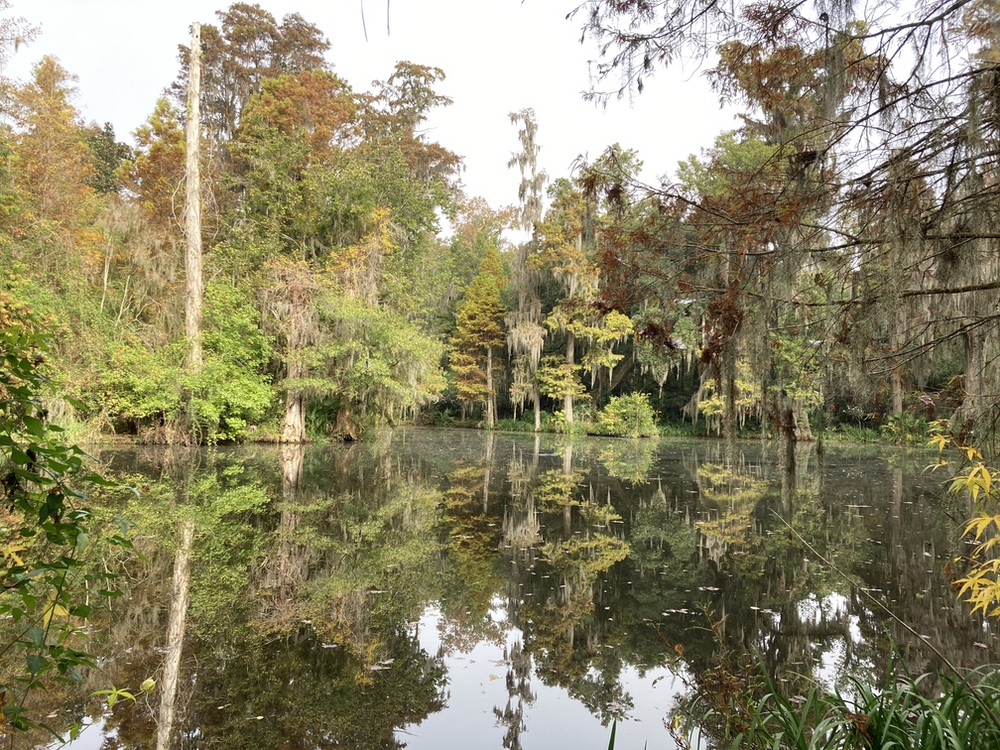
On a random rainy day, I sat in seiza on the concrete, barefoot, gazing into our back yard. Everything was uniformly 53 degrees as I sat down with a mug of steaming broth. I sat under cover of the patio, but open otherwise to the sound of light rain, the gurgle of water in the downspouts, and the occasional drafts of cool air. Previous sunny days, and the current inch of rain had create an entire world of verdant green before me. The world looks different when your eyes are closer to the ground. Time passed. Some light came in.
There, in the Zen-like supremacy of the moment, on the road and adrift in this world, the nicotine would enter my bloodstream and with a blissful rush of pure meaning God would declare Himself to me – just as He did to you, Dee, on your balcony, at 21.49, on that rainy evening in Rosario, Argentina. That five minute interlude, puffing on a cigarette, in the deranged chaos of our lives – you on your balcony and me in some alley in some foreign city – was, to paraphrase Leonard Cohen, the crack where the light came in.
For countless eons, all of our kind have wondered about, sought firsthand and then shared, experiences of such interludes. Are they experiences of the divine? Self-hypnosis? Enlightenment? Semi-sleeping states? Spirituality? Meditation? …and does it actually matter what we each call them? I simply hope you have your own occasional interludes.
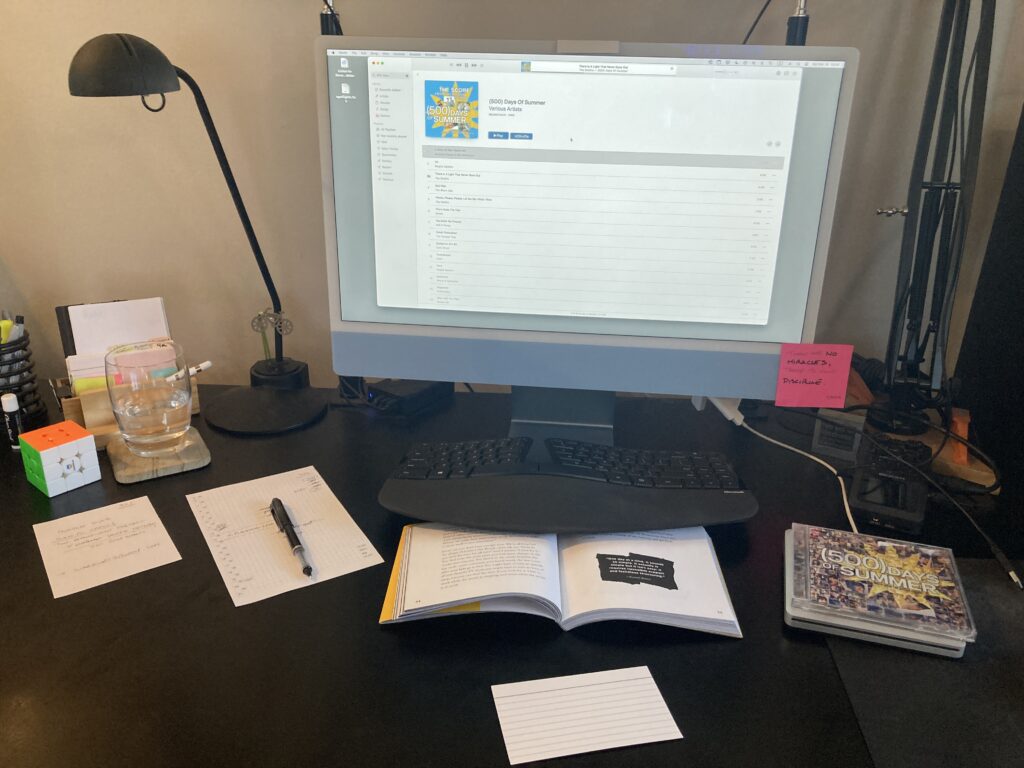
Taking a fresh look at Austin Kleon’s Show Your Work. Book is smashed open to a quote from Russell Brand—with a notecard where I’m about to add this quote to my collection. I’m a bit of an audio nerd—I don’t stream from services, rather stream from the countless CDs that I keep in the ‘ol digital library. I like to start from a movie soundtrack, and then spread out into all the artists. Rubik’s cube, glass of water. Pink postit reminds me: “There are no miracles, there is only discipline“
Holding on to a lot of ideas takes a great deal of time and energy. If, like me, you’re a systems person you can make things much worse. I can build personal knowledge systems, slipboxes, databases, custom software and bend all sorts of technology into new shapes. It turns out—as I hope you’ve already guessed—that if you have too many ideas, and then build and deploy a bunch of clever tools and systems, you just end up with even more ideas. (There isn’t quite an XKCD for that, but number 927 is close.)
One of the few things I know about writing is this: spend it all, shoot it, play it, lose it, all, right away, every time. Do not hoard what seems good for a later place in the book, or for another book; give it, give it all, give it now. The impulse to save something good for a better place later is the signal to spend it now. Something more will arise for later, something better. These things fill from behind, from beneath, like well water.
Building tools and systems is also a terrific way to hide. It’s a variation of the old idea that I cannot start on the real work until I get all this other stuff organized and cleaned up and set up and just so.
Instead, I’m so much happier if I simply take something that brings me joy, and share it.
The only thing better than well-thought-out articles, with a nice water–color image, that refer to a good book, that tie together some thoughts I was already having, published on the open web making the Internet a better place? When it’s written by someone I know personally. Here, have this…
The good news is that, according to Csikszentmihalyi, it is totally in my power to maintain flow, or at least maximize the amount of time spent in the flow state. After all, the attention split between the conflicting objectives happens entirely in my head. The trick, for the lack of a better word, is to convince myself to take interest in what needs to be done and to apply mental energy in order to increase the complexity of the activity at hand.
For me, that attention split—my perception that there actually exist conflicting objectives—is the source of struggle. When I simply don’t invent the need for anything I enjoy doing to be a successful business… Boop. It’s all pleasant creation, heavy lifting and flow state.
With the power of hindsight I can see there was an age of fire. There was a long period—too long, probably—of trying to carve a path through the world. A period of trying to make a dent in the universe. Making my mark. I think it’s telling that all those metaphors involve destruction and defacement. Eventually I see a transition to the age of water. The metaphors are nicer there; flowing, accommodating, and shaping to fit the container.
What do I mean by explorers? I am talking about people who have found and are pursuing a very specific form of passion – I call it the “passion of the explorer.” These people are excited about opportunities to have more and more impact in domains that matter to them. They are constantly seeking new challenges that can help them to learn faster by creating new knowledge that never existed before. They also are actively seeking help from others in addressing these new challenges – they freely acknowledge that they don’t know the answers and that they need help in finding the answers.
Transitions are the difficult times. The wind blows from wildly varying directions. The currents shift. The lighting changes. Grand vistas come into view. More, and different, metaphors.
I can feel my raw power subsiding. Literally. Some days, a 20-minute nap, an hour or so after a nice lunch, is just the most sublime thing. (Not the nap of exhaustion. Not the nap of collapse.) After running the engine with the tachometer near the red-area, it feels nice to settle into the solid, long-haul part of the power curve. More metaphors: A journey. A quest. A culmination. A destination. An end.
Ideals are like stars; You will not succeed in touching them with your hands. But, like seafaring men on the desert of waters, you choose them as our guides, and following them reach your destiny.
People who become engaged with movement in the found environment develop a new way of seeing their environment. Well, t e c h n i c a l l y , they recover a way of seeing their environment which they lost. Mountains, hills, water, stairs… and the moats that criss-cross our communities where the big metal and plastic boxes whiz along— these all become “challenging.” Walls (of various heights from knee to enormous), railings, painted lines— these all become “challenging.” And yet, I’ve had the pleasure on countless occasions to stumble into a built space which feels different. Spaces which don’t require me to see differently. Spaces which beckon me to sit, stand, move, climb, and play.
That we immediately switch to building our cities and countries around people, instead of cars.
Cars (small trucks, commercial trucks, planes, trains and ships) are tools. As I’ve said before what really matters about tools is one’s thinking and choices about tools. What I rarely hear mentioned is that tool choices also affect us. Our use of tools changes us. That’s what I really care about. How am I enabled (to do other things, to live more fully, etc), or constrained, by my choices with respect to tools? Furthermore, how do my choices enable or constrain those close to me? …in my community? …country? …world?