Merlin Mann

Some time around 2005—if memory serves, which it probably doesn’t—I discovered the work and blogging of Merlin Mann. Back then, he was neck-deep in a project called 43 Folders: Time, Attention, and Creative Work. It’s self-described as, “[a] website about finding the time and attention to do your best creative work.” The first post there is dated 2004, and the last is gloriously frozen in place from 2011.

There are so many things to mention about that project. Ahhhhhhh, the halcyon days when we all thought “website” was a cool word. (I’m now in the “web site” encampment.) Mann is the guy who, for better [my opinion] or worse [many others’ option], brought “inbox zero” to everyone’s awareness. He also spent years experimenting with processes, and I went on a magical, multi-year journey experimenting with something called the “hipster PDA.” If forced to choose, I’d say Mann is the guy who most greatly influenced my process thinking.

There’s a phrase in cooking, mise en place, meaning to have everything in its proper place before starting. (The classic example of failure in this regard is to be half-way through making something only to realize you’re missing an ingredient and having to throw away the food.)

Well Mann is the guy who—in my opinion—has done the most to improve processes for knowledge workers and creative people. I’m not sure if he’s ever said it explicitly, but a huge part of what he did was to elevate knowledge workers and creatives by cultivating a mise en place mindset.

ɕ


Gorge-ous

Sometimes I take photographs, but usually not many.

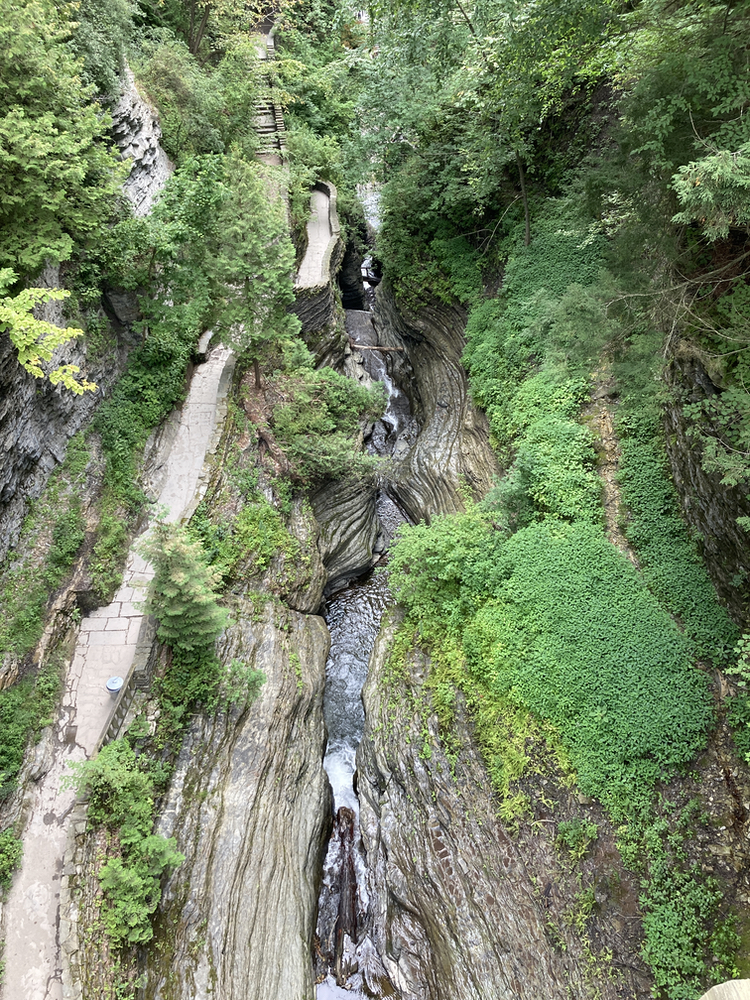
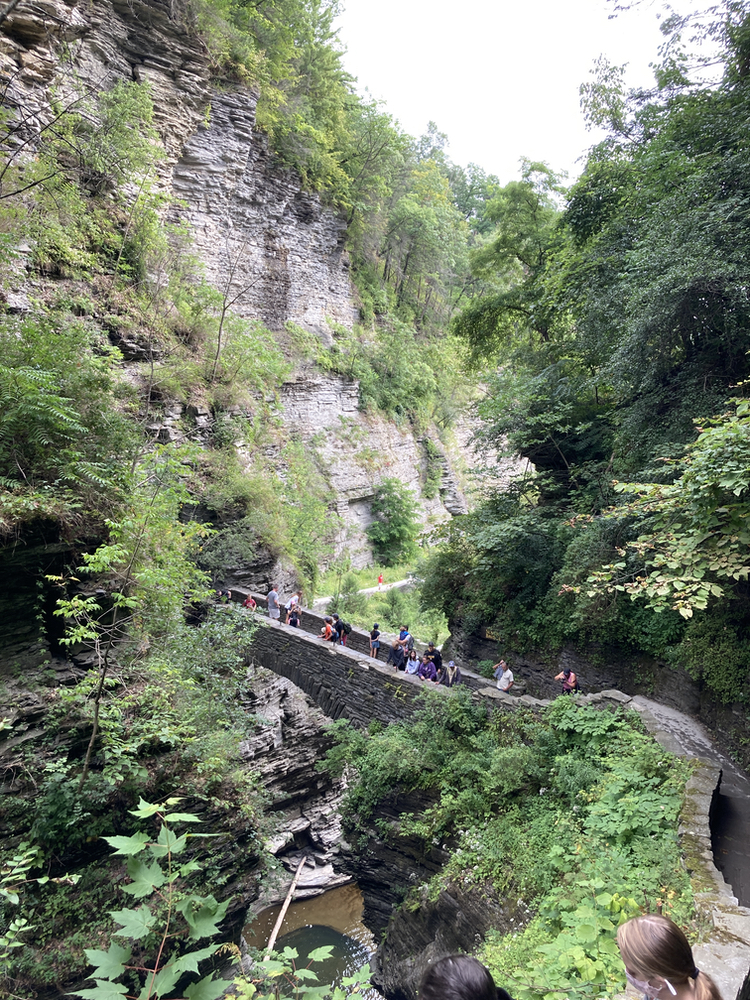
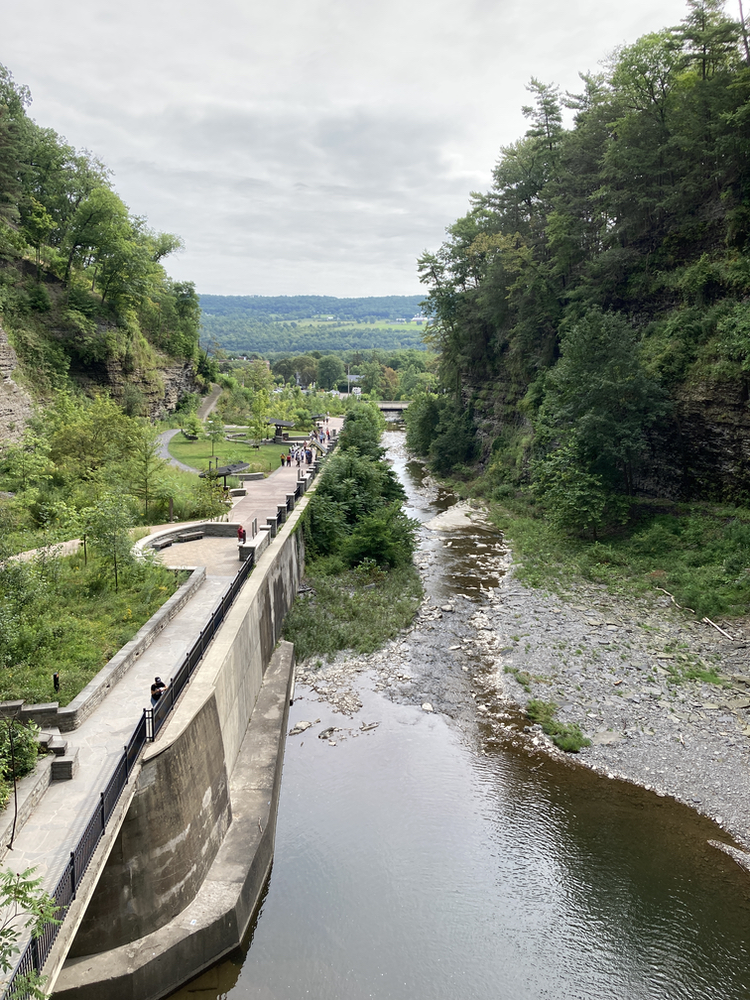
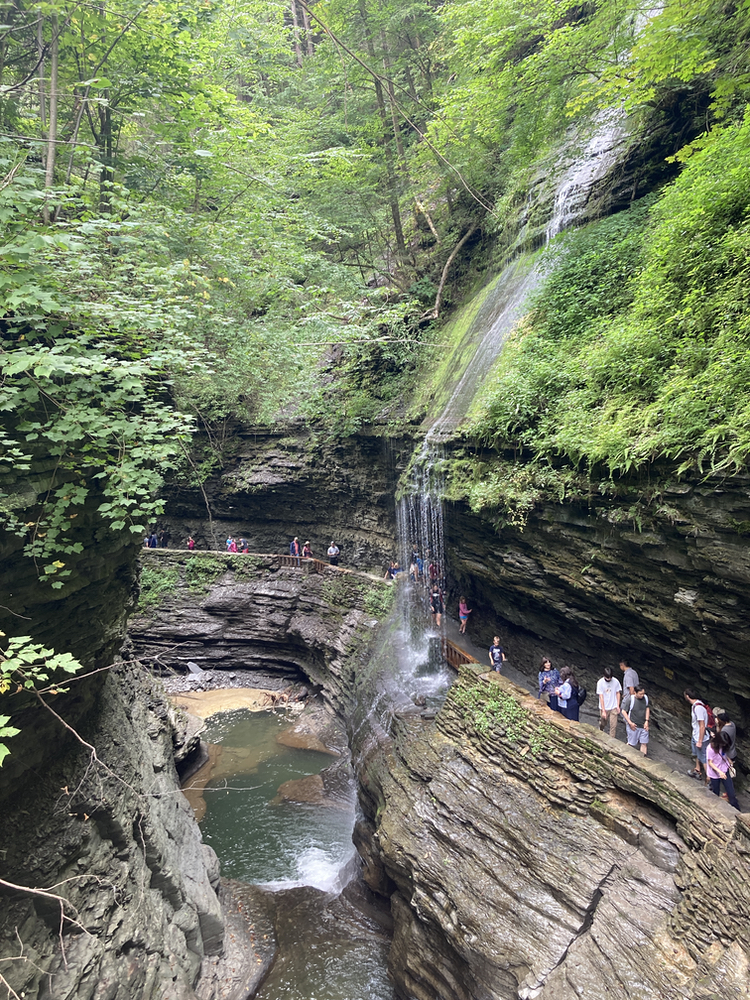
I flipped over the way I think about taking photographs: I only take a photograph if I have a plan for doing something with it. When I took these, I was thinking that they would be good to share as a blog post—if you’re far away from Watkins Glen, you’d enjoy a bit of a virtual visit. I’ll also capture a photograph if I know someone would appreciate receiving it; at someone’s 90th birthday party, I corralled 50 people into a group photo—and then had it large-format printed, framed and delivered as a gift. …and I printed smaller copies for others, and one is framed and hanging in our house. I’ve set up multiple digital photo-frames, to which images are added by my emailing them to special addresses. The one in my sight has 500+ images that span my photography as well as selections from my father’s vast slide-film collection. There’s an enormous collection on my blog in the Photos category posts, and the best-of-the-best are on my featured photography page.

I have vast processes for everything related to my images. Custom software for managing them in archives, including automagic duplication and checksumming to protect against data degradation. (Hint: A backup of a corrupted image is also corrupted.) I have backups to the “cloud.” I have a recurring “maintenance” todo item that prompts me to go through the photos I’ve taken and move them through all my processes.

And I’m fully aware, that shortly after I die, this small eddy of organization where I’m pushing away entropy will be swept away. That’s precisely why I work so hard (although not actually that often) at doing something with the images.

ɕ


Embarking on writing

What’s it for?

For as long as I’ve been recording podcasts I’ve wanted to figure out how to learn more, and retain more, from the conversations. An audio recording of a good conversation can be a good experience for the listener; It can be good experiential learning. But the conversations contain so much more—facts sure, but also connections to other people, projects, stories, new perspectives, insights—which I know I’m missing. If something prompts my memory, I can recall the experience of the conversation, but everything else is either never learned, or if it was, I’ve subsequently lost it.

I’m reminded of…

If you remember what an author says, you have learned something from reading him. If what he says is true, you have even learned something about the world. But whether it is a fact about the book or a fact about the world that you have learned, you have gained nothing but information if you have exercised only your memory. You have not been enlightened. Enlightenment is achieved only when, in addition to knowing what an author says, you know what he means and why he says it.

~ Mortimer Adler, author of How to Read a Book, 1972

There are multiple levels of understanding and learning, contained in each conversation. At the root of my feeling that I’m missing out is the knowledge that I’m only retaining the most-superficial level of the experience.

Who’s it for?

It’s obviously for me. But by doing the writing in public everyone who finds a specific episode interesting would be able to capture and retain more of those “levels of experience” for themselves.

(more…)

The hive mind

Few working scientists can give a ground-up explanation of the phenomenon they study; they rely on information and techniques borrowed from other scientists. Knowledge and the virtues of the scientific orientation live far more in the community than the individual. When we talk of a “scientific community,” we are pointing to something critical: that advanced science is a social enterprise, characterized by an intricate division of cognitive labor. Individual scientists, no less than the quacks, can be famously bull-headed, overly enamored of pet theories, dismissive of new evidence, and heedless of their fallibility. (Hence Max Planck’s observation that science advances one funeral at a time.) But as a community endeavor, it is beautifully self-correcting.

Beautifully organized, however, it is not. Seen up close, the scientific community—with its muddled peer-review process, badly written journal articles, subtly contemptuous letters to the editor, overtly contemptuous subreddit threads, and pompous pronouncements of the academy— looks like a rickety vehicle for getting to truth. Yet the hive mind swarms ever forward. It now advances knowledge in almost every realm of existence—even the humanities, where neuroscience and computerization are shaping understanding of everything from free will to how art and literature have evolved over time.

~ Atul Gawande from, Atul Gawande and the Mistrust of Science

slip:4ufoau1.

I can’t add to that. I only wanted to be sure that others see it too.

Meanwhile, I never bothered to read Gawande’s hit book, The Checklist Manifesto. (To be candid, bordering on obnoxious: Time is limited, and I don’t need to seek more information about processes. I’ve got that sorted.) But it has hovered in my awareness none the less. Recently, two unrelated sources gave over-the-top praise for Gawande’s newer book, Being Mortal. On those recommendations alone it’s now in my reading queue. I’ve cracked it open, and done the preliminary reading… Have you read it? Do you have any thoughts on it?

ɕ


Be the hornet?

Is it better to be the fly on the wall, or the hornet in the room?

I variously categorize conversations on a spectrum from formal to casual. Today I want to talk about conversations that fall in the middle. At the formal end would be police interrogations and then—perhaps—live, antagonistic interviews of politicians. At the casual end would be pillow-talk and long-term friends around a campfire with their preferred beverages. In the middle is fertile ground for great conversations.

So what exactly is in the middle? Therein lie conversations built on a shared intention: Two people who want to resolve a difference, who want to co-create something new from their individual experiences, or who are simply excited about taking a leap into the unknown experience that is a good conversation. It’s that third one which really calls to me these days.

The leap

I’ve now done enough recorded conversations to say two things:

I used to think I was doing interviews. In fact, I began using a process and format intentionally meant to create interviews; I showed up with things I was interested in and I wanted to learn more about from my partner. I soon discovered that when we veered away from the formal-end of the conversation spectrum, (away from the “interview” I had intended to create,) into the more middle-area of simply good conversation, that was when I most enjoyed the experience. My conversation partners clearly enjoyed it more, and the listeners did too. (“hmmmmm… maybe I am onto something here?” )

The first thing I have to say is that the form of the created artifact follows from the process.

If I use a process intended to create formal conversations, that’s what I’ll get, (more or less.) If I use a process intended to create more casual conversations, then I get that, (more or less.) The insight is that the process for creating casual conversation is not itself casual. The process is specific, rigorous, and frankly exhausting. It’s exhausting because I want to execute the process in order to create the best possible conversation, and I want to experience that conversation. That’s in contrast to my conversation partner who is only attempting to do the latter because they’re only aware of their desire to experience the conversation. They’re not aware of the process, and they probably shouldn’t be aware.

Each conversation—each performance, since I’m today talking about when we are recording—is better if we’re comfortable going just a bit farther than we might normally. This is where the process pays off. Everything I’ve done in preparation, and everything I do during the conversation, from the obvious to the subtle to the outright manipulative, is in service of creating the best space for that conversation.

The second thing I have to say is that to create good, casual conversations I have to help my partner leap.

Be the hornet?

I recently listened to Jesse Thorn’s interview of Werner Herzog for The Turnaround. If you’ve read this far, I can’t imagine you wouldn’t enjoy listening to that ~35 minutes of Thorn and Herzog.

In the conversations that I’m currently interested in creating and recording I simply cannot be the fly on the wall. I have to literally sit down with my conversation partner. But there’s an enormous range of engagement that I can vary. (More realistically I can only try to control this, as I’m always balancing the observer-process and the participant-creation experiences.) In my first recorded conversations there quickly became far too much of me performing, (and I’ll leave it at that for today.) Then followed me reigning myself in too far, then some relaxing back towards more of me, and currently I find that I like the amount of me that appears in the conversations.

After listening to Herzog’s thoughts on documentary film-making, (but he talks about a lot more than that in the podcast,) I now see that I need to work on being the active hornet in the room. This is the dimension where I actively lead the conversation—not upstage my partner, but actively lead in the way that two intimate dance partners have a leader, (and, yes, who is leading can change at any moment.)

I need to more often be the hornet. I need to more often suggest simply by my presence that a sting might be imminent. Then if they decline to leap, maybe, sting just a little.

ɕ

slip:4c2co3c7.


Barely noticeable

The authors note that a core resource of the digital economy is the data produced by users of services like Facebook and Google, which can then be used to train machine learning algorithms to do valuable things like precisely targeting advertisements or more accurately processing natural language. The current market treats data as capital: the “natural exhaust from consumption to be collected by firms” for use in training their AI-driven golden gooses. Lanier and company suggest an alternative: data as labor. Put simply, if a major platform monopoly wants your data to help build a multi-billion dollar empire, they must pay you for it. Offering a free service in return is not enough.

~ Cal Newport from, On Seriously Rethinking the Digital Economy – Cal Newport

slip:4ucabo30.

Well, that would change everything.

Imagine I changed the sidewalk in front of my house to have plates that moved slightly as one walks across it. I’ve rigged the plates to absorb some of the motion created during walking to generate electricity to offset my electric bill. Let’s assume further that the movement of the plates is barely noticeable. Perhaps something seems a bit “off” when you walk past my house, but nothing bad happens to you; you don’t fall and you don’t get tired, but you do work just a little harder when walking past my house.

What happens when we scale up that “harmless” little modification to include everyone, walking everywhere?

ɕ


Value giveaway

Fewer are aware that the PC wasn’t IBM’s only internal-politics-driven value giveaway; one of the most important software applications on those mainframes was IBM’s Information Management System (IMS). This was a hierarchical database, and let me pause for a necessary caveat: for those that don’t understand databases, I’ll try to simplify the following explanation as much as possible, and for those that do, I’m sorry for bastardizing this overview!

Ben Thompson from, Oracle’s Cloudy Future – Stratechery by Ben Thompson

slip:4usaoa1.

And, today this web site is a tech blog.

I’ve read, (technically I am in the process of reading,) everything Thompson has written. I skimmed through this long article since it wasn’t news to me. However, if you take about 10 minutes to read this, you’ll know more about Databases and the Big Kids who made the things which became the things you now use every day, than pretty much everyone else on the planet.

/techblog

ɕ


Wherever I go

Your freedom will not come from trying to ignore all the “stuff” or by trying to complete everything—it requires truly detaching from it.

~ David Allen from, GTD and stress – Getting Things Done®

slip:4ugega2.

Detaching from all the stuff is a linchpin behavior for me. Wherever I go, there I find myself; if I want to not be swept away by all the stuff on my mind I have found exactly four things which work:

  1. Sleeping — This however is cheating. This is being unconscious and is simply a form of escape. Depending on what’s on my mind, and how poorly I’ve physically set myself up, (alcohol, caffeine, food, etc.,) sleep may even not be an option.
  2. Distraction — Visual entertainment switches off my brain. Movies, streaming TV, etc.. 100% waste of my life… but it’s an escape which does work.
  3. Focus — I can sweep away the crush of things on my mind if I’m sufficiently focused. Rock climbing, (not just the time literally climbing, but the entire day and experience of it,) is great for this. Lots of other activities indoor, (reading in various mediums and writing,) and outdoor, (walking and biking for example.) This is in fact, still a form of escape from the things on my mind.
  4. Capture and process — This is the only thing I’ve found which works for me. To be clear, a single idea had in a flash might require two full waking-hours days of capture and processing for me to fully flesh out the idea. If there’s even the slightest nook or cranny left unexplored, my broken mind will snag on that like a nick in a fingernail. Harmless, but very very repetitive redundant and repetitive.

I really hope you have no idea what I’m talking about here. If you do, I offer my sincere condolences.

ɕ


Open loops

Jot down every loop that opens; whether it comes via email, or a phone call, or a Zoom meeting, or Slack. Because these loops might emerge rapidly, use a minimalist tool with incredibly low friction. I recommended a simple plain text file on your computer in which you can record incoming obligations at the speed of typing (a strategy I elaborate in this vintage post).

Then, at the beginning of each day, before the next onslaught begins, process these tasks into your permanent system. In doing so, as David Allen recommends, clarify them: what exactly is the “next action” this task requires? Stare at this collection before getting started with your work.

~ Cal Newport from, On Confronting the Productivity Dragon (take 2) – Cal Newport

slip:4ucabo37.

This two part process is the backbone of how I get things done. When I find I have too many ideas rattling in my head it’s time to do a bunch of “capture.” One’s mind is for having ideas not for holding them. I prefer to write things down rather than using a digital device. Yes, my phone [at least] is very often at hand—but I’m a digital import, not a native, so thumb-typing is torture.

Everyone agrees that capturing everything—whether digital or analog, notes, meeting minutes, thoughts, doodles, lists, everything… Capturing everything is important and useful.

But almost everyone has not fully apprehended that second part: Process that collection from yesterday. Every day review all the “captured” stuff and brutally assess it. Can I just ignore it/cross it off as done? Can I put that onto some other list (groceries, errands, etc.)? Why did I capture this? …is it a dream, a flaming urgency, something I want to think more about?

ɕ


On podcasting

The short version of this story is simply: I’m simply curious. I try things. I make mistakes. I ask questions.

My podcasting journey began with the Movers Mindset project, which grew from conversations I started having as part of my personal journey rediscovering movement. Started in 2015, at first it was just a web site that shared others’ writing. But as I travelled, I kept finding myself in cool conversations until one day someone said, “you should have recorded that. I’d listen to that podcast.” Excited, but with no clue how much work it would be, I kicked off the Movers Mindset podcast at the start of 2017. For the first dozen episodes I did far too much of the work myself, until I wised up and started finding a few incredible people to share my new passion.

By this point I was devouring anything I could about interviewing. I smashed through thousands of podcast episodes in the process of wondering, “how does everyone else do it?” Podcasts, books, online courses… Everywhere I turned I found something new to work on in my own journey.

In the fall of 2018 I had about 30 interviews published on the podcast. I was getting comfortable travelling by plane, train and automobile, being invited into people’s lives to capture the Movers Mindset interviews. I was invited to the North American Art of Retreat, a Parkour leadership retreat, in the Cascade mountains outside of Seattle. There I did a series of interviews with the event’s presenters and organizers, and handed those recordings off for Art of Retreat to create their own podcast.

When 2019 rolled around, on a whim, I jumped into an Akimbo course called The Podcast Fellowship. I wanted to search for unknown-unknowns, to rethink everything I had done so far, and much about the Movers Mindset podcast changed in this period. To my surprise, I was invited back to be part of a small group of alumni who assist the coaches for the 4th, (and then the 5th, and 6th) running of the course. It’s mind-bogglingly inspiring and energizing to hang out daily with hundreds of people who share your passion. I even tried to summarize the fun of it in The Journey.

Meanwhile, the Movers Mindset episode numbers kept climbing and I’ve been branching out to interview more challenging guests; challenging for me as I’m forced to converse and discuss topics I know less and less about, but which none the less intrigue me endlessly. In the fall of 2019, this time with help from some of the Movers Mindset team, I was invited back to Art of Retreat. There, we did a second series of interviews for Art of Retreat’s podcast.

If you want to see a more up-to-date listing of what I’ve done in the podcasting space, see my Podchaser creator page.

ɕ