What I understand today is that when the Stoics said that there was an opportunity in every obstacle, what they meant was the opportunity to practice virtue. To be a good person despite the bad things that have happened. To do good in the world despite the bad that has befallen you. They were speaking of the idea of arete. Excellence—in all forms.
For a while, the Movers Mindset podcast’s episodes had opening segments recorded in post-production. They were as you’d expect: Here’s who’s on the show, this is who they are, here are a few things we talk about. This (as you surely know) is a bit of work. In later years—particularly once I was working entirely alone—I simply stopped doing this because, taking the time to do it, stopped me from actually getting the episodes out the door.
LISTENERS CAN’T “SEE” (OR HEAR) WHAT’S AHEAD. When you read a story in a newspaper, your peripheral vision gives you an idea of the stories that surround it. […] On the radio, someone needs to tell you explicitly what’s coming up.
NPR has a concept called “billboards” which are short segments, up-front (“58 seconds long, at the top of the hour”) telling you what’s coming.
How do you (if you do) decide what you put on your “billboard” at the front of the show? Do you have goals; list three things, list something for every major turn in the conversation, etc.? Do you use any tools to help you?
Resistance cannot be seen, touched, heard, or smelled. But it can be felt. We experience it as an energy field radiating from a work-in-potential. It’s a repelling force. It’s negative. Its aim is to shove us away, distract us, prevent us from doing our work.
We all struggle with this. No matter what our art is, there are always those bits that everyone sees and those bits that are covered up. And we face the question of how much effort to put into these various parts. It’s easy enough if it’s a hobby and you have all the time in the world. But you need to ship if you’re making a living off your art.
It’s always good when, as above, I can get any sense of commiseration with other creatives. I had a hard time ever coming to understand I am a creative, and the imposter syndrome for me is eternal. (Also, apparently a shared experience.) Great piece from Sparks about exactly what that quote suggests.
Meanwhile, I’m reminded of something I say often, which comes from my paternal grandfather: When asked his opinion on something, (ala, “How’s that look?”) he’d reply, “A blind man in Idaho would be happy to see it.” This makes no sense, in several dimensions. I have no idea where he got that from. The Idaho bit in particular always made me wonder. He and I were generally in Pennsylvania, so Idaho is a long way away, but oddly specific, while still oddly vague. Where in Idaho? And why Idaho? Maybe Idaho was some Depression-era fake-magical place pushed by con-men and became a stand in for “anyone in Idaho must be really well off.” Because the whole point of the joke is that a blind person would be delighted to see anything. I dunno… maybe it’s a humorous construct because the Idaho part is so extraneous, it feels like it must be important? Really, does that reply mean it looks good, or it’s bad and I don’t want to tell you? I mean, the reply literally does nothing but dodge the question. Or, maybe I’ve just over thought this… for 40 years?
Solitude is more a state of mind and heart than it is a place. There is a solitude of the heart that can be maintained at all times. Crowds, or the lack of them, have little to do with this inward attentiveness.
What’s the longest stretch you’ve gone, away from your love of podcast creation?
For obvious reasons (in case you missed it) I’ve not been doing much in the way of podcasting this year. The last episode I published was March 28th, 2024— so about 8 months now. I’m at a point now, where I’ve enough health that it would be possible to resume . . .
I miss having the conversations, and I even miss doing the uncelebrated work (which we all know so well!) to get them published. But I don’t miss the grind… that treadmill feeling of always having some next thing that could be done.
What’s stopped you in the past? How did you get back on the bicycle? Why did you get back on the bicycle?
There is a huge difference between a job and vocation. A job is what we hold to earn money to meet economic demands. A vocation (from Latin vocatus, calling) is what we are called to do with our life’s energy. It is a requisite part of our individuation to feel that we are productive, and not responding to one’s calling can damage the soul.
The driveway moment: When a report or interview really works, you can tell and we can tell. We can, because the story hits the top of the most emailed list at NPR.org. You can tell, because the story keeps you pinned in your car, in a parking lot, in your driveway, or at the side of the road—as you wait to hear how the story will end. In letters and emails, listeners named these occurrences “driveway moments,” and say they look forward to them, even when it means being late for work or dinner. So that’s your goal: make some driveway moments.
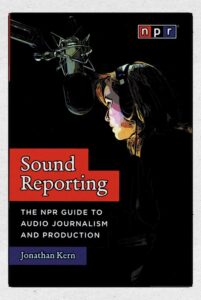
I’m finally heading into NPR’s book, Sound Reporting, and this big of context included by Kernis in the Foreword got me thinking…
What are you doing so that you even know when you’ve put out a “driveway moment?”
It doesn’t matter at all if we feel it’s a driveway moment. It matters if our listeners think so. Are you paying attention to your listeners? Do you have multiple ways for them to connect back to you?
I do think about “driveway moments” when creating episodes. It’s difficult however, given the way that I create my work; They have to simply happen. If one wants to create them, that requires planning, work and editing.
For me, when I encounter a listener (virtually or in real life) the only question I ask them is…
Has any episode grabbed you? …any particular moment or image?
Are we restless and driven to explore, as Sagan says? Will going into space bring humanity together or will we simply bring inequalities and injustices with us? The idea of humans as benevolent explorers sits somewhere between two extremes: those who argue it is our “destiny” to “colonize” other worlds, and those who ask why we’re going into outer space at all.
We’re definitely going. Whether we like it or not, there are enough of us who are unable to not try to wander outside our little cave and over the next hill, sabertooth tigers or no. I think a much better question is: What have we lost, now that many (most?) of us are no longer in touch with the night sky. My answer: A lot. And if we continue and lose our curiosity entirely, everything.
I’ve had the insanely rare privilege of experiencing the real night sky on many occasions. (For one example, once in a very special place, on a moonless night, Mars cast my shadow.) In all my experiences, I still believe I’ve only glimpsed a part of my human heritage. What would we be like if we all were fully in touch with our heritage?