Diligence alone

Remarkable accomplishment requires a remarkable amount of focus; this much is clear. But focus without grounded direction is unlikely to hit the sweet spot.

~ Cal Newport from, Learn the Landscape Before Putting on Blinders

slip:4ucabo14.

I’ve come across this point/idea many times in my journey. It took me a long time to learn how to focus, but it’s proving more challenging to figure out what to focus on.

Diligence? Focus? Single-mindedness? …whatever you want to call it. I am able to get a lot done. But I find I’m always second-guessing myself after I’ve gotten a significant portion of the way through some project…

Today, more questions than answers I suppose.

ɕ


Blake Evitt | The Parkour Community within the Larger Urban Fabric

On Castbox.fm — Blake Evitt | The Parkour Community within the Larger Urban Fabric

How can Parkour communities foster diversity and inclusivity while balancing the growth of gym-based models and maintaining engagement with broader urban and local spaces?

Inclusivity in Parkour is not just ethical but also essential for long-term business growth.

Building a strong and diverse community is not something that is against your business interests. […] A lot of the models are based on a gym only model, which means that we are kind of vastly under serving and ignoring and kind of walling ourselves off from large swaths of the population.

~ Blake Evitt (4:44)

The conversation focuses on the intersection between Parkour as a growing industry and its role in fostering diverse and inclusive communities. One recurring theme is the tension between the rise of gym-based Parkour models and the need to engage with broader urban environments to ensure accessibility. Gym-centric models risk excluding those who cannot afford memberships or lack access to gym facilities. Outdoor training and public space utilization are emphasized as strategies to broaden participation and maintain Parkour’s original roots.

Another topic highlights the role of community leaders in shaping public perception of Parkour. Positive engagement with local governments, schools, and community centers can open doors to wider recognition and acceptance. Initiatives such as after-school programs and collaboration with recreation departments are presented as effective ways to expand outreach. The importance of coaching standards, insurance, and building relationships with diverse groups is also underlined as key to sustainable growth.

Takeaways

Building diverse communities — Inclusion and diversity benefit both the Parkour community and business interests.

Gym-only models — Limiting Parkour to gyms excludes large segments of the population and reduces growth potential.

Public space use — Training outdoors fosters visibility, normalizes Parkour, and improves public perception.

Community engagement — Partnerships with schools, recreation departments, and community centers expand reach and deepen community ties.

Coaching and standards — Developing coaching skills and engaging with certifications enhances professionalism and safety.

Insurance barriers — Finding insurance for outdoor training remains a challenge but is critical for growth beyond gym walls.

Urban integration — Viewing Parkour as part of the urban fabric encourages outreach in varied settings beyond major cities.

Long-term perception — Positive public behavior directly influences Parkour’s reputation and future opportunities.

Resources

Parkour Generations — Organization involved in Parkour coaching, events, and leadership.

Art of Retreat — The leadership and education retreat for the Parkour community.

(Written with help from Chat-GPT.)

ɕ


Stop drifting

Stop drifting. You’re not going to re-read your Brief Comments, your Deeds of the Ancient Greeks and Romans, the commonplace books you saved for your old age. Sprint for the finish. Write off your hopes, and if your well-being matters to you, be your own savior while you can.

~ Marcus Aurelius

slip:4a71.


Stop drifting

Stop drifting. You’re not going to re-read your Brief Comments, your Deeds of the Ancient Greeks and Romans, the commonplace books you saved for your old age. Sprint for the finish. Write off your hopes, and if your well-being matters to you, be your own savior while you can.

~ Marcus Aurelius

slip:4a71.

Normally I would simply let a quote from Aurelius stand on its own. If you’re not familiar with Meditations—Aurelius didn’t choose that title for what he wrote, it was added to his work much later—it was a collection of writings he meant only for himself; this is the emperor of the Roman empire remonstrating himself.

Here’s a second helping of remonstration: Explore. Dream. Discover.

I write this blog for myself. (And no, I’m not laboring under the delusion that I’m creating a work for the ages like Aurelius’s, Meditations.) But I am simply pleased if you, Dear Reader, find my ramblings interesting. I am genuinely delighted if anything I write stimulates your thinking. I am downright ecstatic if any of my questions catalyze your changing the course of your life.

Do you read regularly, and what have you chosen to read with the aim of changing the course of your life?

ɕ


Tormented alike

Wild animals run from the dangers they actually see, and once they escape them worry no more. We however are tormented alike by what is past and what is to come. A number of our blessings do us harm, for memory brings back the agony of fear while foresight brings it on prematurely. No one confines his unhappiness to the present.

~ Seneca

slip:4a105.


Being present

When we work out while listening to a podcast or checking messages, we lose out on being present with our bodies, feeling the experience of moving, exerting ourselves, being in nature.

~ Leo Babauta from, The Practice of Meticulous Attention

slip:4uzeme1.

I try to walk as much as I can. Usually I make it out to walk every day for about an hour. For years I was simply walking in nature with myself and my thoughts. A few years ago, when I got really into podcasts as a listener, I started listening while walking.

But about a year ago—after noticing I’d stopped writing things down about my walks—I realized that I had lost something valuable: My time alone with my thoughts. So I cut back to listening to podcasts for about half the walk.

I’m often asked if I meditate. Yes, particularly in the past year, and it looks a lot like walking.

ɕ


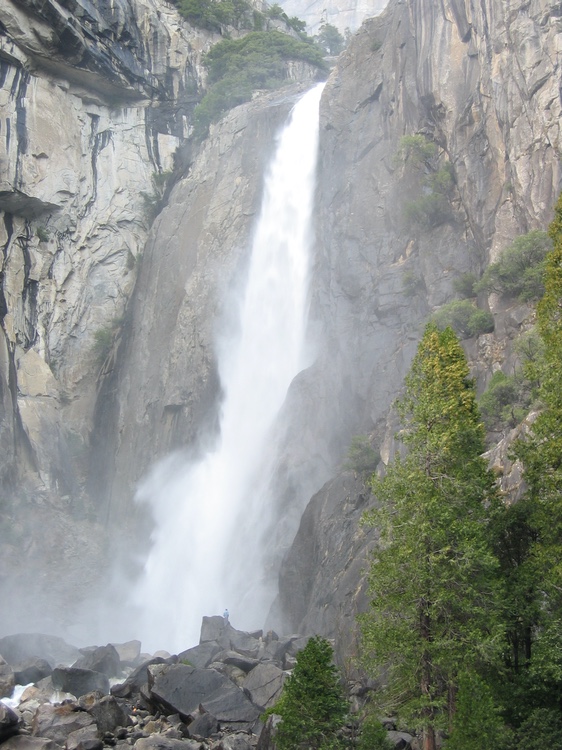
Yosemite Falls

This is the upper fall. It’s 1,430′ (440m). The photo is from a foot bridge at the trail’s closest approach. If you look closely, there is a hiker wearing a blue jacket, standing atop the largest rock.


Willful ignorance

Now when I pass the sign, I try and think of at least one thing I do myself that willfully ignores truths I’d rather not accept. Things I know I should change about myself that I choose not to.

~ Steven Pressfield from, «https://stevenpressfield.com/2015/01/willful-ignorance/»

On one hand, I disagree: The sign’s purpose is to save ducks; it was not created “for everyone.” In that sense, the bad grammar of the sign makes it work better. But, the ducks sign is simply an example. Pressfield’s point about willful ignorance is clear and—at least for me—on target.

A question I like to reflect on periodically in my journaling is: What habit did I curb [today or yesterday]? Also, reflecting on what parts of my behavior I dislike—which was a huge part of my initial journey rediscovering movement 10 years ago—gives me specific things to work on. I think it’s a deeply useful practice to ask oneself difficult questions and to reflect on the answers, (or lack of answers as the case may be.)

Are there any questions you ask yourself on a regular basis?

ɕ


Creating value

Creating value is unrelated to busyness. When you find yourself — as I sometimes do — working long hours, day after day, reacting and e-mailing and hatching schemes, it’s useful to remember that you’re working more than some of the world’s most respected and impactful thinkers.

~ Cal Newport from, You’re Working too Hard to Make an Impact

slip:4ucabo15.

I often write about focus because it’s something I’m trying to improve. When I’ve lost focus, it’s a challenge to call myself back to the important things. But a better plan for improvement would be to not lose focus in the first place, or at least to not lose focus as often.

Recently I’ve been keeping in mind Viktor Frankl’s thought about there being a space between stimulus and response. I find that when I’m able to remember that space, I’m able to consciously decide when, and if, I should shift my focus.

For example, I sat down to write and a myriad of other thoughts arose. Instead of trying to ignore them or make them go away—don’t think of a pink elephant—I zoom in on each idea: I consider the sense of urgency; no, actually there’s nothing urgent about the action this thought is suggesting. I consider the sense of entitlement; no, actually there’s no reason that I should be congratulated or rewarded for this thought or what it’s suggesting I attempt to do. I consider the benefit to myself or others; no, actually this thought isn’t vastly better than the other ideas and projects I’m already working. Soon enough the thought moves along like a petulant child. I think, “let’s see, where was I? I had sat down to write.”

Externally, that whole process—even if I repeat it for multiple thoughts—looks very unlike busyness. It looks much like I’m sitting still. It looks like I’m gazing out the window. It even looks a bit like I’m focused on writing. In fact, I am still focused on writing.

It’s my choice: Is this the moment when I want to change where I’ve placed my focus? If not, then terrific, I’m still focused where I had chosen.

ɕ


Creating running intervals from Morse Code

Here’s an interesting way to use Morse Code to generate running intervals. It’s complex enough to generate infinite variety, but simple enough to generate a workout quickly.

“Running” Morse Code…

The dot duration is the basic unit of time measurement in Morse code transmission.

Select a corresponding amount of running time for the basic unit; Let’s say a “dot” will be 10 seconds of running.

The duration of a dash is three times the duration of a dot.

…so we’ll be running 30 seconds for each “dash” in Morse Code.

The letters within a word are separated by a space of duration equal to three dots,

…so we’ll have 30 seconds of walking between each letter.

and the words are separated by a space equal to seven dots.

…so 70 seconds of walking between each word.

…from Basics of Morse Code, https://en.wikipedia.org/wiki/Morse_code

Finally, you need a handy Morse Code converter, such as moresecode.world. (No relationship to me.)

Build a running sequence like this…

Grab a word, phrase, whatever you want to try “running”. For example, “I AM SLOW”, in Morse Code, is:

.. / .- -- / ... .-.. --- .--

The word “I”, one letter, is simply two dots, ..
…two dots at 10 seconds each, that’s 20 seconds of running for the letter, “i”.

For the space between the words, 70 seconds of walking.

“AM” is, two letters, .- --
…dot-dash is 10+30, so 40 seconds of running
…space between letters is 30 seconds of walking
…dash-dash is, 30+30, so 60 seconds of running

Another space between words, 70 seconds of walking.

“SLOW” is four letters, ... .-.. --- .--
run 30 (S = 10+10+10)
walk 30 between letters
run 60 (L = 10+30+10+10)
walk 30
run 90 (O = 30+30+30)
walk 30
run 70 (W = 10+30+30)

…or more simply, the whole running sequence can be written:

20 / 40 60 / 30 60 90 70

You get a 70-second walking break at the “/” between words, and the 30-second walks between letters at 40-60, 30-60, 60-90 and 90-70.

More examples…

“Mississippi” leads to:
-- .. ... ... .. ... ... .. .--. .--. ..
60 20 30 30 20 30 30 20 80 80 20
(with a 30 second walk between each of those letters)

“run faster” is:
.-. ..- -. / ..-. .- ... - . .-.
50 50 40 / 60 40 30 30 10 50

…and “movers mindset” is:
-- --- ...- . .-. ... / -- .. -. -.. ... . -
60 90 60 10 50 30 / 60 20 40 50 30 10 30

ɕ