Characteristics of the rational soul: Self-perception, self-examination, and the power to make of itself whatever it wants. … It surveys the world and the empty space around it, and the way it’s put together. It delves into the endlessness of time to extend its grasp and comprehension of the periodic births and rebirths that the world goes through. It knows that those who came after us will see nothing different, that those who came before us saw no more than we do, and that anyone with forty years behind him and eyes in his head has seen both past and future—both alike.
An embarrassment of riches swamps me. I have so arranged things that everywhere I turn I find inspiring ideas, growth-catalyzing goals, and outlandish opportunities.
This morning I tenderly cracked open a new-to-me book, (Community: The Structure of Belonging by P Block, 2nd ed., 2018,) and inserted a bright blue, ribbon bookmark. I turned past the first page, then past the second page, and read the dedication:
To Maggie — In appreciation for your commitment, intelligence, love, and integrity that make what I do possible. You are a placeholder for all who give their talents and love in support of others. Your question “Who will do what by when?” changes the world.
I have never had that particular formulation in mind. But I’ve had that sentiment as a driving force for decades. Thank you “Maggie” and Peter Block for making something so long fuzzy for me, perfectly clear.
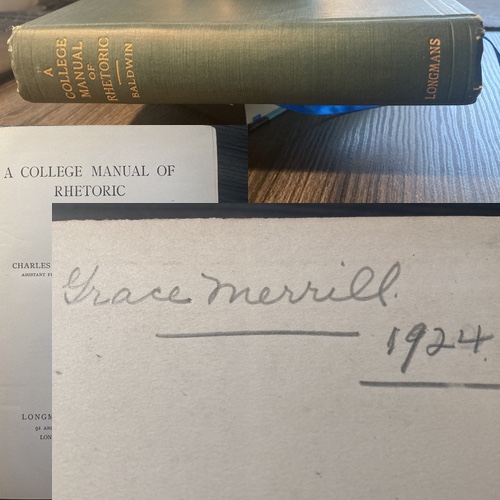
Last weekend, while helping friends pack-house, I found this book:
Wait! Don’t do the math on a book from 1907, and a college student taking Rhetoric in 1924. :)
Instead of packing it, I borrowed the book wondering if this James Sears Baldwin might just be the Baldwin. This is a dry book. But it’s also teaching me a ton about writing. The author hasn’t cracked even the slightest smile in the first 37 pages of this 400+ page tome. But the Baldwin quote I’d love to find within, might just be the sort of pithy thing this author would drop near the end.
Yes, I am willing to read a 400+ page tome on the off chance that I find the quote and get the once-in-a-lifetime thrill of finding an original attribution for a well-known quote. I digress.
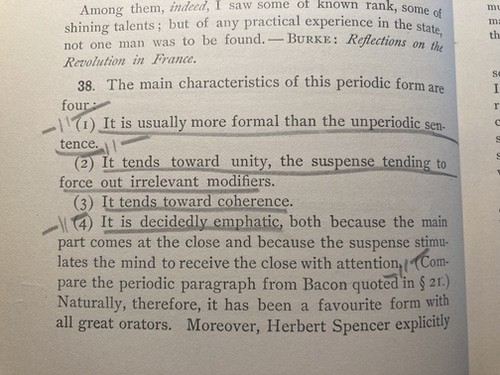
By page 30, I had seen a whole bunch these little diagonal marks, but hadn’t really figured out what she was trying to imply.
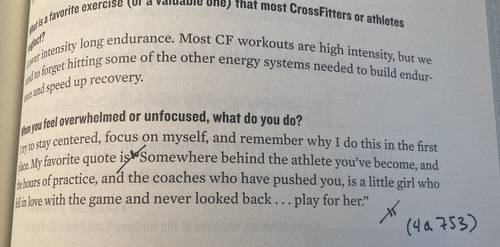
Then it hit me. Quotes! It’s a diagonal line with a quote on the diagonal line. She’s delineating quotations. I’m guessing that she must have written a paper—who’d expect that in a Rhetoric class, right?—and I bet she came back through and marked the quotation sections. At the same instant that I figured it out, my up-to-then habit of drawing a full line across the page, (often a long line, then up or down a line, and then finish going across, to “cut” in the middle of a line,) seemed dumb.
Thank you Miss Merrill. This looks just way cooler:
How can parents and younger generations better prepare for an uncertain future shaped by technology, education, and climate change?
A personal journey reveals the link between decision-making and courageous parenting.
I realized that the future that I thought—as a parent, who grew up as somebody else’s child—I was parenting as I was parented, not as my intellect was telling me I should parent.
~ Karena de Souza (8:23)
This conversation explores the intersection of futurism, parenting, and the challenges of preparing for an unpredictable world. Karena discusses her journey into podcasting and book writing, driven by a desire to engage younger generations and their parents in critical discussions about technology, education, and societal shifts. She emphasizes the importance of equipping children with the skills and mindset needed to thrive in a future dominated by uncertainty and rapid change.
Key themes include the evolving nature of work and the need for parents to adapt their approaches to align with new realities. Karena shares her insights into how decision-making skills can be cultivated and applied, using anecdotes from her life and travels. Climate change is highlighted as a significant focus, with an emphasis on fostering hope and resilience while addressing the challenges it presents to future generations.
Find more pleasure in intelligent dissent than in passive agreement, for, if you value intelligence as you should, the former implies a deeper agreement than the latter.
Without thinking, as I transcribed that quote, I used their preferred way of writing their name—at least, that’s how they are attributed in the source I had at hand. (Every web site I find romanizes it to Thorisdottir, offensively—in my opinion—sterilizing the family name to simple roman letters.) I was feeling all proud about even being able to write that character.
And then I went to file the quote in the slipbox. Uh… “Houston, we have a problem here.”
Step one: What is it? It’s a Thorn. Wikipedia helpfully, (that’s sarcasm,) explains:
[…] in modern Icelandic, it is pronounced as a laminalvoiceless alveolar non-sibilant fricative [θ̠],[1][2] similar to th as in the English word thick, or a (usually apical) voiced alveolar non-sibilant fricative [ð̠],[1][2] similar to th as in the English word the. Modern Icelandic usage generally excludes the latter, which is instead represented with the letter ðæt ⟨Ð, ð⟩; however, [ð̠] may occur as an allophone of /θ̠/, and written ⟨þ⟩, when it appears in an unstressed pronoun or adverb after a voiced sound.[3]
I didn’t quote the part where they say, it’s not actually related to the letter P, which we get from Greek.
Well it looks like a P. That suggests filing this person under “PO”.
Iceland is the only place that has not, long ago, replaced it with “th”, and it’s pronounced like “th”ick. So I’m going to treat it like “TH,” and then Þórisdóttir gets filed under “TO”. (Wait, why not under, “TH”. Because my index of people is arranged by first-letter, plus next-vowel—not by the first two letters.)
How has podcasting impacted Anette Carlisle’s life, goals, and creative journey?
Creative fulfillment emerges as a significant benefit of building a body of podcasting work.
It’s been a way to share some really relevant information around the issues happening right now you know not just in Texas or Amarillo. But across the nation when it was important to do that.
~ Anette Carlisle (1:36)
The conversation explores the transformative power of podcasting in the speaker’s life, emphasizing its role as a creative outlet and a platform for sharing meaningful stories. Topics include the logistical and emotional shifts caused by the pandemic, leading to a more focused approach to podcasting. Anette discusses the transition from in-person interviews to remote ones and highlights the adaptability needed to address contemporary issues effectively through the medium.
The dialogue also addresses Anette’s evolution in communication styles, transitioning from data-heavy presentations to more engaging narrative storytelling. Insights into goal setting and creative fulfillment emerge as central themes, with reflections on how podcasting has influenced personal and professional growth. She values the permanence of podcast episodes as a body of work and appreciates the opportunity to engage in meaningful conversations that align with their broader goals.
Brett McKay: But how can men maintain that vitality, even when they have those responsibilities they have at home?
Vic Verdier: I personally use two strategies, if you want. The first one is very easy. It’s to read books, books and biographies, novels, books of adventures, books of people taking risk. I’m thinking Hemingway, Jack London, but also biographies of great leaders who took risks, and thanks to you, Brett, I learned more about Theodore Roosevelt and the way he reinvented himself all the time, challenging himself. And when you read those books, you realize that you don’t really have anything to lose by trying new things all the time. So that’s my first strategy, getting some inspiration from reading. The second strategy for me is to, on a weekly basis, to do some kind of self-assessment, meaning every week I’m thinking about my life and what I’m doing, and when I start to settle down, I know it’s time to do something different. Do you remember this movie, Groundhog Day, when Bill Murray is repeating the same day over and over again?
Brett McKay: Of course.
Vic Verdier: I think… If I live twice the same day, somehow I wasted one day. So I try to have some diversity in my life, and every time I think that I fall into some kind of routine, I know I have to explore something else or go somewhere else or do… Take another course or learn some new skills.
This wide-ranging conversation with Verdier touches on everything from his military and deep diving careers, to Parkour, MoveNat and general ways to stay fit and healthy. Worth a listen, and doubly-so if you’re a dude over 40. (Or know one.)
There’s an embedded player on that page, or find episode 704 of The Art of Manliness podcast, How to Keep Your Edge as You Get Older.
How does transforming a face-to-face course into an audio and digital format affect the teaching process, and what lessons arise from that experience?
Shifting to virtual teaching reveals how technology and podcast-like approaches can deeply connect with students.
I think it’s interesting. [I] try and think now of where do I get that energy from, when I come and sit in front of microphone or video. But I think, from years of face-to-face lecturing, and I’ve learned to almost fetch that from somewhere inside before I start.
~ Yolande Conradie (8:46)
The conversation explores the process of transforming traditional face-to-face teaching into a fully digital and audio-based format during the lockdown period. One significant focus is the effort required to adapt classroom exercises for online learning while ensuring engagement and energy remain high. Yolande shares her discovery of unexpectedly manageable aspects, like working with green screens and layered videos, alongside the technical challenges of ensuring high-quality audio.
Yolande also reflects on the importance of delivering content with energy and intentionality, even when speaking to an unseen audience. Years of face-to-face lecturing have helped her prepare mentally to connect with virtual learners effectively. Additionally, the discussion touches on how her listening habits for podcasts—particularly those with innovative soundscapes and storytelling—have influenced her approach to teaching and audio content creation.