That is how we are still conditioned socially as adults: Do, achieve, produce results, instead of be, feel, enjoy the process. Quantitative over qualitative. We are obsessed by performance and “tangible” results. But that is one of the great teachings of Parkour and ADD: That the path is just as enjoyable as the destination; That sometimes it is even more important, and that oftentimes it is the destination.
However, the value of saving the marginal hour today is to increase the total number of one’s working hours by one, resulting in a new hour at the end of one’s career, not a new hour at their current skill level.
I’ve made the point that it’s endlessly useful to put an explicit value on my time. I believe my logic and reasons still hold. But this idea, about needing to consider the value of the additional hour towards the end… well that, I’d never thought about. Which is daft of me, because I do often think about the marginal cost of things, and this idea is simply pointing out the marginal value gained by saving something now.
Hopefully, my occasionally marking, “duh,” on my map as a reminder to myself, helps you in some way.
Keep this refuge in mind: The back roads of you self. Above all, no strain and no stress. Be straightforward. Look at things like a man, like a human being, like a citizen, like a mortal. And among the things you turn to, these two: Disturbance comes only from within—from our own perceptions. That everything you see will soon alter and cease to exist.
I’m great at focusing, but am weaker at intentionally choosing what I’m focusing on. I’ve no idea when I realized I was weaker at the latter point. While it’s clear I have a lot of habits and behaviors which work well to help me deal with the weakness, I cannot recall if those developed simply by trial and error.
One habit which works well to avoid disaster is dump it out of my brain into an outline. An emergency spillway prevents complete failure of a dam, but if water ever goes over the emergency spillway, something is terribly wrong. That’s me and brain-dump outlining. I flip my 40-minute sand timer and start a fresh outline, saving it to my computer desktop. (Aside: There is never anything on my computer desktop.) As I’m outlining, panic often nips at my heels. Eventually, I get most everything down. I find long strings of knock-down-doable domino tasks. And I usually find at least one Big Question buried in there.
And then I close the document. It’s cathartic. It’s as if, having written it down, it’s in some sense done.
Don’t try to find your passion. Instead master some skill, interest, or knowledge that others find valuable. It almost doesn’t matter what it is at the start. You don’t have to love it, you just have to be the best at it. Once you master it, you’ll be rewarded with new opportunities that will allow you to move away from tasks you dislike and toward those that you enjoy. If you continue to optimize your mastery, you’ll eventually arrive at your passion.
In Part II of our series, we move out of the 01960s to explore the work of three artists who created their major works during the 01970s and 01980s. We see a shift with these artists to a focus on complete control over the exhibition of their work and meticulously curating the experience the viewer has coupled with a goal of permanence of the artwork in situ.
I’ve little to add here, other than to attempt to convey how arresting I find the artwork in the article. The older I get, the more I find myself being delighted into pausing, often at the smallest coincidences. An alignment of trees, the color of the light, or sound traveling long distances or being altered by terrain and structures, are just a few things that catch my attention.
All that was left was the three of us. Our relationship and trust in each other. Hanging out and having very little to do. Waking up, having breakfast, smoking pot, buying some records, listening to those records, and maybe playing some music. We now had total artistic freedom. Nobody, including us, was wed to any commercial expectations. This gave us the creative freedom to make whatever we wanted, completely free from fear and expectation. In hindsight this was a huge gift.
One can’t learn something new without first admitting one’s ignorance. No matter how great a tea is, none can be poured into a cup that is full of water or turned upside down. There is no trying without being ready to fail. […] Some people, out of pride, exclusively want to achieve; Some others are willing to learn. Guess who gets most done in the long run?
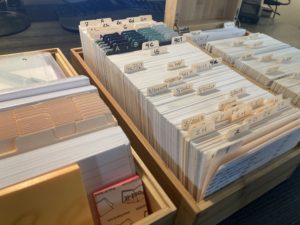
It’s been one year since I started collecting my thinking in a slipbox. In the photo, the box on the left is full of materials—blank slips, dividers, etc. The box on the right is the older portion of my collection of quotes; It’s the portion of the quotes which has been released as daily podcasts for the Little Box of Quotes. The center box is the meat of the slipbox and contains over 1,000 new slips, with about 250 of those being new quotes. But, enough with the statistics.
What can I do with it? A startling amount of interesting things come out. I’m not going to write up an article right here to prove it. But suffice to say I’ve recently been dipping into the slipbox to augment something I was writing. I’m trying to remember, any time I’m writing anything, anywhere to pause and ask the slipbox about it. When I do that, I almost always find something to add.
One really big question I had when I started the slipbox was whether I wanted it to be physical or digital. I’m happy to report that I made the right decision. So much of my life and things that I do are digital. I’m so tired of digital stuff. Any time I can be doing something in the physical world, that’s a plus. Never once have I regretted not being able to free-text search the slipbox. Instead, it remains a pleasantly tactile experience to search, retrieve, and create.