In stressful moments, I try to take distance from the situation, take time to reflect. Whatever the problem, I typically ask myself, “Am I able to make a difference right now?” If I don’t see a clear way to make a positive impact, I reflect further. I think that patience in problem-solving can often be underrated.
Be polite, on time, and work really fucking hard until you are talented enough to be blunt, a little late, and take vacations and even then … be polite.
…when the goal isn’t to end up with a pile of notes?
There are many scenarios where, over time, I do want to end up with a collection of notes. This is straight forward; start taking notes, and keep them somewhere. Bonus points if you review them, or use them as reference, or do anything with them.
But what if I have a scenario where I want to “do a better job” but I don’t care at all about the notes themselves. Suppose you have a regularly scheduled recurring meeting, but you don’t need a historical collection of notes. In fact, suppose you don’t actually need notes, but you think: It would be nice to know what we did last time, so we can follow-up next time.
And so I’m thinking this would be easy. I’ll just have a pile of notes (physical, digital, whatever) and I’ll go through them and … wait, what, actually? Recopy them? gag, that’s tedious. How many do I keep? How long do I keep the old ones? Here’s what I came up with…
I’m working in a single digital document. I have a heading, “Ongoing,” at the top that has the big things we currently have on our radar. The list has some dates with notes; “Oct 2020 — started that big project” and similar things.
Next I have a heading, “Jan 5, 2022” with the date of our next scheduled meeting. When that meeting arrives, I start by doing something very weird: I add “9876543210” on the line below the heading. Then I take simple bullet-point notes under that heading. “We discussed the foo bazzle widget needs defranishizing,” and similar items. Before our meeting ends, I add a heading for the date of the NEXT meeting, ABOVE this meeting’s heading. This pushes the heading and notes down the page a bit.
Then I continue reading. The heading just below this meeting’s, is the date of our last meeting. Just below the heading is “9876543210”, which I put there when we had that meeting. I delete the “9” from the front. I read my notes from the meeting. I may even edit them. Sometimes things that were obvious then, don’t seem so obvious a week later.
Then I continue reading. The next heading is the one from two meetings ago. Just below it is “876543210” — think about that, if it’s not obvious that last week, I read this part and already removed the “9”. So this week, I remove the “8.” Read the notes.
I work my way down each of the historical dates. Snipping a lead number, off the front of the line after each heading. 7. 6. 5. etc.
At the very end of the document, I find a heading that is from 11 meetings ago. Below the heading is “0” — because I’ve looked at these notes 9, 8, 7, 6, etc deleting a digit each time. These notes are now quite old. In fact, they should be irrelevant after 11 meetings. If they are not, I figure out what I have to add to “Ongoing” (the very topmost heading)… or perhaps I put a note under the coming meetings heading (just below “Ongoing”.)
It sounds wonky, but it’s magic. One digital document, you can skim the entire thing right in any of the meetings. You can search in the document. I can be sure I’m not forgetting things, but I can be sure I’m not making a huge collection of crap I’m never going to look at again.
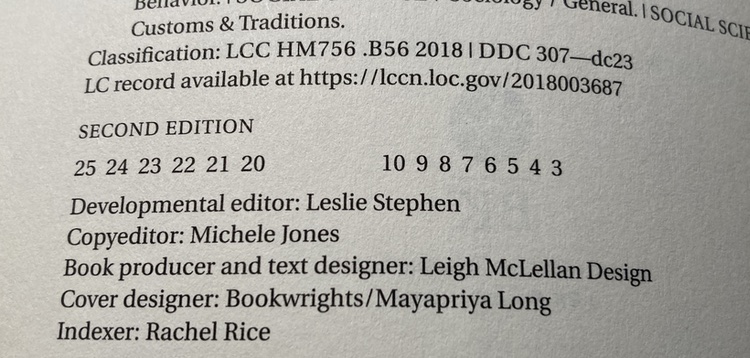
Care to guess where that delete-a-digit each time comes from? It’s an idea from book printing. When they used to set type (physical lead type in trays) they would put “1 2 3 4 5 6 7 8 9 10” (or other orderings of the numbers) in the cover plate. Then print the book. What printing? This one is “1” Next printing? …they’d just chip off the “1” and print “2 3 4 5…” in the book… second printing. They still print those weird sequences of digits in digitally printed books. I believe this one is a second edition, 3rd printing…
For this coming year I’ve been trying on a number of phrases. Selecting a yearly touch-phrase is a fairly new habit. The oldest one I’m aware of is from 2012, but I’ve not had one every year since 2012. Each chosen phrase has been in English, with last year’s being the sole exception. For 2022, I’m going to stick with English; The point of these phrases is to remind me of… something. I’m generally too clever by half, so keeping it simple is invariably the right choice for me.
In the recent weeks I’ve been letting my mind wander around, while keeping the thought that I’d like to find a good phrase for 2022. This is quite intentionally a way to shift my mental context, to adjust what I find salient. One pays attention to what one finds salient. In my recent wanderings, I found myself returned to a post about focus.
Turns out they were the best decisions of my life. Because each one of those difficult decisions that looked like failures (at first) took me a bit closer to my real self. Each of them empowered the real me. Each of them woke me up from the illusion. At this point, I can see a clear pattern of rejection every time I try to get closer to my real self, so the feeling of “looking like a failure” has become more of fuel than a burden.
With emotional empathy, you actually experience a weaker degree of what somebody else feels. Researchers in recent years have been able to show that empathic responses of pain occur in the same area of the brain where real pain is experienced.
It seems obvious to me that being empathic is helpful since it suggests where to direct one’s compassion. However, is it necessary to be empathic in order to be compassionate?
Without compassion is empathy beneficial? Without compassion might empathy actually be harmful?
My main motivation as an artist has always been to create something different. I think the most that any of us can achieve is to find a way to say something new. But this type of thinking is rarely rewarded when it’s time to publish. Newness is seen as a liability. Publishers want something that has been proven to work. This means that the best art will always be the riskiest.
Pride is generally an emotion encountered only when looking backward. But we can also experience it when looking forward to each day, each month, each year, each decade, and even to the end of our life when imagining what we were able to accomplish in that time.
I’m also familiar with, “Pride goeth before destruction, and a haughty spirit before a fall.” I’m not certain the meaning of haughty, although I’d bet that one who exhibits indignation, (anger or annoyance provoked by what is perceived as unfair treatment,) would qualify as “haughty.”
And I sometimes joke that “indignation” is my other superpower.
All of which, I suppose, it a good thing. There are situations where indignation is righteous. But I’m well aware that my indignation—when it flares—is not. So maybe this exercise of looking forward could be a way to refine my pride? If I imaginatively project forward I can consider something I’d be proud of. Then, if I imagine not succeeding at that something, the pride disappears… and does indignation appear?
Does that seem right? …if success or failure in something, which is never actually in my control—reminder: the dichotomy of control—determines whether I experience pride or indignation, is that something actually one worth pursuing?
Could I find instead something about which I’d feel pride regardless of success or failure?
Posting about it isn’t doing anything. It’s just like talk … it’s cheap! Too many people think they are supporting a cause, and the only thing they are doing is posting about it on social media. Doing something is doing something, everything else is just talk.