Part 2: Getting Into Fasting

I’ve been doing 16:8 intermittent fasting for years and recently started 48-hour fasts — dropping about three pounds each fast, gaining one or two back, and trending steadily downward. I wanted to understand what the research actually says about what I’m doing to myself, so I worked with Claude (Anthropic’s AI) to produce this series. I set the structure, chose the topics, pushed back on claims that felt hand-wavy, and guided the editorial tone. Claude did the writing and research synthesis. My curiosity driving Claude’s research and prose.

Routines, Scenarios, and What to Expect

Research brief — the practical onramp. 16:8 IF as a starting point, Craig’s specific eating window, extended fasting scenarios anchored to a weekly rhythm, and what keto flu actually is.

Start With 16:8

You may want to start by getting into 16:8 intermittent fasting — an 8-hour eating window and 16-hour fast — before attempting anything longer.

Is this actually supported? Honestly, no one has studied whether practicing 16:8 first makes longer fasts easier. It’s conventional wisdom without a clinical trial behind it. But the physiological rationale is sound: regular time-restricted eating develops metabolic flexibility — the ability to switch between glucose and fat/ketone oxidation. Someone who does this daily would be expected to enter ketosis faster and with less discomfort during an extended fast. And the practical experience of managing hunger, learning your body’s signals, and knowing what electrolyte depletion feels like are real benefits of prior fasting experience, even if unstudied. (1)

What the research says about 16:8 on its own:

Satchin Panda’s group at the Salk Institute pioneered time-restricted eating (TRE) research, starting with a 2012 mouse study that showed mice on a high-fat diet restricted to an 8-hour eating window didn’t gain weight compared to ad libitum fed mice eating the same food. (2) Human trials with 6–10 hour eating windows have generally shown weight loss, improved glucose regulation, reduced hunger, and improved energy.

A 2020 study by Wilkinson et al. put 19 participants with metabolic syndrome on a 10-hour eating window for 12 weeks and found reductions in weight, blood pressure, and atherogenic lipids. Single-arm trial (no control group), but notable results. (3)

The Eating Window: Skip Breakfast

The simplest way to do 16:8 is to skip breakfast. Eat your first meal around 11:30 AM, finish eating by 7:30 PM. That’s it.

Example daily rhythm:

  • 11:30 AM — First meal (“break fast”)
  • 2:00–3:00 PM — Protein-heavy snack if hungry (0% fat yogurt, protein shake with fruit)
  • 5:30–6:00 PM — Dinner
  • Nothing after 7:30 PM

This gives you a clean 16-hour overnight fast every day. No special foods, no supplements, no elaborate protocols. Just… don’t eat in the morning.

But isn’t an earlier window better? Courtney Peterson’s group published the first controlled feeding trial of early time-restricted feeding (eTRF) in 2018. Men with prediabetes ate within a 6-hour window ending at 3 PM vs. a 12-hour window. eTRF improved insulin sensitivity, blood pressure, oxidative stress, and appetite — even without weight loss. (4)

Peterson’s data suggests an earlier window (say, 8 AM–4 PM) may have slightly better metabolic outcomes due to circadian alignment — insulin sensitivity and glucose tolerance are naturally higher in the morning. But the practical reality is that most people can’t eat their last meal at 3 PM. Social eating, family dinners, real life — the later window is far more sustainable. Peterson’s data shows early TRE is better, not that late TRE is bad. An 11:30–7:30 window still captures the core benefits of a compressed eating window and extended overnight fast.

Extended Fasting Scenarios

Once 16:8 feels routine, you can extend into longer fasts. All scenarios below are anchored to a Sunday ~5:30 PM family meal as the break-fast, working backward:

  • ~22 hrs — Saturday dinner (7:30 PM) Extended OMAD. Easy entry point beyond 16:8.
  • ~30 hrs — Saturday lunch (11:30 AM) Skip one full day of eating. You sleep through the hardest part.
  • ~46 hrs — Friday dinner (7:30 PM) Nearly two full days. Well into ketosis and autophagy is active. Two sleeps make this more manageable than it sounds.
  • ~54 hrs — Friday lunch (11:30 AM) Deep into the autophagy/stem cell priming window. Friday afternoon might be the grittiest stretch — you’re still burning through glucose stores and haven’t hit the ketone clarity yet.
  • ~70 hrs — Thursday dinner (7:30 PM) Three full days. Firmly in Longo’s regenerative territory. Most people report hunger actually diminishing after day 2.
  • ~78 hrs — Thursday lunch (11:30 AM) The “long weekend fast.” Maximizes time in the 48–72+ hour zone where stem cell and deep autophagy research is strongest.

I’ve recently been fasting in the 46-hour to 54-hour options to hit a sweet spot — you get the major benefits (see Parts 3–6), Sunday dinner is a natural social re-entry, and you’re only navigating one or two workdays while fasting. The jump from 54 to 70+ is where most people feel they’re making a real lifestyle commitment for the week rather than a weekend experiment.

Keto Flu: What It Is and Why It Happens

Sometime in the 24–72 hour window, you’ll likely hit the “keto flu” — headache, fatigue, brain fog, irritability, maybe muscle cramps. It actually feels a bit like you’re coming down with the flu. It’s not illness. It’s electrolytes. When I stop eating around Noon on Friday, this happens (if I don’t address the underlying cause beforehand) in the middle of the night Saturday.

Here’s the mechanism:

  1. Insulin drops → your kidneys stop retaining sodium and excrete more water. (Insulin normally signals the kidneys to reabsorb sodium.)
  2. SGLT2 effect: The sodium-glucose transport protein 2 normally reabsorbs glucose and sodium together in a 1:1 ratio. With blood glucose low, SGLT2 activity drops, and more sodium goes out in your urine.
  3. Sodium loss drags potassium and magnesium along with it through coupled renal transport.
  4. The resulting electrolyte imbalance — particularly sodium depletion — drives the entire symptom cluster.

This is well-established physiology, not speculative. (5)

The mental fog typically lifts as the brain adapts to using ketones for fuel. Many people describe a shift to unusual mental clarity once adaptation kicks in — probably related to the brain’s efficient use of beta-hydroxybutyrate (BHB) as fuel.

For me, Friday afternoon until bed is the grittiest stretch on a 46–54 hour fast; By Saturday midday I feel exceptionally sharp.


Sources

  1. de Cabo & Mattson 2019, NEJM — metabolic switching and fasting overview: https://pubmed.ncbi.nlm.nih.gov/31881139/
  2. Panda lab TRE review 2021 — time-restricted eating research overview: https://pubmed.ncbi.nlm.nih.gov/34550357/
  3. Wilkinson et al. 2020, Cell Metabolism — 10-hour TRE in metabolic syndrome: https://pubmed.ncbi.nlm.nih.gov/31813824/ (free full text: https://pmc.ncbi.nlm.nih.gov/articles/PMC6953486/)
  4. Sutton et al. 2018, Cell Metabolism — early TRE improves insulin sensitivity without weight loss: https://pubmed.ncbi.nlm.nih.gov/29754952/ (full text: https://www.cell.com/cell-metabolism/fulltext/S1550-4131(18)30253-5)
  5. Electrolyte mechanism — insulin-sodium-kidney pathway is standard renal physiology; see also general overview at https://science.drinklmnt.com/low-carb/keto-electrolytes/ for accessible explanation of the SGLT2 and insulin mechanisms.

Part 1: Why Fasting Works

I’ve been doing 16:8 intermittent fasting for years and recently started 48-hour fasts — dropping about three pounds each fast, gaining one or two back, and trending steadily downward. I wanted to understand what the research actually says about what I’m doing to myself, so I worked with Claude (Anthropic’s AI) to produce this series. I set the structure, chose the topics, pushed back on claims that felt hand-wavy, and guided the editorial tone. Claude did the writing and research synthesis. My curiosity driving Claude’s research and prose.

The Big Picture

Research brief — general overview of fasting benefits. The most “hand-wavy” of the series: frameworks, history, and the broad case for why not eating is doing something useful.

The Metabolic Switch

The overarching framework for understanding fasting benefits comes from Mark Mattson’s “metabolic switch” concept, reviewed comprehensively in a landmark 2019 NEJM paper co-authored with Rafael de Cabo. (1)

The core idea: when you stop eating for long enough, the body shifts from glucose-based to ketone-based energy. This isn’t just a fuel swap — it’s a stress response that activates adaptive cellular pathways. The metabolic stress of fasting triggers increased expression of antioxidant defenses, DNA repair, protein quality control, mitochondrial biogenesis, and autophagy. These protective mechanisms outlast the fast itself — a hormetic effect where controlled stress leaves the system stronger.

This is the thread that connects the individual benefits explored in the rest of this series: better insulin sensitivity, growth hormone surges, inflammation reduction, cellular cleanup, and (possibly) neurological benefits all flow from this same metabolic switch.

The Breakfast Myth — How We Got Here

Before talking about what fasting does, it’s worth understanding what we were told about not fasting — specifically, the idea that skipping breakfast is harmful.

“Breakfast is the most important meal of the day” is not a scientific finding. It’s a marketing slogan.

The history: A 1944 marketing campaign by General Foods (maker of Grape Nuts) distributed pamphlets in grocery stores and ran radio ads declaring that “Nutrition experts say breakfast is the most important meal of the day.” (2) Some sources trace the phrase further back to a 1917 article in a magazine published by John Harvey Kellogg’s Battle Creek Sanitarium. (3, 4) The cereal industry systematically funded and promoted research that supported breakfast eating, creating a self-reinforcing cycle of industry-funded studies and marketing claims. Harvard nutrition professor Dr. David Ludwig has stated that the idea breakfast is essential comes from the food industry’s historical push, not from unbiased research.

Note on the Bernays connection: Edward Bernays (the “father of PR”) is often credited with creating the “bacon and eggs” breakfast campaign in the 1920s, working for Beech-Nut Packing Company. This is a separate but parallel story — Bernays promoted a hearty breakfast; the “most important meal” language appears to come from the cereal companies. The two threads are often conflated online.

What the science actually shows: A 2019 BMJ meta-analysis by Sievert et al. at Monash University examined 13 RCTs on breakfast and weight. Breakfast skippers had a small weight advantage (mean difference 0.44 kg), and breakfast eaters consumed ~260 more calories per day. Adding breakfast did not improve weight loss regardless of whether participants were habitual breakfast eaters or skippers. (5)

Quality caveat the authors themselves flag: all included trials were at high or unclear risk of bias with short follow-ups (mean 7 weeks for weight, 2 weeks for energy intake).

The adults vs. children distinction: The observational evidence for breakfast benefiting children and adolescents — particularly for cognitive performance and academic outcomes — is stronger than for adults. Growing brains may be more sensitive to glucose availability after overnight fasting. But adults have larger glycogen reserves, better metabolic flexibility, and less acute sensitivity to short-term fuel gaps. The honest framing: the evidence that breakfast matters may hold for growing children, but for adults, the “most important meal” claim was born in a marketing department and has not been substantiated by rigorous research.

So: skip breakfast. For adults, it’s not the mythological “most important meal” — it’s the easiest meal to drop, and dropping it is one of the simplest onramps to intermittent fasting (see Part 2).

What Happens When You Don’t Eat

A rough timeline of what the body does during a fast, painting in broad strokes (the details and evidence for each are in Parts 3–6):

  • 0–12 hours: The body works through available glucose and glycogen stores. Insulin drops. Nothing dramatic yet — this is a normal overnight fast.
  • 12–18 hours: Glycogen depletes. The liver begins producing ketone bodies. Fat mobilization accelerates. You’re entering mild ketosis.
  • 18–24 hours: Ketone levels rise. Growth hormone begins increasing. Autophagy pathways are activating. Inflammatory monocytes start clearing from circulation.
  • 24–48 hours: Full ketosis. Growth hormone surging (up to 5-fold by 48 hours). Autophagy well underway. Insulin at baseline. The “keto flu” window — electrolyte shifts can cause headache, fatigue, brain fog — typically peaks here and resolves as the brain adapts to ketone fuel.
  • 48–72 hours: Deep into the fasting response. Stem cell priming begins (per Longo’s research). Many people report hunger diminishing rather than intensifying. Mental clarity often peaks as the brain runs efficiently on ketones.
  • Refeeding: The regenerative burst. Stem cells that were primed during the fast activate. The system rebuilds from a cleaner baseline.

This timeline is approximate and draws from both human and animal data. The specific evidence behind each claim — including where it’s strong and where it’s hand-wavy — is covered in the subsequent parts.


Sources

  1. de Cabo & Mattson 2019, NEJM — effects of IF on health, aging, and disease: https://pubmed.ncbi.nlm.nih.gov/31881139/ (full text paywalled: https://www.nejm.org/doi/full/10.1056/NEJMra1905136)
  2. Cereal industry/marketing history — Kellogg’s marketing: https://marketingmadeclear.com/kelloggs-marketing-lie/
  3. Priceonomics — how breakfast became a thing: https://priceonomics.com/how-breakfast-became-a-thing/
  4. JSTOR Daily — backstory of breakfast cereal: https://daily.jstor.org/the-strange-backstory-behind-your-breakfast-cereal/
  5. Sievert et al. 2019, BMJ — breakfast and weight/energy intake meta-analysis: https://pubmed.ncbi.nlm.nih.gov/30700403/ (free full text: https://pmc.ncbi.nlm.nih.gov/articles/PMC6352874/)

Temenos, part 2

Today one can conduct an interview on the phone or via Skype, but ideally, in order to truly foster reciprocities of rapport and insight in a meeting, one requires a live countenance and a quiet physical space-like the ancient Greek temenos, with its sacred enclosure or holy grove or magic circle— in which an interview can live and flourish.

Jonathan Cott, xiv, from Listening: Interviews, 1970-1989

There’s this word, again!

I’d spotted it previously… and it came to mind during Steve Heatherington’s monthly podcast call. I was reminded of it by his discussion of telic. But I couldn’t exactly remember the the word temenos at first. I am certain I first heard it mentioned in an episode of Boston Blake’s Mythic podcast, but I couldn’t find a reference to a specific episode (on my blog or by searching.) Then I realized the word appears in the Introduction to a terrific book. Which was also literally sitting on my desk… a crazy confluence of events.

When I first encountered it, I’d not thought of it in the context of what we podcast hosts do for our guests. But Cott makes it crystal clear.

ɕ


Your current reality

You must never confuse faith that you will prevail in the end—which you can never afford to lose—with the discipline to confront the most brutal facts of your current reality, whatever they might be.

James Stockdale

slip:4a1567.


This Isn’t Journaling

Let’s be clear about what we’re talking about here.

This isn’t journaling. Journaling is about processing emotions and experiences. That’s valuable, but it’s not what this is for.

This isn’t “morning pages” or free writing. Those are about getting words flowing without judgment. Again, valuable for what they do, but different purpose.

This isn’t a task management system. You can track tasks if you want, but that’s not the main point.

This is using paper to think better.

It’s externalizing the process of figuring things out so you can actually see what you’re thinking instead of just feeling overwhelmed by it.

When you keep everything in your head, you’re constantly using mental energy just to remember what you’re supposed to be doing. You can’t see patterns. You can’t build on previous thoughts—you just repeat them.

The notebook becomes a record of your thinking that you can reference, build on, and learn from.

That’s what makes it useful. Not the paper. Not the pen. The externalization.

ɕ

This is part of a series about Hand-Write. Think Better.—a method for people who feel overwhelmed to start simply writing more on paper. Get the book →


Differential Prognosis

Most people have heard of a differential diagnosis—the ranked list of possibilities a doctor holds in mind when figuring out what you have. It’s a useful framework because it forces you to hold multiple possibilities simultaneously, weigh them against evidence, and re-rank as new information arrives.

Two things before I get into specifics. If you know me, this post contains a lot of clinical detail about my situation, and I apologize if any of it catches you off guard. If you don’t know me, you can let the specifics of my particular case blur past—because the underlying idea, differential prognosis, is something you will need someday. Everyone does. The specifics are mine; the framework is yours.

I’ve been thinking about a related idea that, as far as I can tell, nobody has named: differential prognosis. Not “what do you have,” but “where is this going”—and critically, how that ranking should shift as new evidence arrives.

Here’s why it matters.

About 1 in 8 men will be diagnosed with prostate cancer in their lifetime. I’m one of them. Gate one.

When I was diagnosed at 52, that itself was unusual. Only about 2–3% of prostate cancer diagnoses happen at that age. Most men are in their 60s or 70s. Being in the left tail of that age distribution isn’t just a fun fact—it correlates with more aggressive biology. Gate two.

Post-surgery pathology came back with extracapsular extension, a positive margin, Gleason 3+4, Grade Group 2. None of those findings individually is rare, but the combination starts narrowing the population I actually belong to. Gate three.

Then my PSA never became undetectable after surgery—a distinction clinicians pay attention to, because it’s different from dropping to undetectable and later rising. It suggests something was there from the start. Gate four.

Then my PSA doubling time landed at roughly three months. Among men with biochemical recurrence (technically defined as PSA reaching 0.2—a threshold I hadn’t even crossed yet, but with a trajectory this clear, no one was waiting for a number), only around 10–15% have doubling times under six months. Three months puts me in the aggressive tail of an already-selected subgroup. Gate five.

The naïve way to interpret all of this—and I’ve encountered it from well-meaning people, and even from some clinicians—is to treat each of those gates as an independent coin flip. “Only X% of men with recurrence have a doubling time that fast, so the odds are still in your favor!” But that treats my trajectory as a series of fresh rolls of the dice. It isn’t.

What’s actually happening is that each gate is evidence of a latent variable—call it underlying disease aggressiveness, or biology, or whatever you want. That variable doesn’t change between gates. Each time I pass through a low-probability bad gate, I’m not just unlucky. I’m accumulating evidence that the hidden variable driving all of this is unfavorable. The gates are correlated through that hidden factor.

This is Bayesian updating, and it’s not complicated once you see it. Each gate is a filter. By the time you’ve passed through four or five of them on the unfavorable side, the population you actually belong to—statistically—is very different from the one your original diagnosis placed you in. Your prior for the next branch point being unfavorable should be substantially higher than the base rate would suggest.

That’s the differential prognosis. It’s a living, ranked list of possible futures that gets explicitly re-weighted at each gate. Not a static risk label you were handed at diagnosis and carry around forever.

And I think naming it matters, because the standard way prognosis gets communicated tends to be snapshot-based. You get staged, you get a risk stratification—CAPRA score, NCCN risk group, whatever—and that label tends to stick in people’s minds even as subsequent events should be revising it. “You’re intermediate risk” can persist psychologically long after the actual picture has shifted substantially toward unfavorable. Clinicians implicitly update their thinking, but patients often don’t. They anchor on the original framing.

The differential prognosis framework fights that anchoring by making the updating the point. You’re not revising a fixed label. You’re maintaining that ranked list and explicitly moving things up or down as you pass through each gate.

Where I think this has real power is in arguing against complacency at each new decision point. In my case, when it came time to decide on radiation and hormone therapy, the sequential history argued for treating aggressively—18 to 24 months of ADT rather than the minimum 6. My history is the prior, and the prior says: don’t bet on the favorable tail anymore.

There’s one nuance I want to be honest about. The framework is stronger at up-regulating concern than at down-regulating it. A negative PSMA-PET scan should move favorable trajectories back up the list. Good news is real and should count. For the framework to be complete—and not just a machine for generating anxiety—it has to account for that symmetry.

And there’s a ceiling effect. At some point you’ve already updated your prior substantially, and the next bad gate provides diminishing informational value. You’re already modeling aggressive disease; one more confirmatory data point doesn’t shift things as much as the first few did.

But I think most people facing a serious diagnosis are nowhere near that ceiling. They’re still anchored on their original risk label, still hearing base rates that no longer apply to them, still treating each new finding as a fresh surprise rather than as another piece of a pattern they should have seen forming.

The differential prognosis says: Pay attention to the pattern. Update the list. And make your decisions from where you actually are—not from where you started.

ɕ


The Empty Space Isn’t Waste

New day = new page.

Even if yesterday’s page is mostly empty.

This is going to feel wasteful at first. You’re going to look at all that empty space and think “I should fill this page before starting a new one.”

Don’t.

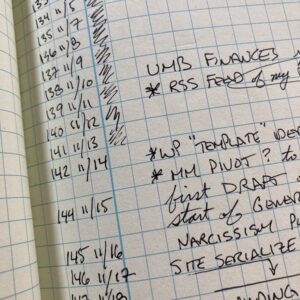
The empty space doesn’t matter. What matters is that you can find things later, and dating each page is how that works. If Tuesday and Wednesday are on the same page, you’ve broken the one feature that makes the whole system useful.

Think about it: three weeks from now, you’re trying to find something you wrote. Was it Monday? Tuesday? If every day has its own page, you can flip right to it. If you crammed multiple days together to “save paper,” you’re hunting.

The notebook is cheap. Your time spent searching is expensive.

Starting a new page each day isn’t about perfection or following rules. It’s about having a system that actually works when you need to look something up.

ɕ

This is part of a series about Hand-Write. Think Better.—a method for using paper to think more clearly. Get the book →


Does this actually work? Here’s my honest answer.

People ask if this works. I don’t know how to answer that.

I can’t promise you results. I can’t show you a before-and-after photo or a chart of my progress. Bodies are complicated. Minds are complicated. The relationship between them is very complicated.

Here’s what I can say.

It’s working. Slowly. I can’t point to a moment when things changed. I just notice that they have.

What I notice now

The way I think about food is different than it was when I started. Some of that is the prompts. Some of it is probably other things. I can’t run a controlled experiment on myself.

I don’t promise anything. I don’t know if it will work for you.

What I know is this: Small thoughts, arriving regularly, change how I see things. That’s the bet. If it’s wrong, you’ve lost nothing but a few seconds each morning.

That’s why 365 Changes is free to try. One prompt a day, delivered by email. If it resonates, you’ll know. If it doesn’t, you can unsubscribe and move on.

365 Changes: A daily prompt about eating — https://365changes.com/

ɕ


The difference between trying to eat better and being someone who does

“I’m trying to eat less sugar.”

“I’m not a person who snacks.”

These sound similar. They’re completely different.

The first one is a battle. It assumes I want the sugar and I’m resisting. Every day is a new fight. Willpower required.

The second one isn’t a fight at all. It’s just who I am. The decision has already been made, somewhere upstream, and the moment-to-moment choices flow from it.

I’m not trying to be someone who eats well. I’m trying to become someone who already does.

Becoming, not battling

The prompts help with that—not by giving me rules, but by putting identity questions in front of me. Who do I want to be? What would that person do here?

Eventually, I stop asking. I just do what I do.

That’s the long game with 365 Changes. Not behavior modification. Not willpower training. Just small questions, arriving daily, that slowly reshape who I think I am.

365 Changes: A daily prompt about eating — https://365changes.com/

ɕ


What happened when I stopped following diet rules and started paying attention

Tell me I can’t have bread and suddenly I want bread. Tell me dessert is forbidden and I’m thinking about dessert all day. The harder I grip the rules, the more I want to break them.

I don’t think I’m unusual in this. Rules create resistance. The moment something becomes off-limits, part of me starts scheming.

Diet rules made me want to rebel. So I stopped following them and started noticing what I was already doing.

Noticing instead of restricting

The prompts I use don’t tell me what to eat. They don’t give me rules or meal plans or forbidden foods. They ask me to notice what I’m already doing.

That sounds soft. It is soft. But it’s also the only thing that’s ever worked for me.

Noticing is neutral. It doesn’t demand anything. It just asks: What’s happening here? Why did I reach for that? What am I actually feeling right now?

Most of the time, I don’t know the answer. That’s fine. The noticing is enough. Over time, patterns emerge. Things I didn’t see become visible. And once I see them, they’re harder to unsee.

That’s the approach behind 365 Changes—not rules to follow, but questions to sit with. One each morning. No judgment, no tracking, just attention.

365 Changes: A daily prompt about eating — https://365changes.com/

ɕ