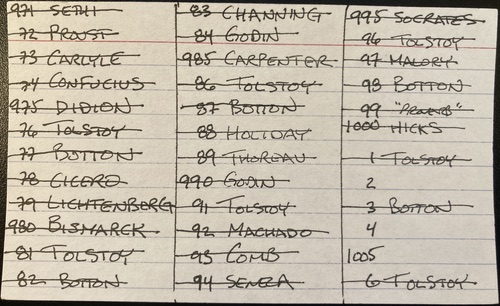
What do you do for fun?

It’s the holiday party season! (At least, on my continent it is.) From late November into January, it’s a pleasant parade of parties and fetes.

“What do you do [for work]?”

omfg could we please stop asking each other this question. My stock reply is, “as little as possible.”

Instead, could we start asking each other questions which actually start the process of getting to know each other? …questions whose answers would actually help us remember each other? …questions which elicit some story or some passion or something other than, “I file TPS reports.”

Let’s start asking:

What do you do for fun?

What’s something you’re passionate about?

What’s something new or exciting in your life?

What are you most proud of from the past year?

…and if you want to really get to know people:

What’s something that’s currently challenging you?

ɕ

§24 – Recovery Days

This entry is part 36 of 37 in the series Study inspired by Pakour & Art du Déplacement by V. Thibault

In certain circles it is said, “what was once your workout will become your warmup.” In my journey of rediscovering activity and play, there was a long period—20 years now, perhaps—where I was able to focus primarily on growth, forward motion, and transformative change. This made for a very long period where my workouts did gradually became my warmups. Certainly I’ve always had rest days; nearly 10 years ago, when I started parkour, it was all I could manage just to recover over the course of the entire week before heading back to the next hard training session. Rest and recovery were always in the mix, simply because I began my journey of transformative work in my 30s.

I’ve found it increasingly challenging to remember the importance of recovery now that I’m no longer shoving the needle of progress ahead day by day. Truth be told, I’m squarely on the mid-life plateau and it is time to take life more freely. Sure, the days of working every day for seven years on the house, climbing mountains, jumping on stuff, and doing things which cause police officers to say, “…and you sir, how old are you? You should know better!” are not over. (As far as I can tell.) But these are also, certainly, the days where spending a couple hours, every day, sitting still reading and writing is truly blissful.

ɕ

Artificial constraints

A lot of my thinking, and sometimes even my problem solving, revolves around juxtaposition. What would the inverse of the current this be? Can I gain useful perspective from the other position? Big/small, loud/quiet, perfuse/sparse, etc.; there are many obvious qualities that create striking changes in perspective. However, I find particularly rewarding juxtapositions in unusual dimensions, and there’s one dimension in particular that pays off more than all others: Time.

Have a problem? …how would I solve it if I had 100 years? …what would have to be the case if I were going to solve it in 5 minutes?

It’s become common to talk about “minimum viable product” in the entrepreneurial space, and that’s a form of time constraint. (But it’s a useful idea because it also includes other constraints such as resources and people.)

The famous Getting Things Done system has many critical components. One in particular is paying attention to the next action for any given project. (And in GTD everything you do in your entire life is a ‘project’.) This too is a form of time constraint; it’s not, “I’ll move this project forward at some point in time,” (the perspective of unlimited time,) rather it’s, “if I was going to move this project forward in the next minute…”

Where in your life might a shift to expectation of greater or lesser time yield a huge benefit?

ɕ

Creating an administrative day

Once I reached a point where most of the administrative and maintenance things were under control, I found that I had a steady stream of small things to do every day. Certainly, having things organized saves time, but things still need to be done—I can’t organize and optimize everything to zero-time required. The next step was to grab a trick from time-blocking: Set aside a chunk of time to focus on those administrative and maintenance tasks in one long go.

I’m not going to bother you with which day of the week I picked. The point is simply that I have a day—the entire day—set aside to do all the things that must be done. Laundry, occasionally changing the house air filters, stacking firewood, scheduled appointments (if I can get them on that day), banking and bookkeeping, special errands and shopping trips for home repair items, and on and on. The point is that I’ve moved all the things which feel like they aren’t directly related to my goals and aspirations—although obviously they are directly related, they just don’t feel related—to one place; one big block of time; the admin day.

ɕ

Goals versus aspirations

A distinction I’ve been making in recent years:

A goal is something specific. It will be clear when the goal is achieved. For me, goals should always be the classic specific, measurable, actionable, relevant, and time dependent, sort of SMART goals.

An aspiration is something directional. It will be clear when progress is made in the direction dictated by the aspiration.

The more goals I set, the worse my life becomes. I set great goals… big challenging, self-stretching goals. They pile on like dead weight and drag me down. Lose 10 pounds. Read an hour a day. …and so on.

Aspirations, being open-ended, don’t feel so daunting. Provided the aspirations lead to actual action, then I don’t need to worry about tomorrow. I can simply do the things—today, now—which are guided by my aspirations. Be someone who moves. Be exposed to lots of fresh ideas. Be someone who helps others. Be someone who creates value. Be someone whose mind works well.

What aspirations do you have?

ɕ

Where you put your mind

There’s a hard-won lesson I learned about getting things off of my mind. If my mind is stuck on something I need to deal with that immediately. Sometimes I still make the mistake of just doing the whatever, to resolve the thing on my mind. But that’s my artificial urgency problem kicking in, and I continue working to avoid that. No, by ’deal with’ I mean simply: Figure out what it is that is making that thing stick in my mind, do the thinking required to figure out the next action, and capture it somewhere not in my mind.

What’s on your mind right now that you could write down/capture outside of your head which would then free your mind for having ideas, rather than using it to try to store ideas?

ɕ

Brandee Laird: Creating experiences, usefulness, and poetry

How can one integrate personal growth, creativity, and leadership to inspire and connect with others?

Brandee Laird discusses many things, including the recent Art of Retreat, being an introvert, and card manipulation. She shares her coaching philosophy, influences, and creating experiences, and reflects on the role of usefulness in her practice. Brandee explains how she handles dark moods, strives to expand her skill sets, and even recites some of her own poetry.

[T]hey end up feeling connected to me by the way I’m doing it and the way I’m presenting myself. But really, it’s whatever tactics and techniques, whatever tools I’m giving them. Whether it’s a game, mess with a partner, or we’re all doing something together, it’s really designed to give them a sense of not being alone in the endeavor. Because parkour is something that we definitely do alone. But we do it alone, together.

~ Brandee Laird

Brandee Laird explores her multifaceted approach to personal growth, movement, and coaching. She discusses how she crafts unique experiences for her students to foster connection and engagement, emphasizing the balance between challenge and joy in her teaching philosophy. Through her reflections on the Art of Retreat, she shares how creating environments for personal and communal elevation has inspired her practice. Additionally, she explains her methods of navigating introversion and dark moods, offering insights into building resilience through creative outlets like poetry and physical movement.

The conversation also dips into the philosophy behind her work, such as redefining parkour as an obstacle-based discipline and expanding its scope to emphasize utility and community impact. She highlights how integrating compassion, creativity, and leadership can elevate both individuals and groups. Her personal anecdotes, such as teaching meditation and ninja skills at a summer camp, reveal her commitment to cultivating meaningful experiences that inspire transformation in others.

Takeaways

Creating impactful learning experiences — Experiences should combine skill acquisition with emotional engagement for lasting impact.

Navigating introversion in leadership — Introverts can consciously generate energy to inspire and lead others effectively.

Growth through discomfort — Embracing challenges leads to personal and communal transformation.

Parkour as a universal practice — Parkour’s adaptability and inclusivity make it a unique discipline with global community connections.

The role of creativity in resilience — Poetry and storytelling provide emotional outlets and foster deeper personal reflection.

Expanding parkour’s scope — Teaching parkour with a focus on utility and values can transform communities and lives.

Balancing joy and suffering in practice — Sustainable training includes both rigorous challenges and moments of lighthearted exploration.

Resources

Brandee Laird @monkeemoves

Opportunitrees (YouTube) — Brandee’s personal parkour video journal capturing moments of happiness and creativity.

Parkour Visions — Organization promoting parkour as an inclusive, community-driven discipline.

Art of Retreat — Event fostering connection and learning within the movement community.

The I Ching — Ancient Chinese text used for guidance and introspection.

(Written with help from Chat-GPT.)

ɕ

Lose no time

I suspect some people need to cultivate a sense of urgency to motivate them. I need less motivation. I need less urgency.

I managed to create a life where my perception is that every waking moment I’m either on-task or off. Every waking moment is either doing something that moves me towards my goals, or a moment of relaxation and unwinding—self-care practices so to speak. (Of course, there’s another third of my life when I’m asleep.)

It’s perfectly obvious that there is no such thing as work versus life balance. There’s just life. Some moments I’m doing this thing. Some moments that thing. Some moments resting my eyes. Some moments eating. Some moments interacting with this person. Some moments with that person. Many moments I’m alive.

The only way it would make sense to talk about work versus life… I don’t mean work, defined as when money is changing hands. I mean work as in efforts spent progressing towards a goal. The only way it would make sense to talk about work versus life balance would be if I were two—or more—different people; the work me and the life me. I can readily see how that could be a thing. I can see people who do that, or at least they try to do that. It’s completely obvious when people try to be one person in work contexts and another for themselves. I’m not sure I ever tried to do that. I’m sure that I don’t want to do that.

There’s just me. There’s just life. I need to catch myself making a distinction between work and life. That would be a moment, earlier than where I’m currently trying to solve my problems, where I might have more purchase.

ɕ

What would it be like?

I have a list of daily reminders that I cycle through. This one came up this morning and, as always, it bears repeating:

Add padding to everything. Do half of what you imagine you can do. We tend to cram as much as possible into our days. And this becomes stressful, because we always underestimate how long things will take, and we forget about maintenance tasks like putting on clothes and brushing teeth and preparing meals. We never feel like we have enough time because we try to do too much. But what would it be like if we did less? What would it be like if we padded how long things took, so that we have the space to actually do them well, with full attention? What would it be like if we took a few minutes’ pause between tasks, to savor the accomplishment of the last task, to savor the space between things, to savor being alive?

~ Leo Babauta from, 8 Key Lessons for Living a Simple Life

slip:4uzesi5.

Where I am, there’s a winter storm coming later today. It’s the end of the world. People rushing around. Grocery stores picked clean. Flurries of communication about, “have you heard…,” and, “is this thing cancelled?” It’s like this every year; not just the first winter storm, but every storm.

The crazier it gets, in general, in life, on the roads, in the markets, online, the more I feel like, “meh.” Tempest in a teapot. All the world is but a stage, and all that. On any given day, there are things I want to do and I set about doing them.

What do you want to do today? Have you allocated time to do that well?

ɕ

Mindless or mindful?

Have you noticed how often we all repeat what we say?

Too many people simply begin talking at another person, before having obtained their attention. This happens all the time! Once you start to notice it, it’s everywhere.

Too many people aren’t paying attention. Although, I suspect it’s partly in response to too many people [and computers and phones and our entire culture] clamoring for their attention, that they’ve stopped paying attention as a self-defense mechanism. Withholding attention shifts the default setting of how attention-getting something must be to actually get their attention.

Many years ago we create a house-rule that we would not talk to each other unless we were in the same room. It took a long time until it became the norm in our house. No shouting from one room to another with a question, or an order. How often do things like, “Hey, could you…” travel from room to room in your home? Our rule forces us, when I want your attention, to go to you. This puts some actual effort onto me, exactly where it belongs. No one is permitted to call from the living room, “Hey, can you bring me…” because we both know full well we should get up and get it ourselves.

Settling into that rule was tough. But part two was far harder. Improving the other side of the exchange: that of the person who is being interrupted, even if it is ever so politely, by a demand for attention. Having reached a point where we each travel to the other, (the first part,) we then had to learn to treat the arriving person with respect, (the second part.) For example, when I’m knee-deep in computer work and she arrives, I had to learn to pause from my work and turn my full attention to this person who is vastly more important than anything happening in my computer. Frankly I’m still working on this.

After a few years of all of the above, I noticed my attention was becoming a much sharper tool in my interactions out in the world. Some of this was surely due to years of martial arts training, but much of the change was due to my intentional practice described above.

(Then I realized just how much of my attention my phone was demanding, and I fixed that shit right quick. Then I threw my participation in social networks under the bus.)

Now, I see countless examples of mindlessness any time I venture out into the regular world. But I also see examples of mindfulness! They’re not as common, but some people I encounter are awake. Some people I encounter are interested and interesting. Some people’s presence make the immediate area a better place.

Which are you, mindless or mindful?

ɕ

Sand through the hour-glass

I mentioned recently that I sometimes use a cheap little sand timer when I want to know when to stop, but don’t want to be directly interrupted by beeps or alerts. The sand runs out quietly. At some point later, I notice the time is up and I bring the work to a stop.

Except when the sand timer gets stuck. My half-hour timer—just that one—every once in a while, stops dropping sand. It’s a pretty teeny stream of falling sand that I can easily miss at a glance. So it’s not at all obvious if it stops. I get into the flow of work. I’m thinking, “yeup, in the flow state.” I’m tearing along, confident that my little sand timer will quietly let me know when to stop.

…and like two hours later I notice the room is getting cold because I haven’t fed the wood stove. Wait wat. *taps sand timer* oh.

I can’t decide if this is good or bad. It’s like deep work roulette. I think I’m going to do a half-hour dash, but maybe I’m going down the rabbit hole. I could easily replace the cheap little sand timer, but I like the randomness of it. The analog-ness of it. Not only is its time keeping approximate, but sometimes it’s totally not keeping time.

Too much planning and structure kills spontaneity.

ɕ

The calling of what could be

The best way I can describe it is a “calling.” I see something—something being done in an inefficient way, a question asked, a powerful tool not being used—and I see possibilities. Ways to combine things, to expand things, or a small bit of connection that would make two things vastly more powerful. It’s a flash of opportunity.

The urge to drop whatever it is that I’m currently doing, and jump on the new opportunity is irresistible. Not quite absolutely irresistible, but it’s close. I don’t get distracted so much by things, but rather by the opportunity for me to take some action to create, integrate, combine, smash and rebuild better, rearrange and permute. Oh yes, it’s a calling. It’s almost an addiction.

Actually, maybe it is an addiction. An addiction to action?

Certainly, I’m biased towards action. That’s a good thing. As an agent—emotional too of course, but as a being who has agency—being biased towards action is a necessary component of being able to consistently affect the world.

However, I’ve come to believe that there’s such a thing as too much action. It’s completely possible, (exhibit ‘A’, me,) to attempt too much action, to do too much, and to lose oneself in a flurry of activity. I’m beginning to suspect that, now that I’m a master of taking action, I need to work on assessing leverage. Feel a calling? How much leverage would that action generate? How much good/benefit/creation/change would that action generate? How, as it were, does it multiply the actions of others?

That might be a theme for 2020: How much does it multiply?

ɕ

Getting things done

GTD

The fact that you can’t remember an agreement you made with yourself doesn’t mean that you’re not holding yourself liable for it. Ask any psychologist how much of a sense of past and future that part of your psyche has, the part that was storing the list you dumped: zero. It’s all present tense in there. That means that as soon as you tell yourself that you should do something, if you file it only in your short-term memory, that part of you thinks you should be doing it all the time. And that means that as soon as you’ve given yourself two things to do, and filed them only in your head, you’ve created instant and automatic stress and failure, because you can’t do them both at once, and that (apparently significant) part of you psyche will continue to hold you accountable.

~ David Allen from, Getting Things Done

I talk often about David Allen’s, Getting Things Done. It’s one of a few books which I keep extra copies of on hand to give to people. There’s a Wikipedia article, Getting Things Done, but it talks more about it rather than describing what/how to do it.

I recently found a talk given by Allen which has been repurposed as a short podcast; Getting Things Done: 55 – Removing System Drag is well worth the few minutes it takes to listen.

Aside: Learning when and how to “go deep” is an important part of what you gain when you understand GTD. If the thought of spending five minutes listening to someone teach you something abhors you, you may need GTD more than you think. /preaching

If, however, what Allen said interests you, a fellow podcaster named Jey Jeyendran, (of Productivity Heaven,) is working on a mini series of podcasts on Allen’s GTD. They’re bite-sized, inspiring and you should check them out. https://productivity-heaven.simplecast.com.

ɕ

US Parkour Association (part 2 of 4): National governing bodies, Board of Directors, and getting involved

What is the purpose and vision of the United States Parkour Association (USPK), and how does it aim to shape the future of Parkour in the United States?

USPK seeks to unite the Parkour community under a shared vision for safety, legitimacy, and inclusivity.

This episode explores the purpose and necessity of the United States Parkour Association (USPK), focusing on its role as a national governing body for the Parkour community. Topics include the importance of legitimacy in representing Parkour to external entities like governments and media, the development of safety guidelines for gyms and events, and the need to preserve the culture and inclusivity of the sport. Members of the transitional board share their vision for how USPK can guide the community while ensuring that its direction remains member-driven.

The discussion highlights the structure and goals of USPK’s transitional board, including the emphasis on transparency, broad representation, and accessibility for members. The board envisions creating a sustainable framework that encourages collaboration among individuals, organizations, and businesses passionate about Parkour. Special interest groups (SIGs) and other mechanisms are designed to empower members to contribute actively to areas such as certifications, competitions, and educational standards.

Takeaways

The need for a governing body — USPK exists to represent the Parkour community’s interests and ensure its voice is heard.

Safety and guidelines — Developing standards to enhance safety in gyms and events is a key focus.

Legitimacy in public perception — USPK aims to counter misconceptions and promote a positive image of Parkour.

Member-driven organization — Transparency and inclusivity are central to USPK’s structure and decision-making.

Transitional board’s role — Current board members are dedicated to establishing a foundation for future leaders.

Diverse membership — USPK invites practitioners, parents, coaches, and businesses to join and contribute.

Special interest groups (SIGs) — Members can actively shape areas such as education, competitions, and safety standards.

Community representation — USPK seeks to be the collective voice of all Parkour enthusiasts in the U.S.

Resources for members — Providing tools like insurance access, event awareness, and networking opportunities.

Combating external challenges — Addressing issues such as unsafe practices and commercialization by external entities.

Resources

USPK Official Website — Provides information about the United States Parkour Association and membership opportunities.

(Written with help from Chat-GPT.)

ɕ

WebSub or PubSubHubbub

I recently found James Cridland’s article, A Podcast Industry Guide to WebSub, or PubSubHubbub. It’s a good unpack of how the RSS-is-a-pull-service impediment to scaling is solved by creating aggregators that support pushing RSS update notifications.

…how does your podcast player notice that daily podcast is out, without polling the podcast’s RSS feed every minute?

I’ve added a link to Cridland’s article to my Deep Dive About Podcast Feeds.

ɕ

The art of starting a fire

During heating season, each morning begins with my ducking outside for the ash pail and then shoveling out the stove. Then with a selection of kindling and a medium-sized piece or two, I build a small work of art and set a match to it. I’ve done this, easily, a thousand times. I’ve read one book entirely about burning wood, and several about thermodynamics and chemistry. I understand the different types of wood and how to season it, the convection of air, and I know intimately how the house and stove interact. I’ve intentionally experimented with variations of the art, including working with more stoves and fireplaces than I can recall. Usually, I have a roaring fire in 30 minutes—sometimes 20—with not the least hint in the house of the smell of a fire. Occasionally it doesn’t work well. Most of those mediocre attempts or outright failures are immediately attributable to my having cut some corner. But every once in a great while, the art eludes me despite my best efforts.

There’s a large lesson in that.

ɕ

Road trip to Dylan’s

This entry is part 3 of 4 in the series The interviews from my perspective

Dylan Johanson / Episode 15

I met Dylan Johanson in 2013. I went to an ADAPT certification course at Kutztown University run by Parkour Generations, and Dylan came down from upstate New York. He hadn’t really had a chance to train with a lot of other people, so this was the first time that he had had a chance to be in a group of roughly 27 candidates for the course, which was enormous. He was just so happy. He was basically running, jumping or laughing the whole time because he had never found such a large group of people with the same passion.

The first day he was sort of playing the, “I’m old,” card because he was in his late 30s at the time, having started parkour after quitting his previous business life. When he eventually bumped into me, it was like, “hey, fellow oldster!” We just sort of clicked, and we wound up walking from the training spots to where lunch was and back and forth. When I started doing the podcast years later, I was always thinking his story was interesting because of—as he talks about in the podcast—his early “days of the ninja”; He would just pick a straight line through Kingston on a Sunday when everything is closed and run over fences, dogs and all that.

He’s over 3 hours by car from me, but I kept trying to find ways to get up and train with him. I made a couple road trips up to his different iterations of the gym. When I finally got a chance to interview him, it was so fun to sit down with no distractions because normally the people that I hang out with, we’re meeting at events, we’re meeting at parkour gyms and things are crazy. For this interview, it was just this chill opportunity for us to sit at his house and relax.

The story of how I got to the actual pressing of record was that I went to a winter retreat that was held in the Catskills. After the event was over, instead of driving the four hours back to where I live, I just drove 45 minutes across the Hudson River. It’s a fond memory for me because I had the quiet drive-time to myself, and I was driving west into a glorious sunset after a deeply introspective, winter immersion retreat.

I drove across the Hudson, and I went directly to the third incarnation of his gym; The gym that I had not yet been to. Everything just came together. There was an adult birthday party happening that evening at the gym, so when I got there, the place was packed with people and all his instructors. I showed up, dropped my bag and went to play on things. It was like the very beginning, “Hey, Dylan, how are you?” “I’m cool.” …and right into showing each other things to try and challenges. It was this perfect, closed loop back to how we met simply jumping and playing.

Eventually the birthday party ended, they closed the gym down, and I went back to Dylan’s to crash for the night. When I travel for podcasting, everything goes with me in one backpack with the rest of my stuff, and normally I just sleep on the floor with my favorite little air mattress. After dinner, I got upgraded to a futon, and it was a great end to terrific day.

In the morning, we sat around his house chatting. His house has some terrific quiet space where you can really recharge. There’s a lot of wood. It’s very much a home. There’s also Tesla, Dylan’s super-sweet love-hound pitpull, and she’s in the podcast too; You don’t hear her, but we talk about her. We sat in his living room with our feet on his coffee table, drinking coffee out of silly-shaped coffee mugs, and just talking about our ADAPT course and other random stuff. I often say that all the episodes are my favorite, but Dylan’s is one of the first where I realized how much having the chance to spend time with the guests before we do the recording changes everything.

The interviews always show the guests’ personality, and you can really get to know them, but it doesn’t work if I literally just walk up and say, “Okay, you ready?” “Yes.” And then press record. It’s priceless to have spent the day before jumping and playing at the gym, dinner at his home, and all night we’re thinking, “what are we going to talk about tomorrow? A leisurely morning with the dog, coffee, and then when we finally did press record, we were just so ready to talk that his interview just clicks. They just fall out like that. There’s little bits here and there that get cut or some do-overs, but it was just so fun.

His story that he tells in the podcast about making ninja lines through quiet, downtown Kingston… that’s literally who Dylan is. Not that he does that every day, but he is literally the person who runs and jumps and plays. In the episode, he talks about some of his favorite spots in Kingston. After the recording, we threw down the recording gear and drove down to Kingston. We went to some of his favorite spots, just randomly jumped on stuff, playing and enjoying ourselves for hours.

It was a fun session for me because it was just the two of us, and we’re both a little older. Now, he’s way better than me athletically, but to get a chance to once again move with this guy that I enjoy training with so much, and in the spots that are his places where he just kept going, “Oh, you got to try this. Oh, you got to try this.” I never had a moment to get bored, he always had the next place in mind. He’s super energetic and fun to follow around.

I didn’t know Dylan when he had his day job. I only met him after he had quit and started working on parkour as a full-time, “how am I going to turn this into an actual project?” job. Simply put, he was trying to create a community. It was in that timeframe when I met him at the ADAPT course. I started running into him at other events, and when he created his first gym I went up. I made another visit when he opened the second incarnation of his gym. I didn’t go up and train with him when he first started his community, but I’ve known him for that whole time.  Eventually he had created the third gym, and that’s when the random confluence of events created the chance to go up for an interview. As I was driving up I was thinking, “I don’t know anybody who’s opened three gyms.” Like three iterations of the same community gym, and that was why that kind of became a thing in the episode; It was me coming to him at the point where he had now done the third one. That’s why when I ask him for advice, he’s very much like, “Yeah, don’t do it. Don’t open three gyms.”

ɕ

Sedimentation and erosion

I have this image of our home as a bunch of related-rates problems: There’s inflow and outflow. Energy: In through my electric meter, out through lighting, waste heat and heating/cooling, water heater, etc.. Climate control: Heat flow in from heating/cooling system, the wood stove, the sun, versus losses through the attic, windows, doors, etc.. Mass: The balance of the rates of the flow of all the stuff.

Ever stop to think of that? Think of your home as a sealed balloon which has two, (or more of course,) doors, (garage doors count,) through which everything passes. Everything—no exceptions—passes in first, and then out second. Everything–every single thing, including the people–is only inside temporarily. The people come and go most frequently, (some pets might exceed some people I suppose,) and some things might remain inside for decades. But still, inside only temporarily.

You know that at some point you, (and everyone else if you share your home,) will go out for the last time. You might carry some things with you on your last exit, or you might arrange for someone else to come in, (and go out and in and out and in and out one last time,) to remove things after you go out for the last time. And of course eventually the entire structure will be removed and certainly at that point, everything you brought in—everything that was temporarily still inside—will go out at that point.

Where does everything you carry in from the market and grocery store go? Where does the furniture go? The books? The nick-naks? The packages and packing material from purchases? The clothes? The postal mail? The firewood you carry in is vastly more massive than the ashes you carry out; where does all that mass go?

Based on how the things around me make me feel, I know I have too much stuff. When I think of our stuff this way—as just a mass of stuff that’s temporarily inside our home—it’s much easier to keep my life under control. Too much stuff? …all I need to do is make sure more goes out than comes in, on average, and the problem will subside.

…and I can have fun with it. If something breaks, is worn out, or I’m done with it, that’s the outbound mass for today! Can I recycle this random thing? Can I FreeCycle this random thing? I no longer feel bad about sending things out, (wether that means landfill, recycle, giveaway, whatever… as appropriate.) Instead, I now find I feel bad about bringing things in. Each time I consider buying something, I think: Do I want to bring that into my life?