It warms my heart any time I discover someone writing on the open web. But boy howdy is it a good day when it’s also someone I know, who I think more people need to hear from.
I’m biased, of course. Most people don’t write out in the open (I’m not criticizing.) Being a someone who does simply means I understand the urge, and the challenge (and the fear) that goes into the pensive from which writing ensues.
“Know thyself” is a piece of advice which is as old as civilization, and probably a great deal older. To follow that advice, a man must do more than indulge in introspection. If I would know myself, I must know my environment; for as a body, I am part of the environment, a natural object among other natural objects, and, as a mind, I consist to a great extent of my immediate reactions to the environment and of my secondary reactions to those primary reactions.
How can movement and mindset be used as tools for healing, growth, and fostering connections in both personal and community contexts?
Rodrigo Stavale and Craig Constantine dip into several topics, including podcasting, children’s learning, and the power of unconventional teaching methods. Stavale emphasizes the significance of modeling and creative play in fostering children’s development and understanding of movement. They discuss the importance of providing diverse environments, such as streets and parks, to encourage risk management and creativity. Stavale also touches upon the value of self-reflection and feedback, noting the benefits of recording podcasts to capture and analyze one’s progress.
Stavale discusses the role of podcasting as a tool for self-reflection and assessment, allowing individuals to evaluate their progress and explore new movement approaches. He also highlights the significance of injuries, explaining how they provide valuable learning experiences that increase body awareness and strengthen individuals.
The best environment to develop kids is in streets, parks, and places with lots of information for them to manage the risks, see the challenge, and be creative.
~ Rodrigo Stavale, 22’30”
Observing his daughter’s learning process, Stavale emphasizes the importance of modeling movements rather than relying on strict instructions. He describes the value of creativity and playfulness in children’s exploration of movement challenges, allowing them to develop their own ideas and philosophy.
Stavale also underscores the importance of self-assessment in movement practice. He encourages individuals to analyze their movements, using methods such as video recordings or written observations, to identify areas for improvement and track progress. Through self-reflection, individuals can deepen their understanding, maintain motivation, and discover innovative approaches to movement challenges.
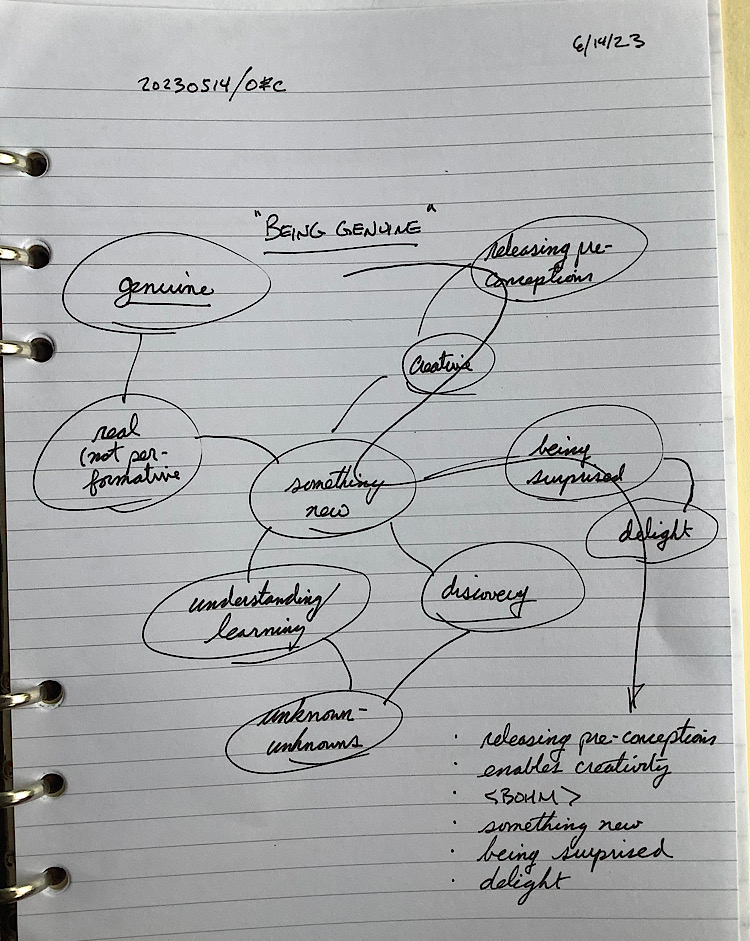
First a hat tip to Austin Kleon. His most-recent post, Do you have a nemesis? included a mind map, which is the most-recent of the countless times I’ve encountered mind mapping. I’m a fan of Kleon for many reasons, not least of which is that he, like me, flouts the usual guidelines for the capitalization of one’s titles.
I’ve tried mind mapping a few times. (What’s that? Did I overdo it with software and processes? …yes, of course!) Today, I was feeling unmotivated to write for Open + Curious. I thought, “Just start. JUST START!” But I simply didn’t want to face the blank screen of the digital document.
Instead, I opened my idea garden wherein I capture interesting nuggets to be seeds for future writing. In my garden, I rarely (I first wrote “never,” but I don’t want to jinx myself) have trouble finding a nugget to write about. I grabbed my favorite pen, and flipped to a blank sheet in the little binder I keep. So much action! I felt like I was already writing. /s
On that mind map I wrote the “something new” at the center. It’s not a meaningless bit of meta; it’s the central idea from a captured nugget. At this point, staring at the paper with my pen in hand felt great, versus facing a digital document which always feels too structured for me to think in. (ref. Sönke Ahrens.) In just a few minutes of thinking and scribbling I had all those bubbles. Then I had a title. …then a route. …an outline. And from there the writing felt doable.
Of late there’s been a marked reduction in the ‘ol mental chatter. I don’t know from where the chatter originates. Sometimes I notice there is chatter; sometimes I notice there is not. When there is chatter, I find it’s usually impossible to stop it in the moment, or even with hours of concerted effort.
If you’re ever able to step back from your own mental chatter, and listen to it with some critical distance, perhaps after a long meditation, or in one of those tired but insightful moments near the end of the day, you might find it indeed exhibits many of the characteristics of an extremely boring and self-absorbed person. It’s not that you yourself are this way — surely you don’t say everything that comes to mind. But the mind does.
The only thing that works for me, to keep the chatter at bay, is to bite off far less than I think I can chew. Then spit half of it out the moment I realize I didn’t actually want it in the first place. My chatter is [I think?] always about something (or some things) specific. The only way to stop the chatter is to realize the thing is not worth doing, or to just do it. With finite time and energy there’s a limit to the “just do it” solution. In recent months I’ve been spending huge amounts of time talking myself into realizing many things are not worth doing. This too is a Sisyphean task, but I think it’s been working— at least if I judge by my perception of recent chatter.
The purpose of myths is not to have us feel separate from the gods in stories but to have us understand that we are capable of the great feats that they perform.
Real life is found only in the present. If people tell you that you should live your life preparing for the future, do not believe them. We live in this life, and we know this life only, and therefore all our efforts should be directed toward the improvement of this life. Not your life in general but every hour of this life should be lived in the best way you know how.