Rasa with Andrew Suseno →

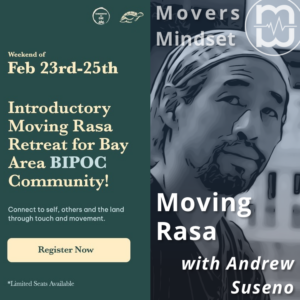
Movers MindsetRasa with Andrew SusenoFeb 7, 2024 · 36:47What is the purpose and impact of the Moving Rasa initiative, particularly in fostering personal transformation, collective identity, and community resilience? Andrew Suseno joins Craig to describe how Moving Rasa transforms trauma into collective hea

What is the purpose and impact of the Moving Rasa initiative, particularly in fostering personal transformation, collective identity, and community resilience?

Andrew Suseno joins Craig to describe how Moving Rasa transforms trauma into collective healing and empowerment through movement, redefining personal boundaries and identity in profound ways.

Andrew Suseno describes the transformative work of Moving Rasa, a continuation from his earlier focus on Parcon Resilience. Andrew and Craig begin with an introduction to two upcoming retreats designed for Asian American Pacific Islanders and BIPOC communities, emphasizing rest, recuperation, and abolition. These retreats aim to support community organizers by reconnecting them with their bodies and helping restore their life rhythms. The events serve as a platform for individuals from marginalized communities to engage in healing practices, fostering a sense of empowerment and collective well-being.

Rasa means taste in Indonesian, and it also means discernment of feeling with the heart. It isn’t just about what our relationship to food is, but it’s what our relationship to anything is— whether it’s a picture on the wall, a book that we read, a friend, a value that we might have. And just like we might have a sensory understanding of what something tastes like, we have a sensory understanding of our rasa for anything. And that sensory understanding can be moved into and explored and improvised with and moved with others.

~ Andrew Suseno, 5:25

Andrew elucidates the concept of “Rasa,” explaining its multifaceted meanings that encompass taste, discernment of feeling with the heart, and essence in various languages, including Indonesian and Sanskrit. This concept underpins the ethos of Moving Rasa, encouraging participants to explore and connect with their essence through movement improvisation.

The conversation further explores the transformative potential of acknowledging and moving through trauma in community settings. Through the lens of Moving Rasa, Andrew shares insights into creating spaces where individuals can engage in self-discovery and collective healing. The dialogue highlights the importance of patience, love, and community in navigating personal and collective liberation journeys, offering a nuanced perspective on time, self-love, and the construction of communal identities.

What if we started with ourselves? What if we forgave ourselves for punishing ourselves? What does that open up in our relationships with others, with ourselves, with objects, with ideas? What movements are possible there? …both literally—physically—movements, but also what movements are possible in the world? …what you can create?

~ Andrew Suseno, 31:01
(more…)

Try it →

I’ve described a problem as being the ability to explain the current state (of something, anything you care to imagine) and a desired state. The problem is that those states are different. Unfortunately, the word “problem” comes packed with negative connotation. That’s not what I’m suggesting here. The “problem(s)” I’m talking about are anything you desire to change.

A critical feature of intelligence is the ability to describe those two states; that’s literally how you do all the intentional things that you do. Current state, desired state… and then working to get from the current state to the desire state is being a problem solver.

In his book, Principles, Ray Dalio describes leadership as something very similar: having the ability to a) visualize a future state be it physical, spiritual, emotional, or all three and b) find the people and the resources needed to make it happen.

~ Cierra Martin from, «https://www.gapingvoid.com/blog/2023/09/17/going-from-idea-to-impact/»

Elsewhere, this is 4ugabo8. — slipbox

Any time anything makes me think, I label it “good”. This is a good little article from Martin.

But Dalio’s description in the quoted bit above—I’ve not read the book, perhaps this gets covered therein—skips over the actual hard part. It’s giving a nice step 1, then step 3 map. When one tries to solve a problem (“problem” as I described above) which involves other people, there is also a step 2: Getting other people to understand you. And you’ve probably noticed that turns out to be really difficult.

ɕ


The trick →

The only thing better than well-thought-out articles, with a nice water–color image, that refer to a good book, that tie together some thoughts I was already having, published on the open web making the Internet a better place? When it’s written by someone I know personally. Here, have this…

The good news is that, according to Csikszentmihalyi, it is totally in my power to maintain flow, or at least maximize the amount of time spent in the flow state. After all, the attention split between the conflicting objectives happens entirely in my head. The trick, for the lack of a better word, is to convince myself to take interest in what needs to be done and to apply mental energy in order to increase the complexity of the activity at hand.

~ Peter Oshkai from, More on flow and photography

Elsewhere, this is 4upemo1. — slipbox

For me, that attention split—my perception that there actually exist conflicting objectives—is the source of struggle. When I simply don’t invent the need for anything I enjoy doing to be a successful business… Boop. It’s all pleasant creation, heavy lifting and flow state.

ɕ


February 04, 2024 — #70 →

Reading time: About 5 minutes, 1100 words
Get 7 for Sunday in your inbox. → Subscribe here.
This issue is https://7forsunday.com/70


I do have some rules →

One rule is: Anything I find, which ticks two (or more!) boxes from my list of decadent favorite pastimes, I must include herein. For example: Something that bashes on social media platforms and makes me chuckle out loud? Oh, that’s getting included. Another rule, written but almost impossible to enforce, is: Don’t over think it.

The humble knife is a good example. An edged tool for cutting tough materials apart is just as useful to 21st-century home chef as it was to a nomadic hunter a hundred thousand years ago. The long past of the knife suggests it will have a long future. In other words, we’re probably not living in the last few years of an eons-long Knife Era.

By the same token, something that has just become “a thing” is less likely to be a long-lasting thing. If everyone around you is suddenly watching rapid-fire videos on something called TikTok, what are the odds we’re in the first few years of a thousand-year TikTok Era?

~ David Cain from, This Will Not Always Be a Thing

Elsewhere, this is 4urati4. — slipbox

But unlike Fight Club, this entire online blog/web site I have isn’t built upon self-delusion… waaaaaaaaait a minute.

ɕ


Tagged out →

In the beginning of this, the most recent, incarnation of my web site (like the Doctor, I myself am not certain what number I’m actually on) I purposely chose not to pre-imagine a taxonomy of tags. I learned that lesson the hard way. For a while, I willy-nilly tagged with reckless abandon. Later, I tried to get clever and always use a tag for any person, place or thing that applied. There are quite a few place tags today. There are a lot more tags for people. There’s an untold number of tags for things, ideas, threads and through-lines. Today, there are a lot of tags (in fact, 2,066 tags—go ahead, I dare you.)

Any system with an upfront access cost this high is just asking to break. This alone, in my opinion, makes tags not worth using.

But there’s more. Oh God there’s more.

~ Tiago Forte from, Tagging is Broken

Elsewhere, this is 4ufobo2. — slipbox

I was delighted when I found this article (is venticle a word? venting + article? it should be) from Forte which lays out very clearly—with some humor—just what it is that makes tags hella suck.

Yet, I’m still clinging to tagging People. ¯_(ツ)_/¯ I also have specific tags (eg, podcasting, meta, intermittent fasting) which I use when I want to link to a specific idea. When someone asks me a question, which I think would be well-answered with a link to a collection of blog posts… I head to the site, do some searching, do some reading, and shine up that tag. Then I share it.

If you resisted my dare above to look at 2,066 tags, I double-dog dare you to look at the page of all the Interesting Tags. It’s much shorter, but not short.

ɕ


Impact with Danny Bauer →

PodtalkImpact with Danny BauerFeb 1, 2024 · 30:52What are the key considerations for creating an engaging and impactful podcast, particularly regarding audience connection, episode length, and content strategy? Danny Bauer reveals the strategic pivot to shorter podcast episodes, fueled by listener a

What are the key considerations for creating an engaging and impactful podcast, particularly regarding audience connection, episode length, and content strategy?

Danny Bauer reveals the strategic pivot to shorter podcast episodes, fueled by listener analytics, to redefine engagement in digital storytelling.

[The takeaway from the analytics was] people weren’t along with me. The super consumers— the super listeners— the super ruckus–makers weren’t. That’s what I call my audience. But at the end of the day, it’s a gift—it’s in service to the listener. Even though I would prefer to go deeper and longer, if people aren’t really consuming that, and growing from it, and enjoying that, then what’s the point? In some sense, I’m wasting my time.

~ Danny Bauer, 3:19

Danny Bauer is keen on optimizing his podcast episodes by tailoring them to better match the preferences of his audience, aiming for increased engagement through format adjustments. He highlights the significance of clearly identifying and naming one’s audience to ensure the content resonates deeply and meets their specific needs.

In life, you’re either a mercenary or you’re a missionary. Mercenaries are going to fight. They’re going to be scarcity minded. Craig has to lose for Danny to win, right. They’re going to compete in the same area, which is called podcasting. Or you’re a missionary and you’re generous, you’re abundant, you do the work even if you’re getting paid or even for free, right. And that’s what I’m doing with school leaders. With the free coaching, it’s because I’m a missionary. It’s about advancing the idea, the category, what we’re putting out and changing the world for the better, versus something that’s just for me.

~ Danny Bauer, 29:50

In his work supporting educators, Danny is committed to offering resources and strategies that bolster leadership skills, fostering a supportive network that empowers school leaders to navigate the complexities of their roles with confidence and innovation.

(more…)

What’s in your way? →

I’m fond of saying that the first 90 percent of something is vastly easier than the second 90 percent. There’s so much wisdom packed into that, and it’s funny—if you know how to tell a joke. Gee Willikers! I’m almost done! When in fact, I’ve only just scratched the surface.

In practice, this means you need to limit distractions to the full extent possible. Pull quotes, so effective near the top of an article, become a nuisance further down; many readers will find themselves unconsciously drawn to them, even when they want to focus on the text. Attention to the basic typographic details, line length, a readable typeface, the right balance between font size and line height, appropriate contrast between the text and background, can make the difference between a reader who makes it to the end of the article versus one who tires and gives up.

~ Mandy Brown from, In defense of readers

Elsewhere, this is 4uaowi2. — slipbox

I can say, without exaggeration, that I’ve tortured myself over every single tiny detail of what you are looking at. That includes the fact that 7 for Sunday looks slightly different in email. (It looks great in email; but what you see isn’t quite as controllable as a web site.) It would probably be good enough if I hadn’t tortured myself about the details, even though I think craftsmanship matters.

But of course readers matter most.

ɕ


Perspectives with Jeremy Fein →

Movers MindsetPerspectives with Jeremy FeinJan 30, 2024 · 33:10What are the motivations, challenges, and thought processes involved in creating, pausing, and potentially evolving a podcast while balancing other professional and personal interests? Jeremy Fein, a coach who embraces the power of conversation, joins

What are the motivations, challenges, and thought processes involved in creating, pausing, and potentially evolving a podcast while balancing other professional and personal interests?

Jeremy Fein, a coach who embraces the power of conversation, joins Craig to talk about the complexities of podcasting and coaching, revealing his journey from creating a successful podcast to purposefully pausing it to refocus.

[Coaching sessions are] much better when they’re not recorded, right? They’re better for the client, which is what matters. And so podcasting felt like a way that I could maybe bridge a gap between the actual work that I do, and— let’s call it content creation. You go to write a caption on Instagram, and it’s just so divorced from the work that I’m doing on a regular basis with clients. That’s why I started [the podcast].

~ Jeremy Fein, 4:28

Jeremy Fein discusses his experiences with podcasting and coaching. He reflects on why he started his podcast, “Nothing Makes Perfect,” acknowledging the abundance of podcasts and his desire to create something meaningful rather than just adding to the noise. Jeremy also delves into his decision to pause his podcast after 25 episodes, a choice driven by a need to reassess and focus on aspects of the podcast he enjoyed and could amplify.

He also talks about the intrinsic connection between his identity and coaching, emphasizing how coaching has become an integral part of who he is. Jeremy’s approach to coaching is deeply rooted in conversation, listening, and idea exploration, rather than traditional fitness instruction. This approach underscores his commitment to personalization in coaching, catering to individual client needs while maintaining a structured yet flexible coaching framework.

(more…)

Passion →

With the power of hindsight I can see there was an age of fire. There was a long period—too long, probably—of trying to carve a path through the world. A period of trying to make a dent in the universe. Making my mark. I think it’s telling that all those metaphors involve destruction and defacement. Eventually I see a transition to the age of water. The metaphors are nicer there; flowing, accommodating, and shaping to fit the container.

What do I mean by explorers? I am talking about people who have found and are pursuing a very specific form of passion – I call it the “passion of the explorer.” These people are excited about opportunities to have more and more impact in domains that matter to them. They are constantly seeking new challenges that can help them to learn faster by creating new knowledge that never existed before. They also are actively seeking help from others in addressing these new challenges – they freely acknowledge that they don’t know the answers and that they need help in finding the answers.

~ John Hagel from, From Expert to Explorer

Elsewhere, this is 4ujofo1. — slipbox

Transitions are the difficult times. The wind blows from wildly varying directions. The currents shift. The lighting changes. Grand vistas come into view. More, and different, metaphors.

I can feel my raw power subsiding. Literally. Some days, a 20-minute nap, an hour or so after a nice lunch, is just the most sublime thing. (Not the nap of exhaustion. Not the nap of collapse.) After running the engine with the tachometer near the red-area, it feels nice to settle into the solid, long-haul part of the power curve. More metaphors: A journey. A quest. A culmination. A destination. An end.

ɕ