Yes, I really should never be watching visual entertainment. But sometimes the day goes so insanely well, that I have to choose what to do with the last hour or so of my day: Start something else, or choose some entertainment. Why I sometimes choose entertainment is left for another day. I digress.
I watched this 10 minute long film called Meridian the other day. Film Noir. Clearly a new movie, but set in 1947 Los Angeles. Hard boiled detective and a green partner. Mysterious woman. Missing people. The ocean, freak storms. It was almost surreal—parts of it definitely were. It has a story, but no resolution. Sometimes you just have to Wikipedia…
oh! Now I get it. It is literally a digital codec test piece. Really, go read the short Wikipedia article on, Meridian (film).
I assist in an online podcasting workshop where a student recently asked:
Could knowing all these [interviewing] techniques be making us more aware of the style, and […] getting us further away from the natural, inherent style we all have […] ?
I’ve mentioned before that I distinguish between “interview” and “conversation” in what I’m currently recording for podcast publication, (for Movers Mindset and other shows.) Today, I’m just going to gloss over that distinction and riff off this student’s excellent observation. Whether we label it “interview” or “conversation,” there’s a key milestone people go through when they realize that practicing something intentionally, is going to—at least partially—paper over their own innate style. This is a normal step in any journey involving mastery practice. After sufficient practice, you will find you still have an innate style; It’s simply different than the one you started with.
I believe that my role as a conversation partner, (being who my guest needs me to be for us to have a great conversation,) and my role in serving my listeners, (being who the listeners need me to be for them to enjoy and/or learn from a great conversation,) are antagonistic. The better I perform at one of those roles, the worse I perform at the other. That’s the balance I’m trying to work out each time I press record. Techniques which serve well for one role, can be detrimental to the other role.
If you do not know the cinema-history relevance of the movie, Rashomon—no, not Rushmore—please check out the Wikipedia article. I’m not suggesting you watch the movie; You will not like it. (If you are the sort of person who would enjoy the movie, then you have already seen it!)
The villain in Rashomon is humanity’s craven need to present itself in a positive light, even if it must perjure itself shamelessly to achieve this.
That is the greatest one sentence summary of Rashomon I have ever seen.
Unrelated, that piece by Pressfield talks about how villains may have evolved in the past to become who they are, but that they certainly are no longer changing.
Question: Does that make me a villain if I am no longer changing?
Also, new word [to me], “helpmeet”— No, there is not a missing space there.
The constant interruptions and distractions of our society are, to me, the opposite of philosophy. Getting caught up in minutiae. Getting caught up in things that don’t matter. Getting caught up in things that are designed to exploit and antagonize us and our emotions.
The way out from the chaos is to first convince yourself that you are in chaos, and to then decide you don’t like the current situation.
It will not work for you to try taking a hiatus from all the distractions. If you try, (just some “for examples” here,) to put your phone down during dinner, or to have a no-internet weekend with your partner, or no internet-surfing in the bedroom, etc., these small diversions from your normal existence will be uncomfortable. So of course you won’t want that small discomfort to grow larger! And there you go; that’s the exact opposite of how you would expand the tranquility in your life. If—somehow—you deeply wanted more tranquility, then you would automatically do all those things I mentioned and many, many more.
The other day I drove to my favorite gym only to discover they were closed that day. It happens that this was announced on Facebook. (I’m not on Facebook.) This experience was not the least bit annoying to me. I drove 20 minutes each way. The ride was pleasant; Just like every other time I drive in a car because I long ago resolved the issues with myself which caused driving and riding in cars to be annoying. I did not begrudge that 40 minutes as “wasted,” and I simply went on to the next thing I wanted to do.
I’m not railing against Facebook. I’m pointing out that if you fix your life, Facebook no longer has an attraction for you.
You are not obligated to be constantly reachable.
You are not obligated to have an opinion on every topic someone might raise in conversation.
You are not obligated to help every other person you physically or virtually encounter.
What obligations do you have?
What do you truly desire?
What is the meaning of life?
Actually… are those even the right questions to ask oneself?
I was going to put together a little post to geek out about the helicopter that flew successfully on Mars. (Just in case you hadn’t heard about that: I’ll pause here, while you re-read that sentence.)
Anyway, turns out that pretty much everyone else on the Internet has done a better job than I could have. For example, here’re four things you should see:
And Universe Today, (which you should follow and read every word, forever) has, You Wouldn’t Believe What I Just Saw. I demand that you click through that link to see the selfie tweeted by the Perseverance rover. Selfie. Persey even has it’s own Twitter account.
We are the Creator Species. We create stuff. From learning how to make a fire to painting the Sistine Chapel to putting drones on Mars, that’s our jam.
Exciting times! Facebook is getting into the game of making Yet Another ™ place that podcast creators will have to jump through hoops to get their podcast shows heard.
Isn’t this all so strange? I mean, shouldn’t the content creators have the power? Shouldn’t entities looking to create a business model have to deal fairly with the creators? It’s as if we, the podcast creators, are doing something fundamentally wrong…
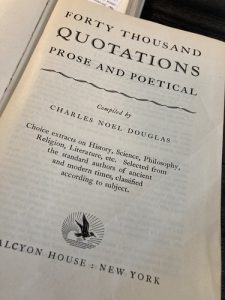
One of my recent acquisitions is this door-stop of a volume, Forty Thousand Quotations Prose and Poetical, published in 1940. Several thoughts spring to mind at this point:
Obviously, this book is 80 years old. Wait, no, that was not obvious to me. I was thinking, “1940… Wow, that’s like 60 years ago,” followed not as quickly as it should have been by, “…no wait, that’s 80 years ago.” So the first thought I’ll share here is that the years pile on like onion-skin pages. Year after year after year after year and before you realize it: Door stop. (Both you have a door stop, and you are a door stop.)
Upon arrival I immediately flipped through it to see what I’d gotten for my $14-plus-shipping. The book says, “prose and poetical,” but I don’t know diddly-squat about this Douglas fellow. There could be forty thousand stinkers better left forgotten. My verdict: The density is low. Perhaps 1 in 4 strike me as even worthy of inclusion in the book. Still, ten thousand quotations prose and poetical are worth 2/10 of one cent each, (in my book.)
It’s said—I’ve heard it said, I’ve said it myself now many times—that our favorite quotations say more about ourselves than of those we’ve quoted.
Is this book a snapshot of 1930’s America? Let this sink in: There’s not a single quote from anyone related in any way to World War II. There isn’t a single modern tech genius in here either. But wait! It was printed in 1940, yes. However the copyrights are 1904, 1914 and 1917. This book is a time machine come to me across more than a century.
I generally give books the page 88 test. That’s laughably near the front of a book which has— (Wait, wat?! This book has exactly 2,000 numbered pages! That’s another tangent I’m not following. Ahem.) Page 88 is laughably near the front of a 2,000 page book. As I carefully flipped towards 88, I was briefly anxious when I thought the entries under “anxiety” might run to page 88, but fortunately, no. The two columns of page 88 cover the tail end of, Apothegm (“a short, pithy and instructive saying or formulation,” honestly, I had to look that up,) then Apparel, and then Apparitions runs onward to page 89.
The first full entry on page 88 is:
A few words worthy to be remembered suffice to give an idea of a great mind. There are single thoughts that contain the essence of a whole volume, single sentences that have the beauties of a large work, a simplicity so finished and so perfect that it equals in merit and in excellence a large and glorious composition.
Now more than ever, opinions divide us. Meanwhile, our ability to effectively communicate has degraded, fueled by social media algorithms and self-selected information silos that confirm our biases, calcify our world views, and consequently drive us even further apart. As a result we suffer—individually and as a collective.
I’ve been cherry-picking episodes of the Rich Roll Podcast, and this is another superlative one. Roll’s discussion—about a half hour in if memory serves—of trying to be a “lighthouse” makes clear an important point about modeling behavior: Be the change you want to see in the world.
Grant and Roll talk a lot about Grant’s new book; That’s a model for a podcast episode which I usually do not like. And they talk almost as much about competitive swimming and diving, which are two more things I’m generally disinterested in. But to my delight, I enjoyed through (contrast with the more usual ‘sat through’) the first half, and currently have the second half awaiting my ears.
In conversation there must be, as in love and in war, some hazarding, some rattling on; nor need twenty falls affect you, so long as you take cheerfulness and good humor for your guides; but careful and measured conversation is always, though perfectly correct, extremely dull and tedious—a vast blunder from first to last.
~ Arthur Martine from, Martine’s Hand-book of Etiquette and Guide to True Politeness
“Kid, anyone can fix it with the right tools. It takes a real mechanic to fix it with a peach basket full of junk,” was the punch-line life-lesson from a story my dad used to tell from his first days in the elevator trade.
I’ve mentioned this book by Martine before. Large parts of it are patently ridiculous. But there are parts of it which are solid.
Anyone can learn something from a well-written book. But it takes a first-rate mind, and a lot of practice, to read through a peach-basket full of assorted crap, find the right parts, and find a lesson or three along the way.