Socrates knew how a rational soul is moved; that it is like a balance, and if a weight is thrown in the scale, it will incline whether you wish it or not. Show the rational governing faculty a contradiction, and it will renounce it; but if you fail to do so, blame yourself rather than the person whom you are unable to convince.
At the mid-point of the path through life, I found myself lost in a wood so dark, the way ahead was blotted out. The keening sound I still make shows how hard it is to say how harsh and bitter that place felt to me —
When one of the company said to him, “convince me that logic is useful,” he said, … Would you like me to demonstrate it to you? Then I must make use of a demonstrative argument? And how will you know, then, whether I am deceiving you with a sophism? And when the man remained silent, he said, … You see how you yourself admit that logic is necessary, since without it you cannot even determine whether it is necessary or not.
Work will happen 24 hours a day, 365 days of the year, if you let it. We are all in that place where we are all letting it for some reason, and I don’t know why.
Characteristics of the rational soul: Self-perception, self-examination, and the power to make of itself whatever it wants. … It surveys the world and the empty space around it, and the way it’s put together. It delves into the endlessness of time to extend its grasp and comprehension of the periodic births and rebirths that the world goes through. It knows that those who came after us will see nothing different, that those who came before us saw no more than we do, and that anyone with forty years behind him and eyes in his head has seen both past and future—both alike.
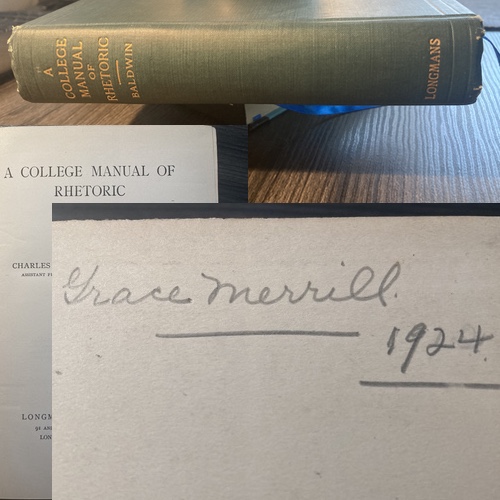
Last weekend, while helping friends pack-house, I found this book:
Wait! Don’t do the math on a book from 1907, and a college student taking Rhetoric in 1924. :)
Instead of packing it, I borrowed the book wondering if this James Sears Baldwin might just be the Baldwin. This is a dry book. But it’s also teaching me a ton about writing. The author hasn’t cracked even the slightest smile in the first 37 pages of this 400+ page tome. But the Baldwin quote I’d love to find within, might just be the sort of pithy thing this author would drop near the end.
Yes, I am willing to read a 400+ page tome on the off chance that I find the quote and get the once-in-a-lifetime thrill of finding an original attribution for a well-known quote. I digress.
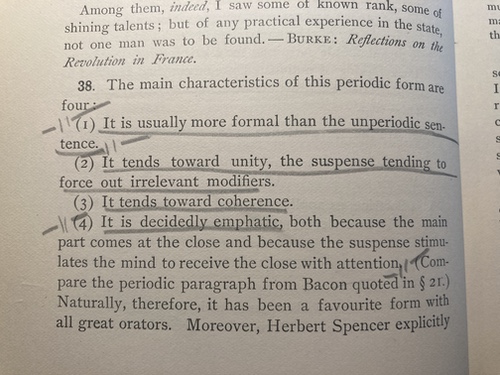
By page 30, I had seen a whole bunch these little diagonal marks, but hadn’t really figured out what she was trying to imply.
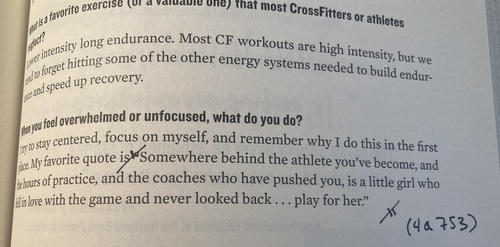
Then it hit me. Quotes! It’s a diagonal line with a quote on the diagonal line. She’s delineating quotations. I’m guessing that she must have written a paper—who’d expect that in a Rhetoric class, right?—and I bet she came back through and marked the quotation sections. At the same instant that I figured it out, my up-to-then habit of drawing a full line across the page, (often a long line, then up or down a line, and then finish going across, to “cut” in the middle of a line,) seemed dumb.
Thank you Miss Merrill. This looks just way cooler:
Find more pleasure in intelligent dissent than in passive agreement, for, if you value intelligence as you should, the former implies a deeper agreement than the latter.
Why all this guesswork? You can see what needs to be done. If you can see the road, follow it. Cheerfully, without turning back. If not, hold up and get the best advice you can. If anything gets in the way, forge on ahead, making good use of what you have on hand, sticking to what seems right. (The best goal to achieve, and the one we fall short of when we fail.)