Recent podcasts

Susanne Mueller published part two of our conversation on, Take it from the Iron Woman and my conversation with Gerdi Verwoert appeared on her, Daring Self-Leadership & The Nature Connection podcast. Episodes of the Podcaster Community’s show continue, recently with Simon Ratcliffe and Hernán Braberman.

ɕ


Recent work

I had a cool conversation with Susanne Mueller for her podcast, Take it from the Ironwoman. She published part one as, Cool to Collaborate for Change in the Chaos of the World. 5 new episodes of the Podcaster Community’s companion show are published, and 2 more for Movers Mindset.

ɕ


Eureka

But this moment cannot come without the days of frustration at the blackboard. “You can’t really blame the storytellers,” Rockmore writes, “It’s not so exciting to read ‘and then she studied some more.’ But this arduous, mundane work is a key part of the process.”

~ Cal Newport from, On the Myth of Big Ideas – Cal Newport

slip:4ucabo31.

And Niels Bohr said something similar about Painful experience. And I bet your experience agrees. I know mine does.

Nobody sees how much time I spend working on podcasting. Every facet is complicated. I’m regularly noticing new things, picking up interesting skills and ideas from nearby areas of expertise. Structural wisdom from the field of authors. Empathic skills from the field of therapists. New kinds of questions from the field of hosts. New vocal skills from the field of speakers. And teachers and mechanics and on and on.

The eureka moments get the attention but they’re very few and very far between.

ɕ


Difficult questions

What would be a good question to ask? How do I evaluate a potential question, in real time during a conversation, to decide if it’s good? What can I do to make this guest enjoy this conversation? In the same vein: What should I do? And what, if anything, must I do? What does this person really want to talk about? What don’t they want to talk about? And if I figured that out, is the right thing to, to honor their desire to avoid it, or to help them face it? Can I help them more by letting them find their own energy level, or by trying to help them change their energy level? Would calming down enable them to communicate more effectively? Would riling them up help them work through their feelings? Should we explore how they are feeling, or how this event we’re discussing made them feel? Should I be more open, and share more with them? Or would my consuming our time doing that, block them from doing what they need to do, or from saying what they need to say? Should we be having more fun? Should we be more serious? Should we instead do the opposite, (make light of a serious subject, or vice versa,) of that society would normally expect? Should I ask them a deep question? Should I ask a question on the same line-of-thought and take us even deeper? Deeper a third time? Or should I pivot to indicate that I want to follow them, not drive them into a corner?

What’s that? …oh, you thought I was going to be talking about the actual questions one might ask another person. Yeah no that’s another question altogether. :)

ɕ


Tetris

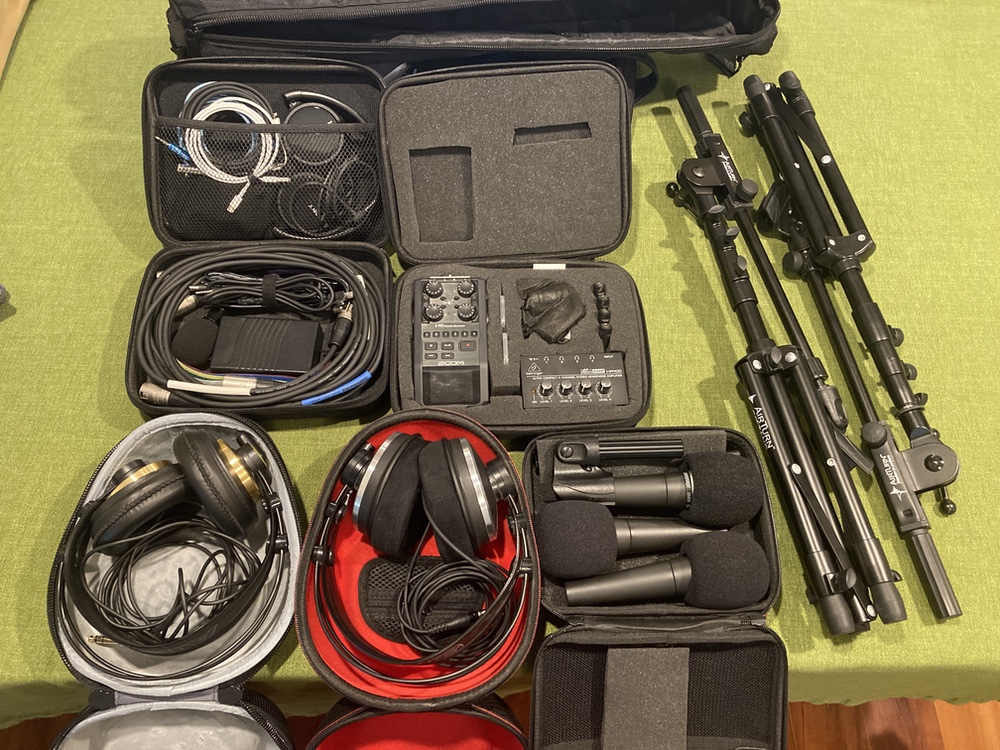
As I mentioned last week, I was recently on a rather long road trip doing some recording for the Movers Mindset project. I took a lot of stuff on the trip, but here’s the two bags which comprised the complete podcast setup—everything I need to press record is in these two bags. The rectangular bag is a proper, no-cheating, most-stingy-airline carry-on size.

And here’s what’s inside: Two full-size (albeit lightweight) mic stands, 2 sets of full-size headphones, and 3 containers of all the podcast recording and listening electronics. (And it’s all battery powered to boot.)

ɕ


New work this week

I’ve been on a road trip this week recording podcasts for Movers Mindset. One thing I wanted to experiment with was trying to record “short” form podcasts for Movers Mindset while on the road. Adrienne Toumayan joined me for a recording titled, Balance.

ɕ


Persistent, but not lonely

To create anything of beauty, daring, and substance that makes the world see itself afresh — be it a revolutionary law of planetary motion or the Starry Night — is the work of lonely persistence against the tides of convention and conformity, often at the cost of the visionary’s aching ostracism from the status quo they are challenging with their vision.

~ Maria Popova from, Coltrane on Creativity, Perseverance Against Rejection, and How Hardship Fuels Art – The Marginalian

slip:4ubajo2.

To be clear, I don’t feel I’m out to make the world see itself afresh. I am out to create better conversations to spread understanding and compassion. And while I understand, now having read a bit more about John Coltrane, how a certain type of genius might need a certain type of loneliness to do their work. That’s not me and my work.

I’m finding that I’m thriving on podcasting. It is a stupid amount of work; Yes, I’ve chosen to set things up, and to set challenges and goals, to create that amount of work. It’s even physically challenging, for example, I’m on a road-trip this week with multiple +4-hour driving days. But I know what I’m in for, and I know what’s going to happen once I press record. Magic. Obviously, a big part of that comes from me, but a critical part of it comes from the other people. I’ve always heard talk of how “creative types” can get lonely. I’ve come around to accepting the label of “creative type.” I recharge in alone time. But I think I thrive when creating in concert with others.

ɕ


What if I just did the thing a bunch more times?

7. Consistent and repeatable results come from a process. “True style does not come from a conscious effort to create a particular look. It results obliquely—even accidentally—out of a holistic process.”

~ Shane Parrish from, 7 Things I Learned in Architecture School

slip:4ufoti1.

That articlette is about a book, 101 Things Things I Learned in Architecture School. The 7th point, in bold, is the penultimate of a best-of-the-best selection from the book. The inner-quoted part is Matthew Frederick, the book’s author.

This point about a holistic process—the idea that mastery isn’t some higgledy-piggledy mish-mash of throwing things together—is an idea I’ve held dearly for a long time. Every time I see it, like in this articlette, I want leap up, flipping my desk over and scream, “Hear! Hear! …and again, louder, for those in the back staring at their handheld devices.”

Every single time that I’ve decided to take a process, and repeat it in search of understanding, (for example, my 10,000 rep’s project,) the learning and personal growth has paid off beyond my wildest dreams. At this point, I’ve done nearly 200 recorded conversations—I’m not stretching the truth, it’s actually hard to figure out exactly how many I’ve done. I’ve started another show recently as part of the Podcaster Community (25+ episodes and counting) and I’ve set up all the moving parts for yet another show as part of Movers Mindset “shorts”. And I keep wondering…

What would happen if I did 500, 1000? …what about 10,000? Not because I want to be famous and whine, “but I did 1,000 episodes why doesn’t anyone love me?!” But because I can see, in myself, how much I’ve learned and grown after 200. What would happen if I did a lot more?

ɕ


This might get personal

these nine principles for interviewing people about tender, personal, tough subjects are tactics that are helpful in any hard conversation. You want to be clear about your objectives for the conversation, to be prepared to listen closely and actively, to prepare the person you are talking to for a different, deeper sort of exchange. You need to respect the dignity of the person you’re talking with, and respect yourself enough to speak up when you disagree.

~ Anna Sale from, Treat an Interview Like a Relationship – Transom

Whether or not you’re doing recorded conversations with guests, there’s a bunch of great advice in that article. I’m particularly drawn to Sale’s point about how her interviews are enabled by the fact that she is creating a relationship with the guest. In any conversation, everything we do either builds up, or tears down, a relationship bit by bit.

In any conversation, it’s my experience that the more intentional I am, the better it goes. Part of that is intentional listening; listening primarily to understand. Another part is being mindful of the other person; deploying empathy and compassion. Another part is keeping sight of where you are headed, and also where it is not possible to get to; knowing what to stretch for and what to let pass is critical.

ɕ


Community for podcasters

So I went and built a new thing: The Podcaster Community.

If you create podcasts — whether you’re thinking about it, just starting out, or are publishing your 100th episode — we’d love for you to join us. It’s free to create an account. Logging in enables the platform features and you can immediately begin posting/replying in the public categories.

I don’t idle well. I get an idea in my head, and I start thinking about all the ways it could be realized. Recently, I’ve had a few separate conversations with podcasters who were looking for something—what they each wanted was different. And so I set off to build it.

ɕ