I learned then that even when I felt powerless to control my job or education — or anything else that seemed out of my hands — I always had control over my own mind and how I treated others. Even when I had nothing else, I could still be kind, just, generous, honest, loving and compassionate.
~ Susan Fowler
Elsewhere, this is 4a1138. — slipbox
I find that I’ve often committed myself to an unmanageable number of responsibilities. There are so many things I have the personal power to do, that I seem to be compelled to constantly deploy my power. Worse, I feel guilty if I’m not constantly applying my power towards some goal. I end up with a forest of goals and a feeling of being trapped. Shortly after feeling trapped, I find myself sinking into the pits of dispair on the shore of the lake of learned helplessness.
One habit I’ve built to try to keep myself entirely away from that lake is a collection of daily reminders. Ever the process maniac, I have them in my personal task management system in a rotation that brings one up each day. There are enough of them that even though they are in a fixed order I never know which is next. Each feels like a fresh reminder. They are collected from Ben Franklin, Leo Babauta and some other places I’ve neglected to keep track of.
They are:
- AM I AN ENERGY-GIVER OR -TAKER? — Strive to lift others up; to leave them feeling better than before the encounter. While being mindful of my own energy level, seek ways to create a zest for life in others.
- BECOME MINDFUL OF ATTACHMENTS THAT LEAD TO CLUTTER AND COMPLEXITY — For example, if you are attached to sentimental items, you won’t be able to let go of clutter. If you are attached to living a certain way, you will not be able to let go of a lot of stuff. If you are attached to doing a lot of activities and messaging everyone, your life will be complex.
- TEMPERANCE — Eat not to dullness; drink not to elevation.
- BE PROACTIVE — While the word proactivity is now fairly common in management literature, it is a word you won’t find in most dictionaries. It means more than meerly taking initiative. It means that as human beings, we are responsible for our own lives. Our behavior is a function of our decisions, not our conditions. We can subordinate feelings to values. We have the initiative and the responsibility to make things happen. (Habit 1)
- AM I LIKELY TO “ACT” OR “REACT” TO A TASK? — Seek the reason for the task so that it may motivate me to proper action. Otherwise, determine how to eliminate or avoid the task entirely. Do or do not; there is no try.
- SILENCE — Speak not but what may benefit others or yourself; avoid trifling conversation.
- WHAT AM I DOING WHILE ON “THE BENCH?” — If there is somewhere I want to be, begin walking. Identify something which I can do now, or very soon, which is interesting. Remember that efficacy is active, not passive.
- BEGIN WITH THE END IN MIND — Each part of your life can be examined in the context of the whole, of what really matters most to you. By keeping that end clearly in mind you can make certain that whatever you do on any particular day does not violate the criteria you have defined as supremely important, and that each day of your life contributes in a meaningful way to the vision you have to your life as a whole. (Habit 2)
- DISTRACTION, BUSYNESS AND CONSTANT SWITCHING ARE MENTAL HABITS — We don’t need any of these habits, but they build up over the years because they comfort us. We can live more simply by letting go of these mental habits. What would life be like without constant switching, distraction and busyness?
- ORDER — Let all your things have their places; let each part of your business have its time.
- WHAT CAN I DO TO BE SO GOOD THEY CAN’T IGNORE ME? — Continuous improvement? A “big swing?” A simple but insightful solution? The path to “the best” is not obvious and likely does not directly through the most-obvious next thing.
- PUT FIRST THINGS FIRST — The degree to which we have developed our independent will in our everyday lives is measured by our personal integrity. Integrity is, fundamentally, the value we place on ourselves. It’s our ability to take and keep commitments to ourselves, to “walk our talk.” It’s honor with self, a fundamental part of the Character Ethic, the essence of proactive growth. (Habit 3)
- AM I AUTHENTIC OR OBSEQUIOUS? — Discerning the difference between obsequiousness and politeness can be difficult, but courtesy should be rooted in benevolence. Politeness should be the expression of a benevolent regard for the feelings of others; it’s a poor virtue if it’s motivated only by a fear of offending good taste. In its highest form Politeness approaches love.
- SINGLE-TASK BY PUTTING YOUR LIFE IN FULL-SCREEN MODE — Imagine that everything you do — a work task, answering an email or message, washing a dish, reading an article — goes into full-screen mode, so that you don’t do or look at anything else. You just inhabit that task fully, and are fully present as you do it. What would your life be like? In my experience, it’s much less stressful when you work and live this way. Things get your full attention, and you do them much better. And you can even savor them.
- RESOLUTION — Resolve to perform what you ought; perform without fail what you resolve.
- THINK WIN/WIN — Most people tend to think in terms of dichotomies: strong or weak, hardball or softball, win or lose. But that kind of thinking is fundamentally flawed. It’s based on power and position rather than on principle. Win/Win is based on the paradigm that there is plenty for everybody, that one person’s success is not achieved at the expense or exclusion of the success of others. (Habit 4)
- HOW DO I TREAT SOMEONE I DON’T KNOW? — Your character shows in how you treat those who can do nothing for you.
- FRUGALITY — Make no expense but to do good to others or yourself; i.e., waste nothing.
- SEEK FIRST TO UNDERSTAND, THEN TO BE UNDERSTOOD — You’ve spent years learning how to read and write, years learning how to speak. But what about listening? What training or education have you had that enables you to listen so that you really, deeply understand another human being from that individual’s own frame of reference? (Habit 5)
- CREATE SPACE BETWEEN THINGS — Add padding to everything. Do half of what you imagine you can do. We tend to cram as much as possible into our days. And this becomes stressful, because we always underestimate how long things will take, and we forget about maintenance tasks like putting on clothes and brushing teeth and preparing meals. We never feel like we have enough time because we try to do too much. But what would it be like if we did less? What would it be like if we padded how long things took, so that we have the space to actually do them well, with full attention? What would it be like if we took a few minutes’ pause between tasks, to savor the accomplishment of the last task, to savor the space between things, to savor being alive?
- INDUSTRY — Lose no time; be always employ’d in something useful; cut off all unnecessary actions.
- SYNERGIZE — What is synergy? Simply defined, it means that the whole is greater than the sum of its parts. It means that the relationship which the parts have to each other is a part in and of itself. It is not only a part, but the most catalytic, the most empowering, the most unifying, and the most exciting part. (Habit 6)
- IS THERE AN ELEMENT OF STRUGGLE IN MY HISTORY? — This reminds me to be kind for everyone I meet is working through their own struggle. Through the experience of my own struggle I can better understand and emphathize with others on similar journeys. Furthermore, being reminded of my past struggles suggests perspective on my day-to-day general lack of struggle.
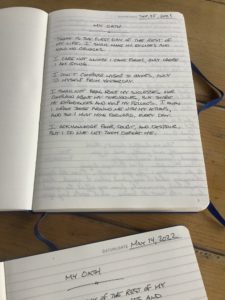
- MY OATH — Today is the first day of the rest of my life. I shall make no excuses and hold no grudges. I care not where I came from, only where I am going. I don’t compare myself to others, only to myself from yesterday. I shall not brag about successes nor complain about my struggles, but share my experiences and help my fellows. I know I impact those around me with my actions, and so I must move forward, every day. I acknowledge fear, doubt, and despair, but I do not let them defeat me.
- SINCERITY — Use no hurtful deceit; think innocently and justly, and, if you speak, speak accordingly.
- SHARPEN THE SAW — It’s preserving and enhancing the greatest asset you have–you. It’s renewing the four dimensions of your nature: physical, spiritual, mental, and social/emotional. … “Sharpen the saw” basically means expressing all four motivations. It means exercising all four dimensions of our nature, regularly and consistently in wise and balanced ways. (Habit 7)
- WHAT HAVE I BEEN READING? — I’ve performed this experiment countless times: Read little: nothing happens. Read more: ideas, new connections, inspiration, questions, motivation, short-cuts, wonder.
- JUSTICE — Wrong none by doing injuries, or omitting the benefits that are your duty.
- FIND JOY IN A FEW SIMPLE THINGS — For me, those include writing, reading/learning, walking and doing other active things, eating simple food, meditating, spending quality time with people I care about. Most of that doesn’t cost anything or require any possessions (especially if you use the library for books!). I’m not saying I have zero possessions, nor that I only do these few things. But to the extent that I remember the simple things I love doing, my life suddenly becomes simpler. When I remember, I can let go of everything else my mind has fixated on, and just find the simple joy of doing simple activities.
- MODERATION — Avoid extremes; forbear resenting injuries so much as you think they deserve.
- WOULD I WANT TO GO ON A LONG CAR RIDE WITH ME? — Long car rides are a quintessential American experience. Along with the good however, comes the opportunity for bad. With others present the confined space, lack of privacy, and monotony of rolling vistas create a microcosm of life on a tiny stage. How I share that stage with the others in the car, and what specifically I do while on that stage tells all.
- GET CLEAR ABOUT WHAT YOU WANT, AND SAY NO TO MORE THINGS — We are rarely very clear on what we want. What if we became crystal clear on what we wanted in life? If we knew what we wanted to create, how we wanted to live … we could say yes to these things, and no to everything else. Saying no to more things would simplify our lives.
- CLEANLINESS — Tolerate no uncleanliness in body, clothes, or habitation.
- AM I SELF-AWARE? — The first step in my journey was realizing I was unhappy. This realization — detecting it, understanding it, believing it, surrendering to it, and finally owning it — was the first piece of bedrock on which I started building.
- TRANQUILLITY — Be not disturbed at trifles, or at accidents common or unavoidable.
- PRACTICE DOING NOTHING, EXQUISITELY — No need to plan, no need to read, no need to watch something, no need to do a chore or eat while you do nothing. You will start to notice your brain’s habit of wanting to get something done. This exposes our mental habits, which is a good thing. Keep doing nothing. Sit for awhile, resisting the urge to do something. After some practice, you can get good at doing nothing, and this leads to the mental habit of contentment and gratitude.
- CHASTITY — Rarely use venery but for health or offspring, never to dullness, weakness, or the injury of your own or another’s peace or reputation.
- WHAT IS MY TALK-TO-LISTEN RATIO? — It’s better to listen to understand, rather than to, (for example,) listen to refute. Silence is fine provided one’s own thoughts are pleasant company. When speaking, think first about why you are about to say whatever it is you’re about to say.
- WE CREATE OUR OWN STRUGGLES — All the stress, all the frustrations and disappointments, all the busyness and rushing … we create these with attachments in our heads. By letting go, we can relax and live more simply.
- HUMILITY — Imitate Socrates.
- FESTINA LENTE — Make haste, slowly. Or, unrestrained moderation. “The worker must be stronger than his project; loads larger than the bearer must necessarily crush him. Certain careers, moreover, are not so demanding in themselves as they are prolific in begetting a mass of other activities. Enterprises which give rise to new and multifarious activities should be avoided; you must not commit yourself to a task from which there is no free egress. Put your hand to one you can finish or at least hope to finish; leave alone those that expand as you work at them and do not stop where you intended they should.” ~ Seneca, On Tranquility [7]
- LOOK BACK — Look back at some of the things you’ve accomplished or experienced and think: Well if that isn’t nice, I don’t know what is.
“One never notices what has been done; One can only see what remains to be done.” ~ Marie Curie (4a585)
ɕ
Elsewhere, this is 4b1 et al. — slipbox
Oct 2019: Added the seven habits of highly effective people from Stephen Covey’s book.
Jul 2020: Added, “what am I doing while on ‘the bench’?” and “what can I do to be so good they can’t ignore me?“
Oct 2020: Added, “festina lente“
Dec 2020: Added, “look back“
Jan 2021: Expanded this into a series of posts, Practicing Reflection.
Mar 2023: An updated list of the prompts is now posted at My Daily Reflection Prompts.