We'll just put a building over it later

We’ll just put a building over it later →

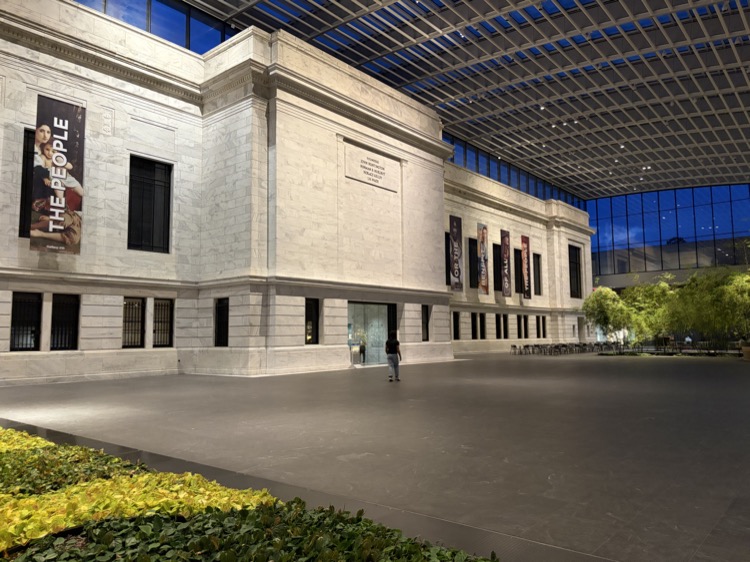
I simply like the way this looks. *snaps photo*

I was standing there imagining the original architects trying to figure out how big to make the museum. I’m sure the size of the grounds, budget, and probably even an existing collection that would go in the museum were all considered. The result of all that discussion was this classically American experience of a museum from that era.

I’m sure that at no point did anyone on the architecture team say: This size is good. If they need more room in one hundred years, they’ll just put a larger building over it and expand.

ɕ


Immersive →

You stand back and in a way, the reason it’s interesting is because it stands out, it doesn’t fit in, it doesn’t look like anything you’ve seen. But this is not really my position — generally. There might be moments where such a performance is necessary but we like to find a stronger relationship between the familiar and the unfamiliar. My feeling is that when a building is too self-referential, the audience is distanced; architecture becomes something that you look at. [Like in a cathedral or a monument?] Right, it’s a spectacle — whereas I think for 99% of the time, architecture is something that you should be inside and absorbed by. It’s something which convinces you by experience more than impresses you by image.

~ David Chipperfield, from David Chipperfield – The Talks

I think that tension exists in any creative endeavor. Perhaps, the existence of that tension is what defines something as being creative?

ɕ


Architecture →

Nature and artificial, entirety and piece, universality and uniqueness, the past and the present. Architects are tormented by the constant conflict of these dualistic propositions! The deeper and more intense the tension is, the more dynamic the creation becomes. That is why architects must continue thinking.

~ Tadao Ando, from Tadao Ando – The Talks

Elsewhere, this is 4uteie30. — slipbox

Of course, not just architects must continue thinking. I find so much more value within things (for example, a conversation) when I hold up pairs of opposites as Ando suggests. Each pair suggests a dimension for consideration, and it’s easier than just staring into the original thing looking for the interesting parts.

ɕ


Organic →

The project started with the intent to regenerate a forgotten piece of land in a dense Coburg pocket. Felicity and her husband, architect Marc Bernstein, purchased the awkwardly shaped 250 square metre block to make it happen, but council deemed the land ‘undevelopable’, and banks were unwilling to approve finances.

~ Amelia Barnes from, An Ultra-Sustainable Home On An ‘Undevelopable’ Melbourne Site

Elsewhere, this is 4uteai1. — slipbox

To be clear: The property is 250 square-meters, or ~1,700 square-feet. Get to a large computer screen. Get your beverage of choice. Then, click through and get lost on that site.

Meanwhile, the thing that struck me was the undulating ground cover outside the master bedroom. It’s good (but not particularly original) to use something that doesn’t require a lot of water (as opposed to turf grasses)—but to shape the ground into something interesting struck me as whimsical. If I don’t have to mow it, then it doesn’t need to be flat. I wonder where else, in the design of my own environment, am I stuck in my thinking.

ɕ


Edinburgh castle →


Frank Lloyd Wright’s Chapel of the Holy Cross →

ɕ


Wow →

Awesome!

ɕ