All cruelty springs from weakness.
~ Seneca
Elsewhere, this is 4a118. — slipbox
Presence, not pursuit.
65 posts, oldest first
The largest portion of life passes while we are doing ill, a good share while we are doing nothing, and the whole while we are doing that which is not to the purpose. What man can you show me who places any value on his time, who reckons the worth of each day, who understands that he is dying daily? For we are mistaken when we look forward to death; The major portion of death is already passed. Whatever years be behind us are in death’s hands.
~ Seneca
Elsewhere, this is 4a191. — slipbox
Nevertheless I shall brave this danger and be bold enough to show [Marcellinus] his faults. He will act in his usual way; he will have recourse to his wit, – the wit that can call forth smiles even from mourners. He will turn the jest, first against himself, and then against me. He will forestall every word which I am about to utter.
~ Seneca, from Letters From A Stoic: Letter 29
Elsewhere, this is 4ulele2. — slipbox
Many of Seneca’s letters are pretty obtuse after all this time. But this one… this one jumped out at me as being really apropos of modern life. And, uh, painfully on point for myself.
ɕ
For remembering makes everything “just now,” doesn’t it? Just now I was a boy, sitting in the house of Sotion the philosopher; Just now I began to argue cases; Just now I stopped wanting to argue them; Just now I ceased to be able. The rapidity of time is boundless—and is more evident when one looks back. For though it goes at breakneck speed, it glides by so smoothly that those who are intent on the present moment fail to notice it passing.
~ Seneca
Elsewhere, this is 4a837. — slipbox
You may be sure that this refractory nature, which demands much toil, has been implanted in us. There are obstacles in our path; so let us fight, and call to our assistance some helpers. “Whom,” you say, “shall I call upon? Shall it be this man or that?” There is another choice also open to you; you may go to the ancients; for they have the time to help you. We can get assistance not only from the living, but from those of the past. Let us choose, however, from among the living, not men who pour forth their words with the greatest glibness, turning out commonplaces and holding. as it were, their own little private exhibitions, – not these, I say, but men who teach us by their lives, men who tell us what we ought to do and then prove it by practice, who show us what we should avoid, and then are never caught doing that which they have ordered us to avoid.
~ Seneca from, Letter 52: On Choosing Our Teachers
Elsewhere, this is 4ulele1. — slipbox
ɕ
Relax the straitened limits of the time which is allotted me. Show me that the good in life does not depend upon life’s length, but upon the use we make of it; also, that it is possible, or rather usual, for a man who has lived long to have lived too little. Say to me when I lie down to sleep: “You may not wake again!” And when I have waked: “You may not go to sleep again!” Say to me when I go forth from my house: “You may not return!” And when I return: “You may never go forth again!” You are mistaken if you think that only on an ocean voyage there is a very slight space between life and death. No, the distance between is just as narrow everywhere. It is not everywhere that death shows himself so near at hand; yet everywhere he is as near at hand.
~ Seneca
Elsewhere, this is 4a891. — slipbox
Putting things off is the biggest waste of life: It snatches away each day as it comes, and denies us the present by promising the future. The greatest obstacle to living is expectancy, which hangs upon tomorrow and loses today. You are arranging what lies in Fortune’s control, and abandoning what lies in yours. What are you looking at? To what goal are you straining? The whole future lies in uncertainty: Live immediately.
~ Seneca
Elsewhere, this is 4a268. — slipbox
Your clear conscience gives reason to be confident; still, since many external factors have a bearing on the outcome, hope for the best but prepare yourself for the worst. Remember above all to get rid of the commotion. Observe what each thing has inside, and you will learn: there is nothing to fear in your affairs but fear itself.
~ Seneca from, Seneca to Lucilius
Elsewhere, this is 4uwose1. — slipbox
What — exactly, specifically — is under your control?
ɕ
Lectures and learned seminars and sayings culled from the teachings of philosophers and educated conversation do not reveal the mind’s real strength. For speech is bold even where the speaker is timorous. What you have achieved will be revealed only when you breathe your last.
~ Seneca
Elsewhere, this is 4a173. — slipbox
I am unafraid as I prepare myself for that day when the artifices and disguises will be stripped away and I shall make judgment of myself. Is it just brave talk, or do I mean what I say? Were they for real, those defiant words I spoke against fortune, or were they just theatre – Just acting a part?
~ Seneca
Elsewhere, this is 4a111. — slipbox
Our soul is sometimes a king, and sometimes a tyrant. A king, by attending to what is honorable, protects the good health of the body in its care, and gives it no base or sordid command. But an uncontrolled, desire-fueled, over-indulged soul is turned from a king into that most feared and detested thing — a tyrant.
~ Seneca
Elsewhere, this is 4a271. — slipbox
I don’t agree with those who plunge headlong into the middle of the flood and who, accepting a turbulent life, struggle daily in great spirit with difficult circumstances. The wise person will endure that, but won’t choose it—choosing to be at peace, rather than at war.
~ Seneca
This is about choice, not about ability.
I am able to rush around accepting challenges, to fix things which are broken, to help people who seem in need, to build neat things out of bits of technology, to arrange little social events with friends or family rarely seen, to seek out new experiences, to try to do all the things…
But I’m slowly learning to choose not to. I’m slowly learning to choose peace.
ɕ
I can say the same of a good man whom no difficult conjuncture has afforded an occasion for displaying the force of his mind. “I account you unfortunate because you have never been unfortunate. You have passed through life without an adversary; no one can know your potentiality, not even you.” For self-knowledge, testing is necessary; no on can discover what he can do except by trying.
~ Seneca
Elsewhere, this is 4a437. — slipbox
Without an antagonist prowess fades away. its true proportions and capacities come to light only when action proves its endurance. You must know that good men should behave similarly; they must not shrink from hardship and difficulty or complain of fate; they should take whatever befalls in good part and turn it to advantage. The thing that matters is not what you bear but how you bear it.
~ Seneca
Elsewhere, this is 4a440. — slipbox
So it is: The life we receive is not short but we make it so; we are not ill provided but use what we have wastefully. Kingly riches are dissipated in an instant if they fall into the hands of a bad master, but even moderate wealth increases with use in the hands of a careful steward; just so does our life provide ample scope if it is well managed.
~ Seneca
Elsewhere, this is 4a428. — slipbox
All excesses are injurious, but immoderate prosperity is the most dangerous of all. It affects the brain, it conjures empty fantasies up in the mind, and it befogs the distinction between true and false with a confusing cloud. Is it not better to endure everlasting misfortune, with virtue’s help, than to burst with endless and immoderate prosperity? Death by starvation comes gently, gluttony makes men explode.
~ Seneca
Elsewhere, this is 4a431. — slipbox
Do not, I beseech you, dread the things which the immortal gods apply to our souls like goads; disaster is virtue’s opportunity. Those whom an excess of prosperity has rendered sluggish may justly be called unfortunate; a dead calm holds them fast, as it were, on a motionless sea. And whatever befalls them comes as a surprise. Cruelty presses hardest on the inexperienced; the neck chafes at the yoke.
~ Seneca
Elsewhere, this is 4a434. — slipbox
Wild animals run from the dangers they actually see, and once they escape them worry no more. We however are tormented alike by what is past and what is to come. A number of our blessings do us harm, for memory brings back the agony of fear while foresight brings it on prematurely. No one confines his unhappiness to the present.
~ Seneca
Elsewhere, this is 4a105. — slipbox
You live as if you would live forever; the thought of human frailty never enters your head, you never notice how much of your time is already spent. You squander it as though your store were full to overflowing, when in fact the very day of which you make a present to someone or something may be your last. Like the mortal you are, you are apprehensive of everything; but your desires are unlimited as if you were immortal.
~ Seneca
Elsewhere, this is 4a425. — slipbox
True happiness is to enjoy the present without anxious dependence upon the future, not to amuse ourselves with either hopes or fears but to rest satisfied, for he that is wants nothing. The greatest blessings of mankind are within us and within our reach. A wise man is content with his lot, whatever it may be, without wishing for what he has not.
~ Seneca
Elsewhere, this is 4a48. — slipbox
[T]he dedications of philosophy are impregnable; age cannot erase their memory or diminish their force. Each succeeding generation will hold them in even higher reverence; what is close at hand is subject to envy, whereas the distant we can admire without prejudice. The philosopher’s life is therefore spacious; he is not hemmed in and constricted like others. He alone is exempt from the limitations of humanity; all ages are at his service as at a god’s. Has time gone by? He holds it fast in recollection. Is time now present? He utilizes it. Is it still to come? He anticipates it. The amalgamation of all time into one makes his life long.
~ Seneca
Elsewhere, this is 4a394. — slipbox
Would you think a man had traveled a long voyage if he had been caught in a savage gale immediately on leaving port and had been buffeted to and fro by alternate blasts from opposite directions so that he was running circles in the same spot? That man has had not a long voyage but a long floundering.
~ Seneca
Elsewhere, this is 4a422. — slipbox
Of all people only those are at leisure who make time for philosophy, only they truly live. Not satisfied to merely keep good watch over their own days, they annex every age to their own. All the harvest of the past is added to their store. Only an ingrate would fail to see that these great architects of venerable thoughts were born for us and have designed a way of life for us.
~ Seneca
Elsewhere, this is 4a382. — slipbox
That quote opens Holiday’s, The Daily Stoic, which I have been circling through for a few years. Fortunately, I didn’t try to study Philosophy too early in life; it took me a couple decades once I started trying to improve myself for me to be ready to really listen. I hope you are far ahead of me.
In recent months I’ve been spending more time reading. The more I read, the more quotes I find to share, and the quote backlog is currently at level, “ridiculous.” I was scheduling quotes for publication in December of 2022 and finally decided I better schedule them more frequently. I have so many quotes that earlier this year I kicked off a podcast with daily quotes; search for “Little Box of Quotes” wherever you listen to podcasts.
ɕ
But the man who puts all of his time to his own uses, who plans every day as if it were his last, is neither impatient for the morrow nor afraid of it. Is there some new kind of pleasure that an hour might bring? All are familiar, all have been experienced to the full the rest Lady Fortune may dispose of as she will; his life is now impregnable.
~ Seneca
Elsewhere, this is 4a414. — slipbox
They are always preoccupied with work so that they may be in position to live better; they spend life in making provision for life. Their plans are designed for the future, but procrastination is the greatest waste of life. It robs us of each day as it comes, and extorts the present from us on promises of the future. Expectancy is the greatest impediment to living: In anticipation of tomorrow it loses today.
~ Seneca
Elsewhere, this is 4a416. — slipbox
Over a billion people currently use Facebook — many at the cost of anxiety, lost honor, personal freedom, and certainly time. If asked why, however, many would reply, “why not?” The service is free, conventional wisdom tells us, so no matter how minor the benefits (which tend to orbit around a generalized fear of missing out), they’re still more substantial than the cost. But as Seneca points out, this assessment is misguided because it ignores the human toll of social media.
~ Cal Newport, from Seneca on Social Media – Cal Newport
Elsewhere, this is 4ucabo33. — slipbox
I generally try to suppress my urge to pounce on opportunities to talk about the well-known downsides of social networks. But a Seneca-CalNewport two-for-one is simply irrestible catnip for me. Here, Newport is referring to the value of one’s own time. That’s the human “toll” that so many people—as far as I can see at least—don’t factor in.
I think I am ready to give up fighting the fight; I’m done [or at least, I really should get a grip, and learn to be done] beating the drum about the evils of social networks. Know what I’m going to do instead? Double-down on creating things on the open web and let people decide what they want to do.
ɕ
If men could see their future years numbered as precisely as their past, what a flutter there would be among those who saw that their remaining years were few, how sparing of them would they be! With a fixed amount, however small, it is easy to economize; but when you cannot know when what you have will be gone you must husband your store very carefully.
~ Seneca
Elsewhere, this is 4a409. — slipbox
They take no notice of it because it has no substance and is not a visible entity, and therefore it is reckoned very cheap, or rather completely valueless. Annuities and bonuses men are very glad to receive, and hire their labor and effort and industry out to obtain them. But upon time no value is set; men use it as carelessly as if it came gratis.
~ Seneca
Elsewhere, this is 4a419. — slipbox
The days of our present come one by one, and each day minute by minute; but all the days of the past will appear at your bidding and allow you to examine them and linger over them at your will. Busy men have no time for this. Excursions into all the parts of its past are the privilege of a serene and untroubled mind; but the minds of the preoccupied cannot turn or look back, as if constricted by a yoke. And so their life vanishes into an abyss.
~ Seneca
Elsewhere, this is 4a400. — slipbox
The worker must be stronger than his project; loads larger than the bearer must necessarily crush him. Certain careers, moreover, are not so demanding in themselves as they are prolific in begetting a mass of other activities. Enterprises which give rise to new and multifarious activities should be avoided; you must not commit yourself to a task from which there is no free egress. Put your hand to one you can finish or at least hope to finish; leave alone those that expand as you work at them and do not stop where you intended they should.
~ Seneca
Elsewhere, this is 4a370. — slipbox
But life is ample, of course, for men who keep themselves detached from involvement. None of their time is transferred to others, none is frittered away in this diretion and that, none is committed to Fortune, none perishes of neglect, none is squandered in lavishness, none is idle: All of it, so to speak, produces income. A very little is therefore amply sufficient, and hence, when his last day comes, the philosopher goes to meet his death with a steady step.
~ Seneca
Elsewhere, this is 4a412. — slipbox
Let me tell you, then, how you must think of me. I am as happy and lively as in my best days. Indeed, these days are my best, for my mind is now free of preoccupations and has leisure for its own concerns; now it amuses itself with lighter studies and now, pressing keenly after truth, it rises to the contemplation of its own nature and the nature of the universe. First it investigates the continents and their position, then the laws which govern the sea which surrounds them with its alternate ebb and flow, and then it examines the stretch which lies between heaven and earth and teems with such tumultuous and terrifying phenomena as thunder and lightning and gales and the precipitation of rain and snow and hail. Finally, when it has traversed the lower reaches, it bursts through to the realms above where it enjoys the fairest spectacle of things divine and, mindful of its eternity, moves freely among all that was and all that will be world without end.
~ Seneca, from Consolation of Helvia (20)
This type and period of writing is referred to as “silver point.” It’s highly polished, almost performance art in itself. Some pieces of silver point—including in my opinion swaths of Seneca’s writing—are tortuous to the language. (As I understand it, tortuous in the original as well as the English.)
What I’ve quoted is the ending of his letter. 2,000 years later, sounds to me like the human experience remains identical.
ɕ
Don’t expect, then, that you can sample the masterpieces of great minds by way of summaries; you must examine the whole, work over the whole. Their structure is a totality fitted together according to the outlines of their special genius, and if any member is removed the whole may collapse.
…
That is why we give boys apothegms, what the Greeks call chriai, to learn by heart, because the childish mind, which cannot comprehend more, is able to grasp them. But for a man advanced in study to hunt such gem is disgraceful; he is using a handful of clichés for a prop and leaning on his memory; by now he should stand on his own feet. He should be producing bons mots, not remembering them. It is disgraceful for an old man or one in sight of old age to be wise by book. “Zeno said this.” What do you say? “This Cleanthes said.” What do you say? How long will you be a subaltern? Take command and say things which will be handed down to posterity. Produce something of your own. All those men who never create but lurk as interpreters under the shadow of another are lacking, I believe, in independence of spirit. They never venture to do the things they have long rehearsed. They exercise their memories on what is not their own. But to remember is one thing, to know another. Remembering is merely overseeing a thing deposited in the memory; knowing is making the thing your own, not depending on the model, not always looking over your shoulder at the teacher. “Zeno said this, Cleanthes that”—is there any difference between you and a book? How long will you learn? Begin to teach! One man objects, “Why should I listen to lectures when I can read?” Another replies, “The living voice adds a great deal.” It does indeed, but not a voice which merely serves for another’s words and functions as a clerk.
There is another consideration. First people who have not rid themselves of leading-strings follow their predecessors where all the world has ceased to follow them, and second, they follow them in matters still under investigation. But if we rest content with solutions offered, the real solution will never be found. Moreover, a man who follows another not only finds nothing, he is not even looking. What is the upshot? Shall I not walk in the steps of my predecessors? I shall indeed use the old path, but if I find a shorter and easier way I shall make a new path. The men who made the old paths are not our suzerains but our pioneers. Truth is open to all; it has not been pre-empted. Much of it is left for future generations.
~ Seneca, from Letter 33, Maxims
This is Seneca at his mic-drop best. (Unlike the borderline torturous silver point style you also see quoted from on occasion.) Here he’s writing a personal letter to one of his long-time students.
If it’s made you perk up, I recommend digging into this letter further by reading, On the Futility of Learning Maxims, overs on the Stoic Letters web site. That’s also a great introduction to the nuance of translating these very old works; there are significant differences between M. Hadas’s translation circa 1958 and whatever translation Stoic Letters is using, (I looked, but it’s not clear to me.)
Obviously the thread I’m tugging on here is meta: It’s one thing to nod along in the audience of a performance— “yes yes yes I agree I’m doing that yes.” It’s quite another to stand up, and ask to speak next. It was about 10 years ago that I began this blog, and about 5 years ago that I began seriously devoting intentional effort to creating something here.
¯\_(ツ)_/¯
I’m not sure that I’m setting much of an example. But trying to walk-the-walk has definitely helped me.
In the spirit of the season: Go read this next, What do you do for fun?
ɕ
PERSPECTIVE — “In the meanwhile, while they are robbing and being robbed, while they disrupt each other’s repose and make one another miserable, life remains without profit, without pleasure, without moral improvement. No one keeps death in view, everyone focuses on remote hopes. Some even make posthumous provisions—massive sepulchures, dedications of public buildings, gladiatorial shows, and pretentious obsequies. But the funerals of such people should be conducted by torch and taper light, as though they had in fact died in childhood.” ~ Seneca, On the Shortness of Life
2 minutes: Pause life. Read. Think. Resume life.
ɕ
Arrived in the middle? Visit the first post, Where to begin?
(The entire series is available to download as a PDF ebook.)
HONESTY — “I am unafraid as I prepare myself for that day when the artifices and disguises will be stripped away and I shall make judgement of myself. Is it just brave talk, or do I mean what I say? Were they for real, those defiant words I spoke against fortune, or were they just theatre—just acting a part?” ~ Seneca
You’ve put a lot of effort so far into practicing reflection. It’s important that we don’t lose the trees for the forest. The focus of daily reflection is the tree; the forest will take care of itself.
ɕ
Arrived in the middle? Visit the first post, Where to begin?
(The entire series is available to download as a PDF ebook.)
FESTINA LENTE — Make haste, slowly. Or, unrestrained moderation. — “The worker must be stronger than his project; loads larger than the bearer must necessarily crush him. Certain careers, moreover, are not so demanding in themselves as they are prolific in begetting a mass of other activities. Enterprises which give rise to new and multifarious activities should be avoided; you must not commit yourself to a task from which there is no free egress. Put your hand to one you can finish or at least hope to finish; leave alone those that expand as you work at them and do not stop where you intended they should.” ~ Seneca, On Tranquility
Last week we began looking beyond this small, introductory journey and talking about ways you could continue on your own.
ɕ
For even peace itself will supply more reason for worry. Not even safe circumstances will bring you confidence once your mind has been shocked—once it gets in the habit of blind panic, it can’t provide for its own safety. For it doesn’t really avoid danger, it just runs away. Yet we are exposed to greater danger with our backs turned.
~ Seneca
Elsewhere, this is 4a225. — slipbox
Why are their pleasures uneasy? Because the motives upon which they are founded are not stable and they totter with the frivolity which gave them birth. … Laboriously they attain what they desire, anxiously they hold what they have attained, and in the meanwhile irrecoverable time is not taken into consideration.
~ Seneca
Elsewhere, this is 4a373. — slipbox
No one is crushed by adverse Fortune who has not first been beguiled by her smile. Only those who become enamored of her gifts as if they were their own forever, and expect deference because of them are prostrated by grief when the deceitful and ephemeral baubles abandon empty and childish minds ignorant of every abiding satisfaction.
~ Seneca
Elsewhere, this is 4a367. — slipbox
Another reprehensible pair is the man who is never at ease and the man who is always at ease. Bustle is not briskness but the agitation of a turbulent mind. And disdaining all activity as a nuisance is not ease but enervation and inertia. … The two attitudes should temper one another: the easy going man should act, the active man take it easy. Consult nature: she will tell you that she created both day and night.
~ Seneca
Elsewhere, this is 4a575. — slipbox
You must catch yourself. Some people boast of their failings; Do you suppose a man who counts his vices as virtues can take thought for remedying them? So far as you can, then, be your own prosecutor, investigate yourself, function first as accuser, then as judge, and only in the end as advocate. And sometimes you must overrule the advocate.
~ Seneca
Elsewhere, this is 4a578. — slipbox
If [the gods] had made philosophic knowledge also a common attribute and we were all born wise, then wisdom would have forfeited its principal quality, which is that it is not fortuitous. What is precious and magnificent about it is that it does not merely happen to people but that the individual is himself responsible for it and cannot obtain it from others.
~ Seneca
Elsewhere, this is 4a584. — slipbox
I may wish to be free from torture, but if the time comes for me to endure it, I’ll wish to bear it courageously with bravery and honor. Wouldn’t I prefer not to fall into war? But if war does befall me, I’ll wish to carry nobly the wounds, starvation, and other necessities of war. Neither am I so crazy as to desire illness, but if I must suffer illness, I’ll wish to do nothing rash or dishonorable. The point is not to wish for these adversities, but for the virtue that makes adversities bearable.
~ Seneca
Elsewhere, this is 4a638. — slipbox
Good people will do what they find honorable to do, even if it requires hard work; They’ll do it even if it will bring danger. Again, they won’t do what they find base, even if it brings wealth, pleasure, or power. Nothing will deter them from what is honorable, and nothing will lure them into what is base.
~ Seneca
Elsewhere, this is 4a695. — slipbox
As the Island of Knowledge grows, so do the shores of our ignorance—the boundary between the known and unknown. Learning more about the world doesn’t lead to a point closer to a final destination—whose existence is nothing but a hopeful assumption anyways—but to more questions and mysteries. The more we know, the more exposed we are to our ignorance, and the more we know to ask.
~ Marcelo Gleiser
Elsewhere, this is 4a785. — slipbox
It feels as if everything I know is fractal! Things are complicated by the fact that everything I discover, read, and learn creates a network of connections in my knowledge. I’m always trying to get enough perspective to see where that network is inbred; I’m always looking for ways to break out of my knowledge bubble. But sometimes, the knowledge bubble can be used to make manageable a task that would otherwise be impossibly large.
Consider the writings of Lucius Annaeus Seneca, known as Seneca the Younger, or most often just written as Seneca. Even just his series of letters to a student make for a 500 page tome. Worse, there are notes, references and multiple very different translations into English. As an example of the complexity, consider these translations of a small excerpt from letter 42. (There are 124 letters plus some additional fragments.)
So, concerning the things we pursue, and for which we vigorously exert ourselves, we owe this consideration—either there is nothing useful in them, or most aren’t useful. Some of them are superfluous, while others aren’t worth that much. But we don’t discern this and see them as free, when they cost us dearly.
~ Holiday and Hanselman from, The Daily Stoic, p75.
If I’m correctly understanding their notes, that’s their translation from the original Greek and Latin texts. I find this translation frequently on the Internet, sometimes crediting those authors/that book, and sometimes crediting, Seneca, Moral Letters, 42.6.
Next, this is from Richard Mott Gummere. My limited digging suggests his original work was published in 1917. I’m guessing it went out of copyright in 2017, because it’s pretty easy to find it entirely republished. (Search for “Seneca Richard Mott Gummere”.) The copy I have is a crappy version from Barnes and Noble. (It’s as if they printed the book at 50% oppactiy.) Gummere titled letter 42, “On Values.” (Seneca did not title them, he simply wrote letter after letter after letter to his student.)
Therefore, with regard to the objects which we pursue, and for which we strive with great effort, we should note this truth; either there is nothing desirable in them, or the undesirable is preponderant. Some objects are superfluous; others are not worth the price we pay for them. But we do not see this clearly, and we regard things as free gifts when they really cost us very dear.
~ Seneca, 42.6, translated by Richard Mott Gummere
Finally, here’s the rendering from a very new publication from Chicago Press, which—again if I’m interpreting things correctly—takes as its primary sources translations from 9 different authors, (including Gummere,) published between 1914 and 2010. The same section is presented with letter 42 titled in the Table of Contents as, “Good People are Rare.” (But the letters in the body of the text are not presented with their titles—recall, Seneca didn’t title them.) Interestingly, I cannot find the following text anywhere on the Internet, the book only having been published in 2015 may be the reason.
This indeed is a point we should keep in view. Those things we compete for—the things to which we devote so much effort—offer us either no advantage, or greater disadvantage. Some are superfluities; others are not worth the trouble, but we don’t realize it. We think things come for free, when in fact their price is very steep.
~ Seneca, 42.6, and translated by Margaret Graver and A.A. Long
As the length of this blog post attests: What starts simply as, “I’d like to read some of Seneca’s writing,” quickly gets complicated. Frankly, it gets impossibly complicated. Impossible as in: Never mind, I don’t have time for this. But I do want to read some of Seneca’s writing. (I have already read many of his letters.)
So my current plan is to use my collection of Seneca quotes to choose which letters to read again and more thoroughly. Thanks to the Internet, I can find the source letter given a snippette of text. Then I can enjoy the letter using my exquisite University of Chicago Press translation, which is magnificently annotated.
ɕ
Philosophy isn’t a parlor trick or made for show. It’s not concerned with words, but with facts. It’s not employed for some pleasure before the day is spent, or to relieve the uneasiness of our leisure. It shapes and builds up the soul, it gives order to life, guides actions, shows what should and shouldn’t be done—it sits at the rudder steering our course as we vacillate in uncertainties. Without it, no one can live without fear or free from care. Countless things happen every hour that require advice, and such advise is to be sought out in philosophy.
~ Seneca
Elsewhere, this is 4a994. — slipbox
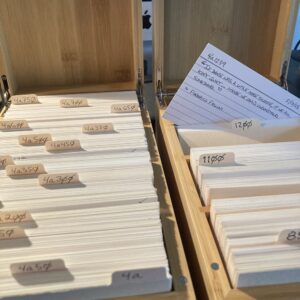
Every day, the Little Box of Quotes podcast publishes a super-short recording of a quotation. For over 3 years—1,247 times and counting—I’ve said, “Hello, Craig here! Today from my little box of quotes…”
Why do all this work? It’s fun! I love sharing quotes (and in podcast form is just one way.) The total listens is north of 60,000 and some have been heard many hundreds of times. I like to imagine all the people who smiled, or went “hunh“. Each episode is only downloaded a dozen–or–so times when published. But then each episode slowly gets heard, as people randomly stumble upon them (I know not how.)
Which episodes are popular? Here are the top 10…
What do I think of that top-10 list? Listening to them—especially the number-1 “Habit” quote—makes me squirm. I can hear so much about them that I’d do differently now. Maybe that’s a good thing? And they all seem so silly… it’s just… Craig reading quotes. But there’s definitely something to this, about the resistance and making art.
How do I record them? They’re pretty raw. I say the entirety of what you hear in one pass. If I make a horrible mistake, I just do it over. There’s no editing—I simply have some basic export settings to set the overall level. The point of the entire thing (when I started) was to practice doing the thing. Talk to the mic. Don’t clean it up in post-production… rather, figure out how to not make mouth-noises, how to breath more quietly, how to sound comfortable, etc.
Where do I still struggle? Saying people’s names! (Pronunciation is difficult too, but that’s not what I mean.) The specifics of how I say the name carries a tremendous amount of information. The tiniest change has a huge affect. Do I sound incredulous that that person ever said something that clever? Do I sound overly reverential? Dismissive? And how long do I pause before saying their name? Faced with endless options, I just do my best and then ship it.
What’s my favorite part? (I have a rapid process: record, replay, save/export, schedule podcast episode. I can do one episode in a few minutes.) Sometimes, maybe 1 in 10, when I play it I get chills. Sometimes, the quote itself, combined with countless other details, makes something I just love.
ɕ
I will keep constant watch over myself and—most usefully—will put each day up for review. For this is what makes life evil—that none of us looks back upon our own lives. We reflect upon only that which we are about to do. And yet our plans for the future descend from the past.
~ Seneca
Elsewhere, this is 4a1516. — slipbox
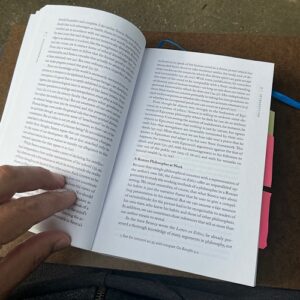
I spend a lot of time reading—frankly, as much time as I can sequester for it. I’ve read several of Seneca’s letters, randomly over the years. A while back I bought this delightful edition from Chicago Press and I’m beginning at the beginning. (There are marks in the book where I’ve already used it for referring to some of the letters.) What knowledge are you putting into your mind?
ɕ
Persevere in what you have begun; hurry as much as you can, so that you will have more time to enjoy a mind that is settled and made flawless. To be sure, you will have enjoyment even as you make it so; But there is quite another pleasure to be gained from the contemplation of an intellect that is spotlessly pure and right.
~ Seneca
Elsewhere, this is 4a1549. — slipbox
What nature requires is close by and easy to obtain. All that sweat is for superfluities. We wear out our fine clothes, grow old in army tents, hurl ourselves against foreign shores, and for what? Everything we need is already at hand. Anyone who is on good terms with poverty is rich.
~ Seneca, letter 4:10-11
Elsewhere, this is 4a1559. — slipbox
Philosophy demands self-restraint, not self-abnegation—and even self-restraint can comb its hair. The limit I suggest is this: Our habits should mingle the ideal with the ordinary in due proportion, our way of life should be one that everyone can admire without finding it unrecognizable.
~ Seneca, Moral Letters, 5.5
Elsewhere, this is 4a1564. — slipbox
That career of yours leads over a clif. To leave such an exhalted life, you have to fall. And once prosperity begins to push us over, we cannot even resist. We could wish to fall only once, or at least to fall from an upright position, but we are not allowed. Fortune deos not only overturn us: It upends us, and then smashes us.
~ Seneca
Elsewhere, this is 4a1569. — slipbox
Every pleasure saves its greatest delights for its last moments. The most pleasurable time of life is on the downhill side, just before the drop-off. Even the time that stands at the very brink has its own pleasures, I believe. Or if not, then it has this instead: One no longer feels the need of any. How sweet it is to have worn out one’s desires and left them behind.
~ Seneca
Elsewhere, this is 4a1574. — slipbox