Dec 27, 2019

Some method for the trivial stuff

Here’s a problem I’ve faced recently: my obsessive focus on a small number of important project causes me to fall behind on the annoying little administrative stuff that pops up on a daily basis. I’m not talking about the regularly occurring minutia, like cleaning my apartment or working out: these can be easily handled with an autopilot schedule. I am referring, instead, to the random, unexpected productivity lint that regularly clogs my inbox and emanates a powerful aura of procrastination-inducing annoyance.

~ Cal Newport from, The Stable Mucking Method

Elsewhere, this is 4ucabo25. — slipbox

The important point is that you have some intentional way of keeping up with administrative tasks. If you don’t, these little thorns will pile up until everywhere you look you find sources of stress. Or worse, to avoid the stress, you stop looking.

Newport’s post describes one method—one which I don’t personally use—and links to another post describing another method. The two posts give a good overview of the problem he’s trying to solve, and some thought-provoking ways of trying to tackle it.

ɕ

Dec 31, 2019

If Lincoln had email

If the Internet is robbing us of our ability to sit and concentrate, without distraction, in a Lincoln log cabin style of intense focus, we must ask the obvious question: are we doomed to be a generation bereft of big ideas? Will we lose, over time, like some vestigial limb, our ability to focus on something difficult for extended stretches? As a graduate student, I’ve had to put in place what are, in essence, rigorous training programs to help pump up my attention span. It’s a huge struggle for me. Somehow, I imagine, if Lincoln was in my position, he wouldn’t be having this same problem.

~ Cal Newport from, Would Lincoln Have Become President If He Had E-Mail?

Elsewhere, this is 4ucabo24. — slipbox

I usually quote things I agree with whole-heartedly. This one is a little different. I like the topic Newport has raised and he brings up several good points, but my thinking differs a bit.

The Internet is only a tool. There’s nothing magical about how it works to change your brain, distract you, or [as I’m found of describing it] eat your face. The power of choice remains with each of us. What do we use the tool for? What things do we talk about? Whom do we associate with? What change are we creating?

The Internet is only a tool. Make what you will of that.

ɕ

Feb 25, 2020

Instead, have a compass

These three interviews, along with many others in the Roadtrip Nation archive, all undermine the notion that you should simply follow your passion, and you’ll immediately be happy. For Glass, Steele, and Merrick, the path was more circuitous. This doesn’t mean, however, that their success is entirely serendipitous.

~ Cal Newport from, The Pre-Med and Ira Glass

Elsewhere, this is 4ucabo22. — slipbox

Newport has written a lot geared toward helping college students navigate, (college, life, time management, everything.) This piece is of use to everyone, whether or not you feel you are currently following your passion.

I think, (and I’m not saying this is in contradiction to what Newport wrote—I’m just wandering off here,) it’s far more useful to follow your own compass—whatever it points toward. It’s not even critical that you always make progress in the direction is points. Having a compass simply keeps you oriented. Which is, obviously the opposite of disoriented. And who wants to be disoriented. Having some orientation, gives you at least some confidence, and confidence enables you to move.

ɕ

Mar 30, 2020

It’s really good to be really bad

This is an idea I’ve come across repeatedly during the research I’ve conducted for my various books. There’s something incredibly valuable in the deeply frustrating yet rewarding pursuit of mastering something hard.

~ Cal Newport from, The Deep Benefits of Learning Hard Things

Elsewhere, this is 4ucabo19. — slipbox

This idea comes up all over the place, and for good reason. Nearly 3,000 years ago, people like Marcus Aurelius where writing things about the absolute necessity of continual self-study and self-improvement. Books such as G Leonard’s, Mastery and countless bits on the Internet about self-improvement. My personal, direct efforts applied to myself—find some idea, reflect on it, then figure out how (if! of course) to apply it to myself… My efforts remain ongoing.

( I need a special character, or something, that I can put before these questions, to make it clear that I mean this entirely in a non-judgemental way– I only intend to spur your thinking… )

What are you up to?

ɕ

Apr 2, 2020

Creating space in the morning for reflection

“The pleasure in thinking and doing things well is…deep-wired.” I think this is absolutely true. Thoreau retreated to Walden Pond, in part, to do nothing — to just observe and live deliberately — but he also wrote a first draft of a book, A Week on the Concord and Merrimack Rivers, while in his cabin. He then left the pond to move in with Emerson, where he wrote another book, this one about his experience at the pond, then another soon after, Civil Disobedience. Thoreau found peace observing nature; but his real pleasure was in producing enduring work.

~ Cal Newport from, On Productivity and the Deep Life

Elsewhere, this is 4ucabo18. — slipbox

I’ve long ago lost any real sense of which life changes have had the most benefit. But if I were to pick one, it would be making time to reflect. I’m often making adjustments here and there to my life, and those changes are always based on a period of reflection. What have I been doing that has been making me feel well? What have I been doing that has been making me feel unwell? …and so on.

For a while—three years to be specific—I’ve been trying to begin each day with some basic movement/stretching and then some sort of physical activity. I’m talking about first thing each morning. Get out of bed, deal with necessities (eg, coffee :) and then begin with movement and activity. 3 and 2 years ago, that activity was running. For the past year, the physical activity has been a sort-of-like-Olympic-weight-lifting program called Happy Body.

This is not working for me. Sure, when I manage to start with activity then I’m awake and moving and it’s good for my health and I get lots of what I want done each day. But it’s a struggle every. damn. day. blech! What I really want, first thing in the morning, is to NOT be physically active, but rather to be mentally active.

Starting today, I’m overhauling my first-thing-each-day routine to be:

  1. Reflect on the day’s self-assessment reminder
  2. Reflect on the day’s entry from Holiday’s, The Daily Stoic
  3. Read my previous journal entries and write in my current journal
  4. Spend some time in philosophical reading

I encourage you to build a reflection habit. It can be first-thing each morning or whenever works for you. (Many people allocate time for reflection as the last thing each day before going to sleep.) You should intentionally choose what to do as your reflection practice. I’ll go so far as to suggest you perform a few weeks experimentation with each idea you come up with, until you find a reflection practice that works for you. The more you reflect the more you’ll want to iterate and improve creating a virtuous feedback loop.

That’s the plan anyway. It’s certainly the best plan I’ve come up with for me, so far.

ɕ

Apr 13, 2020

Wherein I continue my perennial rant against social networks

His friends, however, were aghast at his decision to leave the social network and argued strongly against the action. Their airtight case? Certain activities, such as finding out about parties, would become less convenient. The convenience principle is so ingrained in our culture that Daniel’s friends believed that their argument that something would become less convenient was unimpeachable. Daniel, for his part, ignored them. He missed a few invitations, but not many.

~ Cal Newport from, Distraction is a Symptom of a Deeper Problem: The Convenience Principle and the Destruction of American Productivity

Elsewhere, this is 4ucabo16. — slipbox

I spent time writing about social networks for this post—but deleted it all because I’ve nothing nice to say. Instead I’ll smirk, and point at what someone else has written.

Great article though from Newport. As usual for his 2012 epoch, it’s specific to college students but contains deep wisdom for all.

ɕ

Apr 17, 2020

Creating value

Creating value is unrelated to busyness. When you find yourself — as I sometimes do — working long hours, day after day, reacting and e-mailing and hatching schemes, it’s useful to remember that you’re working more than some of the world’s most respected and impactful thinkers.

~ Cal Newport from, You’re Working too Hard to Make an Impact

Elsewhere, this is 4ucabo15. — slipbox

I often write about focus because it’s something I’m trying to improve. When I’ve lost focus, it’s a challenge to call myself back to the important things. But a better plan for improvement would be to not lose focus in the first place, or at least to not lose focus as often.

Recently I’ve been keeping in mind Viktor Frankl’s thought about there being a space between stimulus and response. I find that when I’m able to remember that space, I’m able to consciously decide when, and if, I should shift my focus.

For example, I sat down to write and a myriad of other thoughts arose. Instead of trying to ignore them or make them go away—don’t think of a pink elephant—I zoom in on each idea: I consider the sense of urgency; no, actually there’s nothing urgent about the action this thought is suggesting. I consider the sense of entitlement; no, actually there’s no reason that I should be congratulated or rewarded for this thought or what it’s suggesting I attempt to do. I consider the benefit to myself or others; no, actually this thought isn’t vastly better than the other ideas and projects I’m already working. Soon enough the thought moves along like a petulant child. I think, “let’s see, where was I? I had sat down to write.”

Externally, that whole process—even if I repeat it for multiple thoughts—looks very unlike busyness. It looks much like I’m sitting still. It looks like I’m gazing out the window. It even looks a bit like I’m focused on writing. In fact, I am still focused on writing.

It’s my choice: Is this the moment when I want to change where I’ve placed my focus? If not, then terrific, I’m still focused where I had chosen.

ɕ

Apr 23, 2020

Diligence alone

Remarkable accomplishment requires a remarkable amount of focus; this much is clear. But focus without grounded direction is unlikely to hit the sweet spot.

~ Cal Newport from, Learn the Landscape Before Putting on Blinders

Elsewhere, this is 4ucabo14. — slipbox

I’ve come across this point/idea many times in my journey. It took me a long time to learn how to focus, but it’s proving more challenging to figure out what to focus on.

Diligence? Focus? Single-mindedness? …whatever you want to call it. I am able to get a lot done. But I find I’m always second-guessing myself after I’ve gotten a significant portion of the way through some project…

Today, more questions than answers I suppose.

ɕ

Apr 28, 2020

Honing your craft

We’ve created this fantasy world where everyone is just 30 days of courage boosting exercises and life hacks away from living an amazing life.

But when you study people like Martin, who really do live remarkable lives, you almost always encounter stretches of years and years dedicated to honing craft.

~ Cal Newport from, Closing Your Interests Opens More Interesting Opportunities

Elsewhere, this is 4ucabo13. — slipbox

This is the eternal challenge of seeing the forest through the trees; of maintaining perspective.

I’m constantly reminded of the scenes in the Hobbit where they are trying to walk through 250 miles of a forest named, Mirkwood. “Do not leave the path,” is the only guidance they are given. After what seems like endless daily struggles, they eventually dispatch a party member to climb a singularly large tree to the uppermost branches. Unfortunately, even from that lofty perch all that could be seen was more forest forever and ever in every direction. In fact, they were in a low lying area, reasonably close to the forest edge. Crushed by the misleading perspective, their journey takes a turn for the worse.

I have so many projects where I start into the forest with the best intentions. I steel myself with, “I know this is going to turn into a slog at some point, and I’m going to remember why I went into the forest to give me the strength to carry on!” Yeah, that never works out. If the project is actually worth doing, then the forest is necessarily crushingly vast and the journey through must eventually become hopeless. Of course it’s hard; that’s what makes it worth it.

The secret? You have to love living in the forest, just for the sake of living in the forest. Then every morning is an adventure. Sure, some days are going to suck, but every morning will begin a new day of opportunity.

ɕ

Apr 29, 2020

And then it gets harder

I don’t think we emphasize enough the importance of evidenced-based metrics. Deep work is important. Making lots of bets is important. But if these efforts are not grounded in the reality of your field — including the hard truths about what you really do need to potentially succeed, not just what you know how to do — they are wasted.

Cal Newport from, You Need to Master the Rules Before You Can Reinvent Them

Elsewhere, this is 4ucabo12. — slipbox

Deep work; yes. Making lots of bets (or, fail faster, pick yourself, iterate quickly, etc.); yes. Grounded in reality; yes. Are those all necessary? yes—actually, hell yes, amen and once more, louder, for those in the back!

But are they sufficient? If you have those three, will you be successful? Setting aside the timing and random luck parts of success, nope I think you also need tenacity.

I’m not sure if it’s learned, innate or both of those. But there’s a necessary tenacity. Ever play tug-o-war with a dog and a rope-toy? That dog has the tenacity, in Spades. (Without Googleing, can you tell me where the phrase, “in Spades” comes from?) holy shit no you dont thats my rope toy i am never gonna let go as long as you want to play this is my favorite game oh my gawd best day ever!!

But, a good dog also knows it’s a game. Tenacious? Absolutely. Drop that toy like a hot potato when something better comes up? What rope toy?

ɕ

Apr 30, 2020

Quitting at quitting time

The best thing you and I can do at the end of the writing day is to stash our work gloves in our locker, hang our leather apron on a hook, and head for the workshop door. If we’ve truly put in our hours today, we know it. We have done enough. It won’t help to keep at it like a dog worrying a bone.

~ Steven Pressfield from, “The Office is Closed”

Elsewhere, this is 4usete6. — slipbox

…and similarly: Perfectionism is a Loser’s Strategy

Elsewhere, this is 4ucabo10. — slipbox

I’ve recently learned that “inertia” as a word, was first applied to the cosmos during a fairly recent philosophical shift in thinking. People like Copernicus were looking at the cosmos and used “inertia” to point out the universe’s inherent, not-alive property; as in, the cosmos possesses inertia, the property of being inert. Newton’s idea of inertia, in the sense that slow moving dump trucks have a lot of inertia, aligns with the idea that the inert cosmos resists. It resists starting and it resists stopping. Newton’s equation, “F=ma” is a result of inertia; If (F)orce is zero on the left, then (a)cceleration is zero on the right. If acceleration is zero, then velocity remains constant.

Aside: “velocity” is speed, “how fast?” and direction, together as one property. Turning a corner in a car, at the same speed, is a change in velocity. To do so requires force from the steering tires of the car. The steering wheel is simply a well designed control for applying lateral force to the front of your car to control your velocity without changing your speed.

Where was I? …oh, right! Inertia. The cosmos. Back to it…

The inert cosmos resists starting and stopping. But I am not inert! I long ago recognized that when I was not moving—figuratively speaking, moving by being engaged making progress toward some goal… When I was not moving, then I needed to do something to get moving. I needed to start, and realizing that I was bad at starting, I needed to practice starting. Okay, did that.

Unfortunately, I have created a new problem: I don’t know how to stop. It turns out one really needs to also be able to start and to stop. Now that I’ve mastered starting, I can finally begin to learn to stop.

<sarcasm>And surprise!</sarcasm> F=ma. Starting and stopping are equally difficult.

ɕ

May 12, 2020

Presuming, of course, you actually know of something better to do

“If you don’t dedicate your time and attention to working with this roto-mill,” the clerk warns, “you might miss out on some benefit that we’re not thinking of now. I don’t see how you could afford such a risk in today’s age of modern yard tools.”

~ Cal Newport from, Would You Buy a Yard Tool if You Had No Idea What to Use it For? So Why Would You Sign Up For Snapchat?

Elsewhere, this is 4ucabo9. — slipbox

Maybe I’m going about this all wrong? We—me, Newport, everyone that I’m following and reading—keep saying things like this. (Read the article, it’s super short.) I keep talking about how engaging in certain things is a waste of one’s precious time. But it occurs to me that maybe for some people it is not a waste of time. Maybe for some people, playing Nimecraft, scrolling through Bacefook or Twettir is actually the best thing they’ve yet found to do with their time. (Data point: I do remember when that was the case for myself!)

Today, I have a list of things that I want to do—that I enjoy doing, that yield benefits, and which make me and the world a better place. I also have a list of things which I find pointless which I do not want to do. Maybe it would be far more useful for me to be asking, rhetorically, of the world at large:

What do you want to be doing with your limited time here?

ɕ

Jun 10, 2020

Interrupt driven

Think about this question for a moment. The Apollo program was massive in size and complexity. It was executed at an incredible pace (only eight years spanned Kennedy’s pledge to Armstrong’s steps) and it yielded innovations at a staggering rate.

And it was all done without e-mail.

~ Cal Newport from, How We Sent a Man to the Moon Without E-mail and Why it Matters Today – Cal Newport

Elsewhere, this is 4ucabo5. — slipbox

Not just without email, but without computers or networks or cell phones or even hand calculators. They did it with paper, drafting tools and slide rules. Meetings, planning, and most importantly:

Communication.

All these tools that I have are only useful if I understand how they work. When you first start working in some field, you get the most basic tools—two manual, screwdrivers; one straight-blade and one Philips head. When you can tell me why the Philips head was invented, you can have a hand driver with interchangeable driver heads (“bits.”) When you can use them all… When you see a screw-head and pick the right bit… When you’ve exhausted your forearm from driving screws, then you can have a power driver. When you use the friction clutch correctly, you can have a larger power driver. And so on. (You can tell the quality of the craftsman by the way they maintain their tools. Yes, skilled persons can do great work with shitty tools. But at mastery level, the art is expressed in the tools themselves. Yes, all arts.)

So yes, you really do need to understand the different between wifi, cellular and Ethernet; between Apple’s IM, carrier SMS, and WhatsApp; between email, Google Docs, and Word.

As Carl Sagan wrote, “We live in a society…“

ɕ

Jun 16, 2020

I try to forget my ideas

Keeping track of project ideas, in my experience, is usually a waste of time. I used to fear that if I didn’t capture and review my sparks of brilliance I’d forget them and an opportunity for impact would be lost.

The reality, however, is that most people (myself included) have waymore ideas for things to work on than they have time to work. Forgetting ideas is not your problem. Having too many ideas competing for your attention to execute any one well is a more pressing concern.

~ Cal Newport from, Deep Habits: Forget Your Project Ideas (Until You Can’t Forget Them) – Cal Newport

Elsewhere, this is 4ucabo4. — slipbox

In the beginning I didn’t try to do anything with my ideas. Even though—my mom may disagree—I had mastered bathing and dressing, I was still under the false-impression that my mind was for holding ideas. It’s not good at that. Actually it’s terrible at that.

It took me a few decades to figure out— …honestly, I never did figure it out. Rather, I started reading a bunch of stuff about how to get my arse organized, and started to write things down. College helped. 43 Folders helped, a lot. Reading Getting Things Done made the final pieces click into place.

Whereupon I entered the Second Epoch of Craig. At this time I dutifully studied, and earned my title, Wizard of Process and Organization, with a specialization in Internet Dark Arts. Do not meddle in the ways of Process and Organization Wizards; we are quick to anger and you are tasty with ketchup. As you can tell, I completely lost my marbles in the process. Near the end of this Second Epoch I reach the epitome of my list-building, (and project management setups, and universe-domination plans.) I was completely drowning in over-planned, over-committed, over-stressed, over-organization.

Cue, Thus Spoke Zarathustra, and the dawning of the Third Epoch of Craig. Wherein I straight-up deleted most of my lists of ideas and plans. The really important stuff continues to live in my level-37 wizard process-management systems. I know they’re working when I forget they’re working and yet things magically appear when I need them to.

Ideas are worthless. It’s execution, (plus luck, and timing,) that makes them valuable. I’ve a few ideas that I cannot get out of my head. Those are the ones I’m working on in an attempt to make them go away. But it’s a good day any time I can manage to just forget about some idea having blissfully done nothing with it.

ɕ

Jun 25, 2020

I am the elephant

Ever since I first read these words, they stuck with me as useful for understanding the working world in particular. The whole edifice that we now call “productivity advice” distills, I realized, to instructions for cajoling the elephant. If you’re not firm, it’ll do what it wants to do.

~ Cal Newport from, Deep Habits: Never Plan to “Get Some Work Done” – Cal Newport

Elsewhere, this is 4ucabo3. — slipbox

Plan? Do? Chaos? I get so swept up in systems that sometimes I just bridle and rebel. I think the problem comes up when I have too many systems that don’t have an end goal. My systems are supposed to make the space for me to get real things done. But if all I have is ongoing systems of the busy-work that’s supposed to make space, then I rebel. Because I also need real projects. I want to spend as much of my time as possible getting real things done. Real things for which I have real reasons for wanting to do them. And those real things require real planning.

Generally, I don’t have a problem with over-planning; I can do a tremendous amount of planning, but experience shows that I always do better if I resist the urge to begin… start now! Take action! It’s always better if I resist action, instead doing a brain-dump session and then setting the whole thing aside. When I return later, more ideas flow and more planning ensues. Maybe a third session. Maybe even a fourth.

Meanwhile, the elephant dozes as I plan surreptitiously.

Ever notice that the “doze” in bulldozer is the exact opposite of the elephant’s? Eventually, the planning reveals a beautiful domino setup, and it’s time to awaken the elephant who easily bulldozes them one by one.

ɕ

Jun 29, 2020

All of humanity’s accrued knowledge

As I elaborated in last week’s episode of my podcast, Neil Postman argues that it was the introduction of mass-produced longform writing that really unleashed human potential — ushering in the modes of critical, analytical understanding that birthed both the enlightenment and the scientific revolution, the foundations of modernity. It allowed us to efficiently capture complex thought in all its nuance, then build on it, layer after layer, nudging forward human intellectual endeavor.

~ Cal Newport from, On the Exceptionalism of Books in an Age of Tweets – Cal Newport

Elsewhere, this is 4ucabo2. — slipbox

I’ve often ranted against lack of attention-span, and wasted time. But Newport, and in particular some things he’s quoting and talking about from another article, make the point that all of human history is encoded in written form. Why is that so? Because it works, and it works really well.

There is a place for visual and auditory information, of course. Those tools of communication are power tools compared to writing—well, almost all writing. As I’ve said many times here though: One can have the power tools after demonstrating mastery with the manual hand-tools.

ɕ

Jul 11, 2020

Baseball

If I stick with it, however, my mind eventually downshifts — quieting the noisy neuronal clamoring for easy entertainment, and leaving instead an unencumbered attention of a type that I often seek in my work.

~ Cal Newport from, Deep Habits: Listen to Baseball on the Radio – Cal Newport

Elsewhere, this is 4ucabo6. — slipbox

Once or thrice I’ve heard a baseball game on the radio. This would have been back in the 80’s when with some neighborhood friends—brothers, whose father was a plumber—we’d occasionally ride to a baseball game. The kind of game where we were playing as kids; semi-organized little league games at random churches’ baseball fields scattered around the Pennsylvania rolling hills. A homerun into left-field was in the graveyard and into right-field was in the corn field. I can’t convey in writing what it sounded like riding in the truck with the radio on; some combination of a monotonous announcer with a touch of crowd noise, a big ‘ol truck engine—this was the plumbing truck full of plumbing supplies in the back—a 5-speed manual floor shift and 3 rowdy kids with the windows rolled down and the smell of fields and manure and baseball gloves.

I think I had something else to say about baseball and focus when I started typing. But I forget what it was.

ɕ

Jul 22, 2020

Mindful communication

With few exceptions, e-mail use arose organically within organizations, with little thought applied to how digital communication might best serve the relevant objectives.

~ Cal Newport from, The E-mail Productivity Curve – Cal Newport

Elsewhere, this is 4ucabo41. — slipbox

As usual, this is an interesting article from Newport. He proposes a productivity curve for email—how productive we are without, with-some, with-more, with-too-much—which explains perfectly why some people love email and some people hate it.

The key point about email is to use it intentionally. Not simply one’s own use; not simply, “I only check my email twice a day,” or, “I’m always at ‘inbox zero.'” The key is to deploy email wisely, in a way which increases productivity of a team, (family, community, whatever.) If adding email into the mix is going to increase productivity, then do so. Then zoom out and look at all your other communication tools, and perform the same calculus. Email is simply one example of a tool which initially [hopefully] increases productivity, but too-soon becomes a detriment.

ɕ

Jul 25, 2020

Sabbaticals are not the solution

What is it about digital addictions that make us think the occasional break will suffice?

~ Cal Newport from, Digital Sabbaticals Don’t Make Sense – Cal Newportsense/

Elsewhere, this is 4ucabo40. — slipbox

Weekly sabbaticals make no sense, sure. But less frequent sabbaticals are powerful. Take a week off from—whatever, email, social networks, etc.—and your addictions are made obvious. Nothing surprising there. The question is: Do you then consciously bring the addicting drug back into your life?

That’s not hyperbolic soapboxing; That’s a real question for you to consider.

ɕ

Aug 3, 2020

Now the work begins

This is the lesser told story about the quest for elite accomplishment. It’s common to hear about the exciting initial phase where you’re terrible but motivated and therefore see quick returns. But so many people, like C. K., soon hit a plateau. They’re no longer bad. But they’re also not improving; stuck in a circle that doesn’t take them anywhere.

~ Cal Newport from, How Louis C. K. Became Funny and Why it Matters – Cal Newport

Elsewhere, this is 4ucabo39. — slipbox

But I’m still left with the question: How do I distinguish, putting in the effort, from, bashing myself on the rocks? Because I’ve got the work-ethic, put-in-the-effort, do-the-hard-work, thing down pat. What I don’t seem to have—in my opinion—is success. I’m certainly not enjoying life generally. It’s just long stretches of hating myself in the form of insanely hard work, with brief windows of relaxation.

ɕ

Aug 15, 2020

Open loops

Jot down every loop that opens; whether it comes via email, or a phone call, or a Zoom meeting, or Slack. Because these loops might emerge rapidly, use a minimalist tool with incredibly low friction. I recommended a simple plain text file on your computer in which you can record incoming obligations at the speed of typing (a strategy I elaborate in this vintage post).

Then, at the beginning of each day, before the next onslaught begins, process these tasks into your permanent system. In doing so, as David Allen recommends, clarify them: what exactly is the “next action” this task requires? Stare at this collection before getting started with your work.

~ Cal Newport from, On Confronting the Productivity Dragon (take 2) – Cal Newport

Elsewhere, this is 4ucabo37. — slipbox

This two part process is the backbone of how I get things done. When I find I have too many ideas rattling in my head it’s time to do a bunch of “capture.” One’s mind is for having ideas not for holding them. I prefer to write things down rather than using a digital device. Yes, my phone [at least] is very often at hand—but I’m a digital import, not a native, so thumb-typing is torture.

Everyone agrees that capturing everything—whether digital or analog, notes, meeting minutes, thoughts, doodles, lists, everything… Capturing everything is important and useful.

But almost everyone has not fully apprehended that second part: Process that collection from yesterday. Every day review all the “captured” stuff and brutally assess it. Can I just ignore it/cross it off as done? Can I put that onto some other list (groceries, errands, etc.)? Why did I capture this? …is it a dream, a flaming urgency, something I want to think more about?

ɕ

Sep 6, 2020

Time spent organizing my time

Something organized people don’t often talk about is how much time they spend organizing their time.

~ Cal Newport from, Spend More Time Managing Your Time – Cal Newport

Elsewhere, this is 4ucabo36. — slipbox

Guilty as charged, Your Honor! So today, something a little lighter than usual—I think?—with a few snapshots of how much time I spend organizing my time.

It is an exceedingly rare morning that I don’t spend about half an hour planning out the day. This little block of time begins with “surfacing:” Ducking into all the many online mediums where I am present, and—this is very hard—not engaging, but skimming over things to see what rises to a level of getting my attention today. Many productivity sources and guides suggest doing this at night, at the end of your day, but that does not work for me.

Every Monday I take an “administrative day”—the entire day. I stuff the day full of all the random things of life. Any errands to run, laundry, lawn mowing if I can, bookkeeping (literal banking and accounting and such). I do my best to resist doing any real work. I do anything like changing the bed linen, or high dusting the house, or stacking firewood, or changing a flat tire on my bike, …anything that I would consider “not important” …except of course if I never got around to doing it, then it’s a critical disaster …that’s “administrative day” stuff. This isn’t exactly time spent on organizing, but still.

I use sophisticated planning/project-tracking software, called OmniFocus, to manage a lot of stuff. (Things from recurring daily things, to true projects that have many steps and milestones and due dates.) Every two weeks—on an Admin Day!—I spend about an hour just going through every nook and cranny of my OmniFocus. (If you’ve read Getting Things Done, this is part of the review process.) I tend to ruthlessly delete stuff in an effort to combat my incessant tendency to take new things on.

At least once a month—again, on an Admin Day—I do the same sort of “look through every nook and cranny” review of the Basecamp system that is used for one of the companies I’m part of. Sometimes I can do that in 5 minutes, sometimes I’ll spend hours on it.

At the least organized end of the spectrum, (yes, my time spent managing my time comes in a spectrum of how organized it is,) I often—maybe twice per month this happens—will go off, (as in “off the deep end,”) and outline some project that I’m considering doing. I’ll whip out my favorite outliner, OmniOutliner, and do a brain dump of some project. This can take from 5 minutes to an hour or more depending on what I’m thinking about. Quite often, I’ll then simply set aside some awesome idea that I don’t have the time to execute, or the resources to have it done under my direction. I used to think this was wasted time, but it is the only way I can get things off my mind: When it pops up later, I either think, “I already did all the thinking,” or I go back to the outline and tinker some more. (What remains, forever, is just to squash the recurring lizard-brain fear of missing out by not executing the project.)

So let’s see, how much time is all of that combined? I’m awake 16 hours a day, but realistically, only half that time could ever be used to some specific end. So 8 hours a day of “self-directable life”. 1 out of 7 days is an Admin Day… 1/7 ~ 0.1428… The rest of that stuff might—maaaaaaybe, but probably not—eat a second day’s worth of each week . . . 2/7 ~ 0.2857…

So in response to how much time do I spend managing my time? I’ll say:

15 to 30% of my entire available life.

ɕ
Sep 14, 2020

Pseudo-Depth

The bottom line is that if you’re intrigued by depth, give real depth a try, by which I mean giving yourself at least two or three hours with zero distractions. Let the hard task sink in and marinate. Push through the initial barrier of boredom and get to a point where your brain can do what it’s probably increasingly craving in our distracted world: to think deeply.

~ Cal Newport from, Deep Habits: The Danger of Pseudo-Depth – Cal Newport

Elsewhere, this is 4ucabo35. — slipbox

My mind loves to wander off. It often wanders off to familiar ideas. Ever have a small burr on a finger nail? You fiddle with it slightly, scuffing it with another nail. Some thoughts feel like that in my mind. Not a problem exactly—not bad enough that I’m going to get up for the nail file. But, none the less, there is this idea yet again. My fascination with rock climbing is one such idea. Why, exactly, does climbing fascinate me? I’ve spend many a CPU cycle recursively interrogating this question.

Upon reading Newport’s post, I find it has pointed me in a direction I’d not previously seen: Is it the deep focus found within the pursuit of rock climbing which draws me to it?

ɕ

Sep 23, 2020

Seneca on Social Media

Over a billion people currently use Facebook — many at the cost of anxiety, lost honor, personal freedom, and certainly time. If asked why, however, many would reply, “why not?” The service is free, conventional wisdom tells us, so no matter how minor the benefits (which tend to orbit around a generalized fear of missing out), they’re still more substantial than the cost. But as Seneca points out, this assessment is misguided because it ignores the human toll of social media.

~ Cal Newport, from Seneca on Social Media – Cal Newport

Elsewhere, this is 4ucabo33. — slipbox

I generally try to suppress my urge to pounce on opportunities to talk about the well-known downsides of social networks. But a Seneca-CalNewport two-for-one is simply irrestible catnip for me. Here, Newport is referring to the value of one’s own time. That’s the human “toll” that so many people—as far as I can see at least—don’t factor in.

I think I am ready to give up fighting the fight; I’m done [or at least, I really should get a grip, and learn to be done] beating the drum about the evils of social networks. Know what I’m going to do instead? Double-down on creating things on the open web and let people decide what they want to do.

ɕ

Oct 17, 2020

Breathing Room

To abstain from all information about the world at this current moment would be a betrayal of your civic duty. On the other hand, to monitor every developing story in real time, like a breaking news producer, is a betrayal of your sanity.

~ Cal Newport from, Focus Week: Give Your Brain Some Breathing Room – Cal Newport

Elsewhere, this is 4ucabo32. — slipbox

This tension is not only real, it’s necessary. You need to have this tension; it’s a critical component of how you assess the world by choosing what to filter in and what to filter out. The difficult part, of course, is if you don’t intentionally manage this balance.

How many things just pop in front of you each day? Are you happy with that amount?

ɕ

Nov 7, 2020

Barely noticeable

The authors note that a core resource of the digital economy is the data produced by users of services like Facebook and Google, which can then be used to train machine learning algorithms to do valuable things like precisely targeting advertisements or more accurately processing natural language. The current market treats data as capital: the “natural exhaust from consumption to be collected by firms” for use in training their AI-driven golden gooses. Lanier and company suggest an alternative: data as labor. Put simply, if a major platform monopoly wants your data to help build a multi-billion dollar empire, they must pay you for it. Offering a free service in return is not enough.

~ Cal Newport from, On Seriously Rethinking the Digital Economy – Cal Newport

Elsewhere, this is 4ucabo30. — slipbox

Well, that would change everything.

Imagine I changed the sidewalk in front of my house to have plates that moved slightly as one walks across it. I’ve rigged the plates to absorb some of the motion created during walking to generate electricity to offset my electric bill. Let’s assume further that the movement of the plates is barely noticeable. Perhaps something seems a bit “off” when you walk past my house, but nothing bad happens to you; you don’t fall and you don’t get tired, but you do work just a little harder when walking past my house.

What happens when we scale up that “harmless” little modification to include everyone, walking everywhere?

ɕ

Nov 22, 2020

Deeply held beliefs

This book is complicated and ambitious. But there’s one thread in particular that I think is worth underscoring. Crawford notes that the real problem with the current distracted state of our culture is not the prevalence of new distracting technologies. These are simply a reaction to a more fundamental reality: “[W]e are agnostic on the question of what is worth paying attention to — that is, what to value.” In the absence of strongly-held answers to this question our attention remains adrift and unclaimed — we cannot, therefore, be surprised that app-peddlers and sticky websites swooped in to aggressively feast on this abundant resource.

~ Cal Newport, from From Descartes to Pokemon: Matthew Crawford’s Quest to Reclaim our Attention

Elsewhere, this is 4ucabo28. — slipbox

Turns out Crawford was interviewed by Brett McKay, another person I’ve often quoted here. I’ve not yet listened but the episode is Becoming an Individual in an Age of Distraction.

Originally I thought “social media” itself was the problem. Eventually it became clear to me that social media is the symptom. People want to be fed saccharine lives through their phones because they’ve never been taught that they need to consciously make decisions about what’s important to them.

ɕ

Nov 29, 2020

Digital minimalism

To be a digital minimalist, in other words, means you accept the idea that new communication technologies have the potential to massively improve your life, but also recognize that realizing this potential is hard work.

~ Cal Newport

Elsewhere, this is 4a902. — slipbox

That’s from, On Digital Minimalism and is the most succinct description of digital minimalism I have ever seeing.

Elsewhere, this is 4ucabo27. — slipbox

“Realizing this potential is hard work,” is a sublime understatement. Tracy asked me for a password to something and we ended up in a deep rabbit hole of having to also share the security questions, and it’s tied to my cell phone and actually I don’t know what the password is because I forgot to store it (in my little password management tool) even though my browser had it remembered so I’d been logging in for . . . Complicated.

Obviously in the case of the password, it was worth the effort. But then, next minute, we’re faced with the newest social service, and this software and that software and on and on. Choosing the default of engaging with each thing is an already-lost war.

ɕ

Dec 7, 2020

Don’t ask for advice

An important, but counter-intuitive, strategy we found essential in this style of research is to avoid simply asking people for advice. When you ask for advice, you’ll often get vague, unhelpful answers. Instead, you need to observe what the top performers in your field are actually doing differently. Act like a journalist not a protege. This can often yield surprising insights about what actually matters to move forward.

~ Cal Newport from, Are You Working In Your Career or On Your Career?

Elsewhere, this is 4ucabo26. — slipbox

I’ve found this to be the case as well.

There are some people who give advice well. There are far more people who can give useful answers to good questions. Asking, “what do you think I should do,” isn’t going to get you useful guidance nearly as often as asking, “how did you do that.” You simply must do the hard work of figuring out whom to ask, and what to ask them.

In a recent conversation on the podcast, Thomas Droge brought up the idea of seeking younger persons to be your mentors; maybe not a formal mentorship relationship, but to be open to being a sort of stealth protege (my interpretation, not his words.) These two ideas dovetail: If you try to ask a younger person, literally, for advice, that’s not going to work well nearly as often as asking, “how did you do that?”

ɕ

Jul 10, 2021

Selection

In the most general sense, productivity is about navigating from a large constellation of possible things you could be doing to the actual execution of a much smaller number of things each day.

~ Cal Newport from, The Productivity Funnel – Cal Newport

Elsewhere, this is 4ucabo1. — slipbox

A decade ago, I was swamped by the sheer number things I could possibly do each day. In one sense, that’s a good problem to have. But good or bad problem, “swamped” and “drowning” are adjacent. I’d committed myself to far too many things. Large swaths of those “possible things” every day came with emotional baggage, and often with the self-imposed weight of “should.” And so I worked on that and eliminated all the negative things.

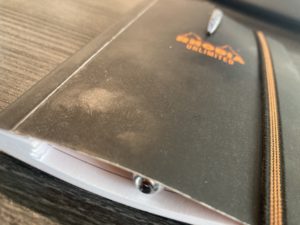
Unfortunately, selecting what to tackle each day remains just as challenging. I’ve a habit of creating a “page for today” that I scribble on early in the morning. As the day progresses, I cross things off, jot down notes, scribble things which I need to add to my other systems, etc.. Over the years, I’ve used various bits of random paper; for a time, I was using the back-side of all the printer paper from the recycle bin. I’ve used spiral notebooks, tablets, and even a custom spreadsheet, (which I printed on 8.5×11 paper and cut in half to make my own table of half-sheet daily schedule/grid.)

Recently, I realized that the size of the paper I was using was getting progressively smaller. I’m currently using a 3×5-size of Rhodia notebook. (These, if you’re interested. Durable, great paper, and, critically, every page is micro-perforated so I can tear out each day to start fresh the next day.) The sublime recipe of page size, line space, handwriting style and hours in the day goes a long way to keep my selection of what to do tending towards the possible. Whether the sheet for today feels cramped or airy is a good indication of what I’m setting myself up for.

And to be clear, I don’t plan every day into this little book early each morning. On the days when I’ve something big planned—a day trip to the beach, a long weekend away—I throw all structure to the wind. But most days I do.

ɕ

Sep 22, 2021

Fan-boy mode, on

Neither our economy nor the demands of a life well-lived dictate that everyone should aspire to be sitting alone at a desk in rural Narashino, crafting literature to the light of the rising sun. My growing concern, however, is that such real commitment to thought has become too rare.

~ Cal Newport from, Haruki Murakami and the Scarcity of Serious Thought – Cal Newport

Elsewhere, this is 4ucabo34. — slipbox

I’ve read every post on Newport’s blog. I have both Deep Work and So Good They Can’t Ignore You, and Digital Minimalism is in my “priority” subset of my wishlist of books. (Yes, I am aware that I have problems.) But I’ll out myself: I’ve not read either of the two Newport books that I already have, and see no point brining the third into the mix until I do. But whining about my privileged-problem of having too many books, isn’t my theme here. Rather, I want to think about why is it “that such real commitment to thought has become too rare.” Because I totally agree that such is so.

(That’s all. I’m thinking about it, and now so are you.)

ɕ

Oct 30, 2021

Eureka

But this moment cannot come without the days of frustration at the blackboard. “You can’t really blame the storytellers,” Rockmore writes, “It’s not so exciting to read ‘and then she studied some more.’ But this arduous, mundane work is a key part of the process.”

~ Cal Newport from, On the Myth of Big Ideas – Cal Newport

Elsewhere, this is 4ucabo31. — slipbox

And Niels Bohr said something similar about Painful experience. And I bet your experience agrees. I know mine does.

Nobody sees how much time I spend working on podcasting. Every facet is complicated. I’m regularly noticing new things, picking up interesting skills and ideas from nearby areas of expertise. Structural wisdom from the field of authors. Empathic skills from the field of therapists. New kinds of questions from the field of hosts. New vocal skills from the field of speakers. And teachers and mechanics and on and on.

The eureka moments get the attention but they’re very few and very far between.

ɕ

Nov 13, 2021

Not grinding away

Critically, as Gribbin’s explains, during this period Galileo was also occupied in part by his success in “leading a full and happy life,” in which “he studied literature and poetry, attended the theatre regularly, and continued to play the lute to a high standard.” He was not, in other words, locked up, grinding away in relentless pursuit of results. Yet results are what he did ultimately produce.

~ Cal Newport from, On Pace and Productivity

Elsewhere, this is 4ucabo29. — slipbox

Everything wears down, wears out, and wears away. The light that burns twice as bright, lasts half as long. There are cautionary tales about the hedonic treadmill. The tortoise and the hare. The ant versus the oxen; I’ve always liked that aphorism from Lao Tzu.

Let’s grant that the ant walks a great distance, removes debris from the colony, and collects food for 10 ants. Meanwhile, the ox accomplishes nothing. But when he awakes refreshed from his nap, he can plow a field in a few hours. For comparison, how long will it take the ant to plow the field?

I’ve always liked that aphorism from Lao Tzu: It reminds me to always be the dozing Ox.

I am frequently asking myself two questions:

What would world-class look like?

Is this thing I just did world-class?

I may fall short— honestly I think I always fall short of executing world-class. That does not mean I stop asking those questions. That does not mean I stop trying. The mantra is not, “do more!” It’s not, “hurry up!” I am not alone in this thinking:

The constructive evaluation of activities, asset allocations, communications, policies, and procedures against purposes and intended outcomes has become increasingly critical for every organization I know of. The challenges to our companies continue to mount, with pressures coming these days from globalization, competition, technology, shifting markets, erratic economic swings, and raised standards of performance and production, making outcome/action thinking a required twenty-first-century behavior.

“What do you want to have happen in this meeting?” “What is the purpose of this form?” “What would the ideal person for this job be able to do?” “What do we want to accomplish with this software?” These and a multitude of other, similar questions are still sorely lacking in many quarters. There’s plenty of talk in the big meetings that sounds good, but learning to ask, “Why are we doing this?” and “What will it look like when it’s done successfully?” and to apply the answers at the day-to-day, operational level—that will create profound results.

~ David Allen, p272, Getting Things Done circa 1989

ɕ

Feb 24, 2022

Parkinson’s Law

Ferriss popularized the personal version of Parkinson’s Law, which correctly notes that our work expands to fill the time we give it. The original Economist essay on the topic also embeds an organizational version of the law, which I read to say that if you leave a group, or a team, or a company to operate without sufficient structure, they may converge toward unexpected and unproductive behaviors.

~ Cal Newport from, Revisiting Parkinson’s Law

Elsewhere, this is 4ucabo23. — slipbox

Pithy sayings are punchy. (For example: Parkinson’s Law states that work expands to fill the allotted time.) But they’re also woefully inadequate; there’s no room for depth or surety. In this case though, it turns out that Parkinson’s Law is based on actual research… into the bureaucracy of the British Navy. Who knew that this pithy little phrase is actually a real model based on actual research. (…uhm, Parkinson, that’s who.)

There are plenty of ways to turn Parkinson’s law into actionable direction: Ship it. Iterate and course-correct. Show me your discard pile. (That is to say, do sub-par work until your work is up to par.) Minimum viable noun. (Which urges one to chop off everything not absolutely necessary in order to get that noun into the world sooner.) All of which, I’m semi-surprised to note, are about constraining the time allotted to do the work. It’s all about moving the goal posts closer.

ɕ

May 30, 2022

Digital minimalism

To be a digital minimalist, in other words, means you accept the idea that new communication technologies have the potential to massively improve your life, but also recognize that realizing this potential is hard work.

~ Cal Newport

Elsewhere, this is 4a902. — slipbox

Jul 3, 2022

Reflection

[…] if you applied this approach, there’s not a strengths-weaknesses binary. It’s, “is this particular skill where I need it to be or not?” […] That could be a skill—if I’m understanding this correctly—that you’re identifying, “I need to get this even farther to get where I want to get.” You might be at a skill level there that everyone would say that’s a strength of yours, you’re really good at that. And so it seems like the strength-weakness binary, is not that useful, at least in this framework. It’s just where you’re trying to get, and what skills are not where they need to be to get you there.

~ Cal Newport ~1h9m from, Deep Questions episode 39 with David Epstein, «https://www.buzzsprout.com/1121972/6035176?t=4140»

Elsewhere, this is 2si1. — slipbox

David Epstein is, most recently, the author of Range. Newport and Epstein’s conversation ranges—sorry—widely, and nearer the end they get into talking about reflection as a mastery tool. Epstein mentions a particular reflection process as something he had included only in passing in his first book, The Sports Gene.

Newport’s point, quoted above, changed how I think about skill level. Epstein had been discussing how he’d learned of Marije T Elferink-Gemser‘s research. Based in the Netherlands, a team had been running these things called the Groningen talent studies for over a decade studying skills, proficiency and mastery in Soccer athletes.

These were questions that, the first time I asked, she sent and said, you answer these at least every month. What’s your goal has to be as clear as possible, but it doesn’t need to be realistic at this point. …dreaming is allowed at this point. Do you have any idea of what’s needed to perform at the level you aim for? How do I make sure how do I make sure that I get an even better idea of what’s needed to perform at that level? How am I going to arrange that? Who are the people I need to reach that goal? And how can I make sure that they’ll help me to reach that personal goal? Am I sure I want to reach the goal and why? Those were the original set of questions that I received.

~ David Epstein, ibid.

That’s a tremendous set of questions for self-reflection!

ɕ

Aug 12, 2022

This is the trick

Sanderson argues you should instead experiment to figure out what combination of motivation, and circumstances, and accountability work best for your particular personality. He responds well to tracking a daily word count in a spreadsheet. Others, he notes, thrive under the social pressures of a writing group, while others lean on deadlines to induce work. The key is recognizing that the urge to avoid hard things is human, and should be expected. It’s part of the process.

~ Cal Newport from, Brandon Sanderson’s Advice for Doing Hard Things – Cal Newport

Elsewhere, this is 4ucabo38. — slipbox

I’m filing this under “things I wish I had learned 30 years ago”. Some things I really track, and some things I just do whenever I feel like. One way or another though, it’s important that I be honest with myself. “Do I really want to do this?” …or do I just like the idea of being able to say “I did that”?

ɕ

Mar 12, 2023

Solitude

At the slightest hint of boredom, you can now surreptitiously glance at any number of apps or mobile-adapted websites that have been optimized to provide you an immediate and satisfying dose of input from other minds. It’s now possible to completely banish solitude from your life.

~ Cal Newport from, New Study Confirms the Value of Solitude

Elsewhere, this is 4ucabo21. — slipbox

Newport is on-point. (Although, “surreptitiously” is not how I would describe some people’s use of our current mobile technology.)

There is also an exquisite and rare variety of solitude found in the presence of others. In such instances, the other serves to reinforce the value of the solitude. The implicit suggestion that those present could choose to end the solitude makes it all the more sublime.

ɕ

Mar 20, 2023

Dump out the box

In the end, what matters is your lifestyle. The specifics of your work are important only in how they impact your daily experience. As I summarized, when choosing a career path: “Fix the lifestyle you want. Then work backwards from there.” This idea, which I dubbed lifestyle-centric career planning, subverted popular advice from that period which tended to emphasize the importance of passion and dream jobs. In this widely-accepted schema, the full responsibility for your ongoing satisfaction was offloaded to the minutia of your professional endeavors.

~ Cal Newport from, The Most Important Piece of Career Advice You Probably Never Heard

Elsewhere, this is 4ucabo20. — slipbox

Somewhere we each have a box full of specific things. I have a plastic storage tub full of electronic accessories—a spare hard drive, a spare ethernet switch, various cables, an extra mouse, the HDMI cable, and the power adapter for the rest of the world. As a kid, I had a huge styrofoam cooler (it’s a long story) full of Lego bricks and parts. I’m not talking about the proverbial “junk drawer.” I’m talking about a proverbial “box” into which we place specific things. My electronics accessories, my printing supplies, my rock climbing gear, and even all the bookcases considered as one “box.” It’s pretty obvious—I hope?—that since we’re continuously adding things to the boxes, we need to periodically “dump out” the box and cull. The cables that don’t fit anything we currently own… The books we didn’t like or enjoy… Every time I dump out some “box” and toss (or sell or donate etc.) some of the items, my life improves.

This morning I was thinking: When is the last time I dumped out my box of people? …my box of responsibilities? …my box of things I think I should do? …my box of dreams?

ɕ

May 21, 2023

Slow, surreal

I’ve embraced this slow philosophy for most of my professional career. As with Stearns, I too have become a believer in how much can be accomplished in normal 40-hour weeks; if you’re willing to really work when you’re working, and then be done when you’re done. It’s nice, however, to see someone so much more eminent than me also find success with this fixed-schedule approach.

~ Cal Newport from, Professio sano in vitam sanam (on balancing work and life)

Elsewhere, this is 4ucabo8. — slipbox

The other day I had a most surreal experience. I was at home. The weather was gorgeous and I spent most of the day on the patio. For about half of the day I did nothing in particular. And I felt—in the moments when I was doing nothing—that that was fine.

I have often experienced this surreality, but always when I have been away. Always, critically, when I had intentionally spent time planning and working to create space to be away. Think of it like getting a running start to coast through the away time; the experience of that surreality had always been while coasting.

“…and then be done when you’re done.” But the other day? I dunno. I did stuff, and then I was done, and that was okay.

ɕ

May 29, 2023

Setting and scene

Lately I’ve been struggling with setting. As many people have noted, excessive fiddling with getting things ready, or “just so”, before feeling one can begin to do something is simply a form of procrastination. It’s a form of hiding from doing the work. Steven Pressfield describes this as the “resistance” which shows up just when you are finally facing the real work that you are called to do.

I tell this story not because I think a method approach, in which you inhabit your characters and their behaviors, is the best way to write fiction. (If this were true, a lot more authors would take a swing at romance novels.) But instead because it’s an extreme example of a more general point that I’ve been emphasizing recently: when it comes to cognitive work, setting makes a difference.

~ Cal Newport from, On Vampires and Method Writing

Elsewhere, this is 4ucabo7. — slipbox

Setting is real, and it is important. But there’s a second part to finding (or creating) the optimal environment: Scene. Where are the others who are also doing the same work? It could be the other painters or authors like you, and you’re all living in a neighborhood and regularly gathering and conversing at the local cafes. (The archetypical writers scene of the 1900s was in Paris.) If I’ve imagineered a certain niche of work that I want to do, how do I find (or create) the scene?

ɕ

Nov 15, 2023

It matters that you stop

“I wonder what would happen if I created a daily podcast, and did nothing else— if I didn’t tell anyone, didn’t share on social media, nothing. Just publish the thing every day.” So I went and made it happen, over 1,300 times. The answer to “what if?” is: I would receive a cornucopia of benefits simply from doing the work, even if no one heard a single one of them. I received: practice speaking extemporaneously, lessons in dramatic reading, countless tiny lessons of microphone technique, countless nuanced insights of physiology, and much much more.

Unfortunately, over the years, I became fixated on the least-important part of my original question: Daily.

I think this dynamic, to one degree or another, impacts anyone who has been fortunate enough to experience some success in their field. Doing important work matters and sometimes this requires sacrifices. But there’s also a deep part of our humanity that responds to these successes — and the positive feedback they generate — by pushing us to seek this high at ever-increasing frequencies.

~ Cal Newport from, Danielle Steel and the Tragic Appeal of Overwork

Elsewhere, this is 4ucada1. — slipbox

It’s become clear that maintaining the pace is a problem, and so I’ve changed the pace. And in a blink, I feel I’m again focused on that still-overflowing cornucopia of benefits.

ɕ

Mar 8, 2024

Diverse, distributed and interesting

A small platform—like a family restaurant, or an indie bookstore—can be run by a small group of passionate people. Possibly, it can even be run by one person. Things are too big, when they get big enough that everything needs to be normalized (specified, rules based, flow charted, committee decided and charted.)

The future of the internet that most excites me is also, in many ways, a snapshot of its past. It’s a place where the Neil Gaiman’s of the world don’t need to feed their thoughts into an engagement engine, but can instead put out a virtual shingle on their own small patch of cyberspace and attract and build a more intimate community of like-minded travelers. This doesn’t necessitate a blog — podcasts, newsletters, and video series have emerged as equally engaging mediums for independent media production. The key is a communication landscape that is much more diverse and distributed and interesting than what we see when everyone is using the same two or three social apps.

~ Cal Newport from, Neil Gaiman’s Radical Vision for the Future of the Internet

Elsewhere, this is 4ucane1. — slipbox

It comes down to engagement versus contribution. A large platform is one where engagement is rewarded (time spent on the platform, ads viewed, affiliate links followed, likes given, etc.) and a small platform is one where contribution is rewarded. What makes small platforms and spaces potentially great is that everyone’s contribution can be seen. “I see what you did there,” is both how culture is created and how cultural norms are enforced.

ɕ

May 8, 2025

What is the actual thing?

As someone who writes a lot about knowledge work in the digital age, I’m fascinated by this model of cooking, which I define as follows: a workflow designed to enable someone with a high-return skill to spend most of their time applying that skill, without distraction.

~ Cal Newport, from Let Brandon Cook

Elsewhere, this is 4ucale1. — slipbox

For a decade I’ve been aware of this point. I’m, basically, a one-person creative process. If one leans into this way of thinking, then you immediately want to start figuring out how to not do all the other things. Which is fine if I were a one-person business process. But I am not. I’m not only a creator of valuable (in some sense other than money) work. I’m also the person who is nourished, enabling said creative work, by the random other parts. Whichever way you think of it though, Newport makes interesting points.

ɕ

Nov 12, 2025

About notebooks

The problem facing knowledge work in our current moment is not that we’re lacking sufficiently powerful technologies. It’s instead that we’re already distracted by so many digital tools that there’s no time left to really open the throttle on our brains.

Cal Newport, from https://calnewport.com/forget-chatbots-you-need-a-notebook/

This is something I’ve been thinking about for a few months. I recently went back to my lab notebook habit from 30+ years ago. It’s like discovering a bicycle for your mind: It multiplies the power of what my mind is good at. But not too much. (like a car where you’re completely cut off from the world.) Using a notebook I can hold thoughts outside my mind, return to them, and see them.

There’s also the magic that happens when you hold onto a thought long enough to write it down. That’s much longer than we usually hold on to any thought.

ɕ