There is no good in arguing with the inevitable. The only argument available with an east wind is to put on your overcoat.
~ Lowell
Elsewhere, this is 4a1377. — slipbox
I’ve now done a lot of recorded conversations for podcasts. I’ve spent a lot of money, and I’ve spent a vast amount of time. I’ve had every imaginable problem. I’ve been stressed out. I’ve literally worked myself to exhaustion and illness.
The line from Zeno was that we were given two ears and one mouth for a reason. That reason? To listen more than we talk.
To learn from people who can teach us. To find something that makes us better.
~ Ryan Holiday from, 27 Things I’ve Learned From 150 Million Podcast Downloads
Elsewhere, this is 4uryti4. — slipbox
The rewards I’ve gotten—the things I’ve learned and the people I’ve met and the experiences I’ve had—have been worth every penny and every moment and every hardship.
The opportunity to speak with hundreds of people (most of whom I’d never have crossed paths with, let alone had a good conversation with) is priceless.
ɕ
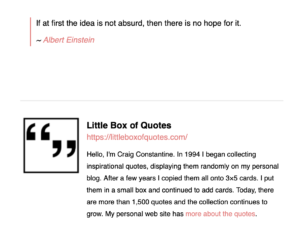
I didn’t set out to collect quotes. I simply wanted to randomly be inspired, or challenged to think, by things others have said or written.
…and 30 years later, I now get a little email from my past self every day. No noise. Just a quote. https://littleboxofquotes.com/
In 1994 I began collecting inspirational quotes, displaying them randomly on my personal blog. After a few years I copied them all onto 3×5 cards. I put them in a small box and continued to add cards. Today, there are more than 1,500 quotes and the collection continues to grow.
ɕ
Gratitude is like the good faith of traders—it maintains commerce; And we often pay, not because it is just to discharge our debts, but that we may more readily find people to trust us.
~ Rochefoucauld
Elsewhere, this is 4a1376. — slipbox
Pick an arbitrary, stupid goal, become totally involved in it, and pursue it with vigor, and what happens to you in that pursuit is your life.
~ Kenny Shopsin
Elsewhere, this is 4a1375. — slipbox
Clear cut and plant. Clear cut and plant. I’m not sure, but this doesn’t feel like a great idea. I started reading this article thinking it wasn’t going to be that interesting. I was wrong. I’ve moved through forest where there are no trails: doing boundary monitoring and corridor maintenance for the Appalachian Trail Council, and bush–whacking towards rock climbing. It’s type-2 fun. But reading about what these super-humans do to move through clear-cut “blocks”… *shudders* that’s definitely type-3 fun.
Up in the sparsely populated wildernesses of the north, meanwhile, logging companies work 24/7 to fell trees for lumber, leaving behind ‘cut blocks’ – bleak fields of stumps, mulch, roots and detritus covering thousands of hectares. Following in their wake come hordes of seasonal tree planters, who drive for miles up dangerous roads to enter these remote areas. Staying in basic bush camps, off the grid and armed only with shovels and bags of saplings, they set about creating new forests from scratch.
~ uncredited, from The tree musketeers
Elsewhere, this is 4usoai2. — slipbox
“Fun” comes in 3 types: Type-1 fun is fun in the moment. Type-2 fun isn’t fun now, but we’re really going to enjoy this once we get past this sucky part, even more so as soon as we’re done, and especially years from now when we retell this story. Type-3 fun isn’t fun now, mistakes have been made, life choices need reconsidering and this is actually going to be a cautionary tale when retold.
ɕ
Reading time: About 5 minutes, 1000 words
Get 7 for Sunday in your inbox. → Subscribe here.
This issue is https://7forsunday.com/72
Preparation—getting everything just so, the right desk, the right software and computer, the right room, the right beverage, the right time, the right mindset—is really simply a form of hiding. Sometimes it’s only a few moments, sometimes it’s days, but I always hide before writing every single one of these blog posts. I definitely don’t enjoy the hiding. I mildly enjoy the writing. I love the reading and thinking parts that this 13-year labor of insanity requires. But some people are not only good at the writing, they absolutely love the craft of writing itself.
While you or I may respond with a counter-argument, Tolkien went home and wrote 148 lines of heroic couplet […]
~ Brenton Dickieson from, The Effect of J.R.R. Tolkien’s Mythopoeia
Elsewhere, this is 4uaimy2. — slipbox
This seemed insane. Who would take an idea for a counter-argument, from a conversation, and rush off to go write for what must have been hours? And then I realized that I do that sort of thing all the time. I run with an idea down some rabbit hole, forming it into something real in the world. It’s only that I don’t it with writing.
ɕ
If you make people think they’re thinking, they’ll love you. If you really make them think, they’ll hate you.
~ Don Marquis
Elsewhere, this is 4a1374. — slipbox