This entry is part 21 of 25 in the series M. Eades' Blog
Meat eating made us human. The anthropological evidence strongly supports the idea that the addition of increasingly larger amounts of meat in the diet of our predecessors was essential in the evolution of the large human brain. Our large brains came at the metabolic expense of our guts, which shrank as our brains grew.
This entry is part 21 of 72 in the series My Journey
I’ve been slowly making steady progress on a number of healthy goals. One of them is good ‘ol weight loss.
It is important that I avoid going crazy with snack food. But sometimes I simply get hungry between meals. And most importantly, because I’ve been doing intermittent fasting, it is very important that I have something ready to eat at Noon in cases where a full meal isn’t easy to get. So if I’m driving, or out doing something with friends or family, and Noon rolls around… what are you going to do? I don’t want to be a stick-in-the-mud and demand we stop what we’re doing to have lunch promptly at Noon.
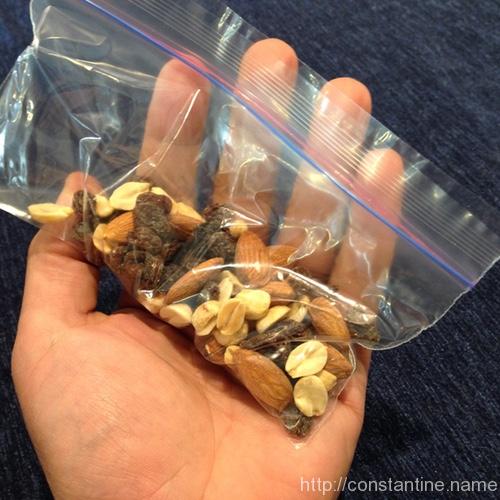
GORP to the rescue!
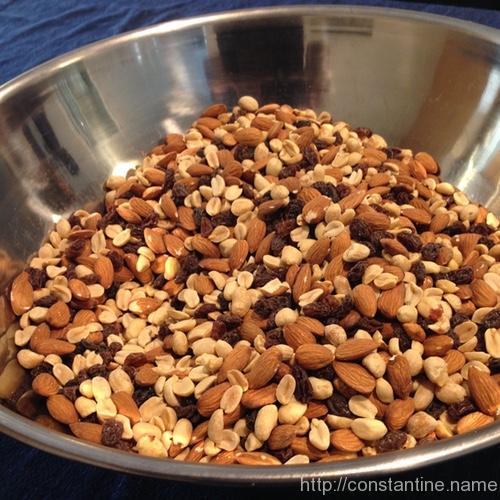
GORP is simply Good Old Raisins and Peanuts. But I particularly like mixing in raw almonds to get the micronutrients, and fat — fat is GOOD for you! Peanuts are not a true nut by the way. So this recipe is just roughly equal part mixture of raisins, peanuts and almonds. (Note, dry roasted unsalted peanuts, raw unsalted almonds.)
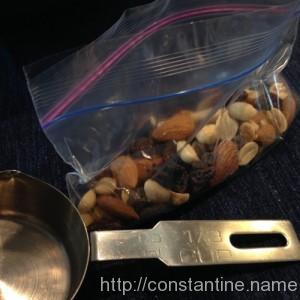
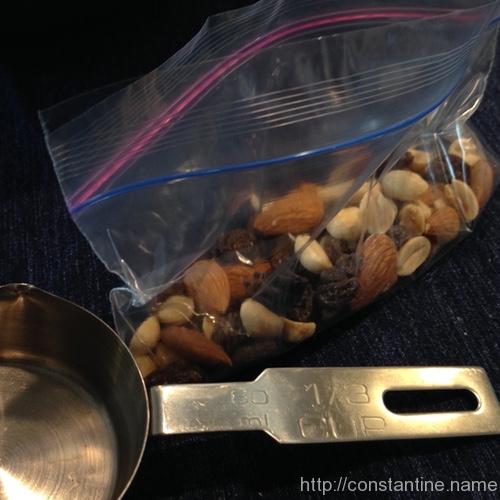
I mix this up in bulk, and measure it out in 1/3 cup servings in small snack size plastic bags. You get about 45 servings out of this batch. The serving size is deliberate: It is about 240 calories; about 22g fat, 19g carbs and 11g protein. So I know I can have one of these with ZERO guilt. They are small enough to fit/carry anywhere, and small enough in calories to have little effect on whatever dieting you may be doing. On the other hand, they are large enough in calories and nutrition that I can easily go a couple hours before getting hungry again for a meal.
Update May 2016
There are two things to notice.
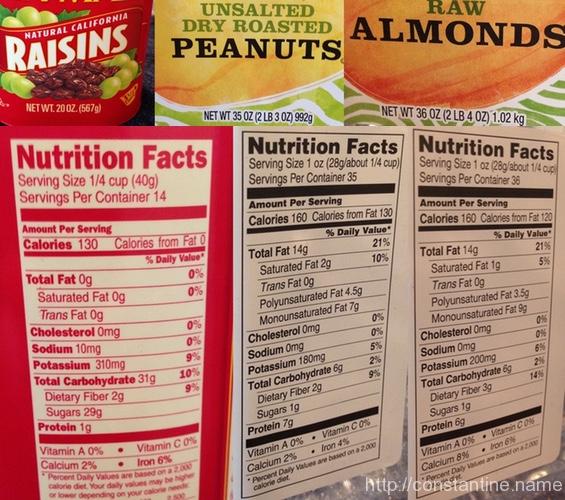
The nutrition info I’ve given comes NOT from the “serving size” info on the containers. Instead, I extrapolated to get the nutritional data for the entire container and then divided by the number of 1/3-cup servings I make out of the entire mix.
240 calories is a surprisingly small handful of this stuff. Every time I eat one of these, I think, “I’m hungrier than this size… but ok I’ll start with this.” Then, an hour later I’m like, “I fell for it again… 240 calories was enough.”
This entry is part 20 of 72 in the series My Journey
Instead of berating yourself when you’re not motivated to exercise, or getting mad at yourself when you struggle with eating unhealthy food, take a step back and look at it from a different angle:
“How can you build the habit of success and put your focus there, instead of chasing the motivation to make it happen?
It’s easy to become ensnared – to chase motivation and fail – or rationalize inaction and never try. Every single one of us has fallen into this trap. I’d love to hear about your experience with this, and how you plan to (or already have) overcome it.
In a vague sort of way, I found this idea in my own training. As usual, Steve Kamb brings clarity to the party. This idea of incremental actions, of habits, and little processes that make success a foregone conclusion is at the core of my Parkour training.
… demand doesn’t pick up quickly as prices drop. We are dealing with a world that has a huge amount of debt. China in particular has been on a debt binge that cannot continue at the same pace. A reduction in China’s debt, or even slower growth in its debt, reduces growth in the demand for oil, and thus its price. The same situation holds for other countries that are now saturated with debt, and trying to come closer to balancing their budgets.
I have now discussed this a few times, and a common objection raised is that she is over-complicating a simple case of supply-and-demand. To which I say: What part of our enormous, intertwined, legacy, critical to everything from food to medicine to transportation to energy production, global dependency on petroleum is simple?
This entry is part 20 of 25 in the series M. Eades' Blog
The anthropological record of early man clearly shows health took a nosedive when populations made the switch from hunting and gathering to agriculture. It takes a physical anthropologist about two seconds to look at a skeleton unearthed from an archeological site to tell if the owner of that skeleton was a hunter-gatherer or an agriculturist.
When you combine the science of recognizing deception with the art of looking, listening, you exempt yourself from collaborating in a lie. You start up that path of being just a little bit more explicit, because you signal to everyone around you, you say, “Hey, my world, our world, it’s going to be an honest one. My world is going to be one where truth is strengthened and falsehood is recognized and marginalized.” And when you do that, the ground around you starts to shift just a little bit.
I have seen this happen more times than the number of yaks I’ve shaved. At nearly every job I’ve had, I’ve walked this fine line. I’ve had performance reviews where I’ve been called pushy, aggressive, assertive, abrasive, or bitchy simply for speaking up in a similar manner to that of my male colleagues, and on the other side of things, I’ve been interrupted and spoken over more times than I can count. I’ve worked at places where I was the only one being interrupted (backstory: I’ve been the only woman in a lot of engineering departments), which has bothered me. But I’ve also worked at places where everyone interrupts each other all the time. For a while, I thought that was better. “At least I’m not being spoken over because I’m the only woman; the guys get interrupted too,” I thought to myself. But everyone interrupting everyone else really isn’t that much better.
For, let’s say, the first half of my life, I was always the one doing the interrupting. As I’ve begun to listen, I now realize how much everyone interrupts everyone else. When I’m relaxed and on my game, I try to have a meta-listening happening so I can tell when to stop talking to keep the conversation working. As best I can manage, when I’m interrupted, I simply stop talking.
But sometimes, just for fun, I like to toss this in quietly while the interrupter is still speaking…
Oh! I’m sorry, did the middle of my sentence interrupt the beginning of yours?
Following “via negativa” may seem like a defensive and risk-averse way to live. But by focusing on what you don’t do, you actually put yourself in a position to be more aggressive with life. The man who has never been arrested, doesn’t have debt, and doesn’t have the drama that comes with bad relationships has more opportunities presented to him and more money, energy, and willpower to capitalize on those opportunities when they appear; the man who has gone though life making stupid mistakes, doesn’t. In other words, you’ll never get a chance to work on the “shalls” if your life’s been wrecked by ignoring the “shall nots.”