Wassup? Catchin’ a train to Boston…
ɕ

Wassup? Catchin’ a train to Boston…
ɕ
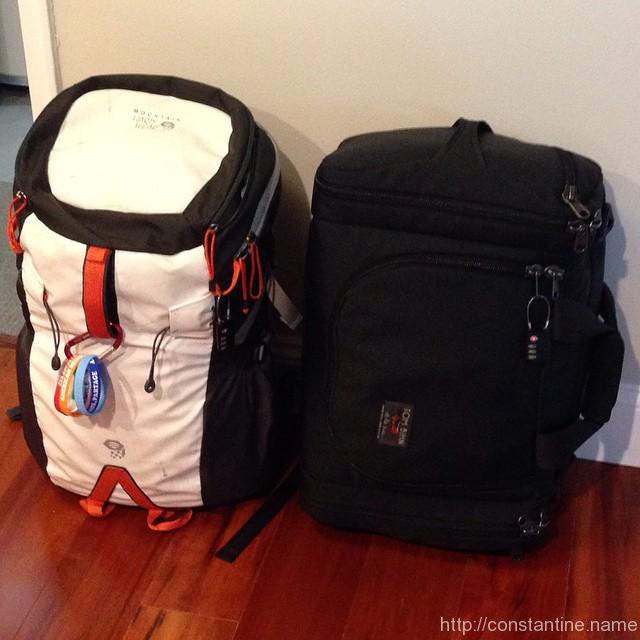
Packed and ready to “parkour floor” it in Boston. But first, a detour to the Wells Fargo Center in Philly for the Rush 40 Tour concert!!
ɕ
Instead of specializing someone who is specialized in something else, we need to un-specialize them. We need to give people what they don’t have at the foundational level first. …
Once that foundation is established we’re able to move into almost any specialized activity, and that’s the goal. Not just to be good at exercising for a while, but to have bodies that are capable of doing whatever we want without injury in the real world, for the rest of our lives.
~ Matt Malloy from, «http://roguedenver.com/variability-fitness-training/»
ɕ
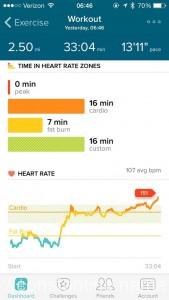
A while back I mentioned I’ve been experimenting with a FitBit HR and an intentional, designed, fitness program. I’ve been playing with this more. I originally didn’t like that I couldn’t just redefine all the zones to the HRs that we’re targeting.
Most, tradition/common workout programs I’ve seen have just 3 heart rate (HR) zones based on a maximum HR which is simply computed based on your age. The plan I’m working with from Mike, is significantly more complex. (Details for another post I suppose.) Anyway, the plan calls for very specific workouts, for example: “17 minutes in Z1”.
I noticed on day one, that the FitBit only has one “custom zone” that you can configure. So, I’ve begun manually setting the “custom zone” to the goal HR before some of the workouts. Once I plug in the specific Z1 lower/upper numbers, I can then set off on the workout.
On the device, there is an icon-based display that shows you quickly if you’re below/in/above the target zone. Normally, the icons refer to one of the FitBit’s built-in zones. But it turns out that if you set a custom zone, then the icon status is for your custom zone. Ok, now THAT’S useful!
The above screen grab is from a morning run where I had the custom zone set to my specific Z1 values. The graph shows the FitBit’s default zones (blue/”under”, yellow/”fat burn”, orange/”cardio”) and it overlays my custom zone as the hatched band. The bar graph even adds a value for the time in the custom zone.
In this example I set out to perform, after warming up, for 17 minutes in Z1. …and BAM! 16 minutes in Z1 by it’s measure. Now that’s a targeted workout.
Aside: The tail end of the graph was a strong-run-out, 1/4 mile. My opinion is that the FitBit sucks at picking up highend HR. Either that, or I’m a machine, and can run an 8 minute mile pace at a 151HR. …and it’s not the latter of those two.
ɕ
It’s a shame that it generally takes a tragedy to remind us how short and unexpected life can be, and that we need to enjoy every day. The stark realization is that inorder to live our lives fully and happily, we have to remember we have no extra lives.
This is it.
Did you enjoy your story?
~ Steve Kamb from, There are no extra lives. Make this one count. | Nerd Fitness
Elsewhere, this is 4unebo5. — slipbox
ɕ

Next up… start learning some bio.
ɕ
There are people who build things and people who tear things down. Just remember which side you’re on.
~ Sharon Ann Lee
Elsewhere, this is 4a56. — slipbox
Here’s what it boils down to: Human beings are simultaneously individuals and members of society, not fundamentally one or the other. Some issues (like free speech) are easier to understand from the individual point of view, while others (like traffic) require a social point of view.
~ Doug Muder from, The Individual and the Herd | The Weekly Sift
Elsewhere, this is 4uwete1. — slipbox
This is a long read and it’s *gasp* “thinky.” It’s also about *swoon* vaccination, but it’s really about individual rights and social responsibility. Repeat this phrase over and over, “an intelligent person can consider an idea without accepting it,” and give this a read.
ɕ
He replied that although the drug did dissolve gallstones, it didn’t treat whatever the underlying problem was causing the gallstones in the first place. Patients who took the drug, got rid of their stones, but as soon as they went off the drug, the stones redeveloped. He said the only effective permanent treatment of gallstones was to remove the gallbladder.
Over the next few years of my medical education, I learned this was the common wisdom on dissolving gallstones. It can be done, but what’s the point? The stones will simply come back.
Turns out, however, that there may well be a way to avoid surgery, get rid of gallstones and, most importantly, keep them gone.
~ Michael Eades from, «http://www.proteinpower.com/drmike/low-carb-diets/get-rid-gallstones-without-surgery/»
ɕ