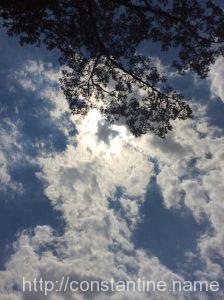
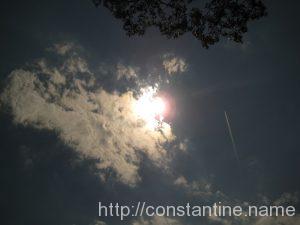
The mostly eclipsed solar disk is in the middle of this photo– just a bit above the center. Normally, at this stage of the eclipse, the partly exposed solar disk would cause retina damage if you look at it directly. But thanks to this cloud… ok, fine, yes, clouds don’t block UV light so looking at this is a BAD idea. I looked quickly. A few times. It was TOTALLY worth it. Here, you can look all you want, but you might need to zoom in a bit…
The entire eclipse was very “busy”. It was clear, then some clouds, then clear, a cloud… the viewing conditions changed second-by-second. Truly a rare event to see.
But I still don’t see ads in my Instagram feed. Literally none. This might be because I don’t have a Facebook account, or might be because my Instagram account is flagged in some sort of hidden way because of my prominence from here at Daring Fireball, or might be a bug. This has been a years-long mystery to me (that I probably shouldn’t complain about).
I understand why Instagram is adopting Facebook features: They work. But for years I logged into Instagram and enjoyed it more than Facebook. I fear a day when I wake up, open my phone and can no longer tell the difference between the two.
Reminder: On social media, YOU are the product being sold to the advertisers.
I recently deleted my Instaspam account entirely. I used to enjoy posting and viewing, but it’s just a useless stream now (like Bookface.)
Meanwhile, way back in the beginning, I had the foresight — knowing Instaspam would get eaten, monetized and rot into junk — I used a plugin on my site which kept all my photography: They are still locatable here, with one of my favorite tags: #Instaspam
If you ask anyone who’s read [Fahrenheit 451], that hasn’t read it in like 20 years, “What do you remember of how that came to be in the book?” They’d say, “There’s this totalitarian government.” The truth is, it was the people. It was the people who decided that any dissenting opinions that would offend specific groups in society, ought to be burned. So it was self-inflicted. I think that’s what we are doing right now. We are slowly torching the first amendment and free speech by, basically, going on these witch hunts. I think it’s the most dangerous thing in the U.S. right now.
In Allen Ginsberg’s poem “Howl” (1955), Moloch is used as a metaphor for capitalism and industrial civilization, and for America more specifically. The word is repeated many times throughout Part II of the poem, and begins (as an exclamation of “Moloch!”) in all but the first and last five stanzas of the section.
I just recently, (in the scale of my life,) stumbled over an explicit reference to Moloch. I was all like, “Moloch? Who the what is that? *bookmark*”
I finally got around to reading the WikiPedia article and realized that there’s a huge amount of Moloch wriggled into and behind a ton of the classic fiction which I love.
To say that I “struggle” with distractions is a HUGE understatement.
Some time ago, I saw the following idea — sorry, I forget where — and I wanted to share it. (I’ve no idea if/how you would do this on non-Apple-IOS devices, sorry.) Ready?
Move EVERYTHING off of the home screen.
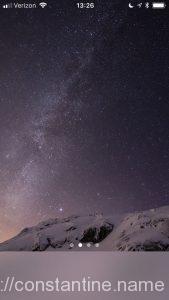
This is not the lock screen on my phone — THIS IS THE HOME SCREEN. When I unlock the phone, this is what I see. Nothing. The frequent-apps/dock is empty, and all the apps are ‘rightward’ in other screens. And they’re just in a jumbled mess because I never swipe off this screen.
Instead, I swipe down and type in the search field.
Perhaps you’re thinking, “so what?”
It changes your life. I spent weeks (after making this change) waking up my phone, staring at this screen and thinking, “wait, why did I wake up my phone?” Now I think, “what’s the weather going to be?” wake the phone, swipe down, type ‘w-e’ touch weather app. Etc. Wake the phone, do exatcly what I want, close phone.
Yes, this does still require a small bit of discipline to not double-tap Home and swipe through the running apps, but I never was a big user of that anyway.
If you’re paying close attention, you’ll note my phone is in “do not disturb” mode at 1:30 in the afternoon. That’s another pro-tip. Add EVERYONE you’d ever want a call from to your VIP list. Disable the “ring through” feature (where multiple calls from the same number can push through do not disturb). Then schedule DND from 11:01 to 11:00 daily. <<= …read the ordering of those times carefully.
(…and sorry, no, that is not the one-secret-minute when you could actually call me.)
Any time I’m expecting a call from someone random — car’s in the shop, plumber is expected around 9am — I just turn off ‘do not disturb’. As a bonus, I immediately realize how many junk calls I used to get. I don’t have a problem remembering to turn it back on, and I get a fresh reminder of how delightful it is to have the phone screen my calls.
These days?
My phone now NEVER rings.
Except when it does! …and I discover that it is now always someone I would like to talk to.
Imagine you’re walking through a forest. I’m guessing you’re thinking of a collections of trees — what we foresters call a “stand” — with their rugged stems and their beautiful crowns. Yes, trees are the foundation of forestes, but a forest is much more than what you see.
One of the most fascinating portions of her treatise, for it applies to nearly every aspect of life in every era at every level of society, deals with the complex ecosystem of talent, ambition, and success — what we do with our talent, what others make of our success, and how to cope with one of the ugliest impulses of the human heart: the small-spirited urge to tear down those who have risen to prominence by their own merit.
This photograph best captured the mood and lighting, just as the eclipse began, when these wispy clouds slid before the show. It gave us a welcome variation from trying to stare directly at the naked sun.
…now I want to write a science fiction novel about a planet full of aliens who are perfect game theorists, but who always behave kindly and respectfully to one another. Then some idiot performs a census, and the whole place collapses into apocalyptic total war.
That pull quote is simply fun. The article is actually a serious attempt to pick apart an interesting philosophical question.
I’m not sure I agree with his conclusions… actually, I’m not even sure I understand the question he’s thinking about. But I find that the more I peek in the dark corners of the basement of my philosophical ideas, the more comfortable I sleep at night.