I think that there’s a certain delusional quality that all successful people have to have. You have to believe that something different can happen.
~ Will Smith
slip:4a247.
I think that there’s a certain delusional quality that all successful people have to have. You have to believe that something different can happen.
~ Will Smith
slip:4a247.
The world breaks everyone and afterward many are strong in the broken places. But those that will not break it kills. It kills the very good and the very gentle and the very brave impartially. If you are none of these you can be sure it will kill you too but there will be no special hurry.
~ Ernest Hemingway
slip:4a184.
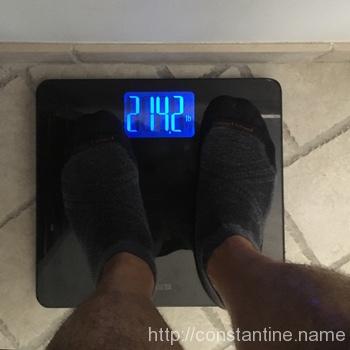
I’m not quite ready to publish scantily-clad selfies… so I left my socks on. I’ve a target weight in mind which corresponds to 20-year-old-me and a good photo from 1991.
Meanwhile…
This is the least I have weighed in 20 years. About 55 pounds (25kg!) lighter than 2008.
A visiting Finn mowed my lawn for me yesterday, and so I had time for one last run on this continent before I leave for a triple-stop Parkour trip in about twelve hours.
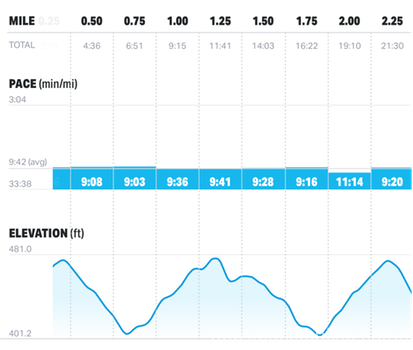
The graph is a little odd because I didn’t stop the tracking immediately, so there’s a huge bar for the last split (not shown.) It’s a lollipop route, so the 11-minute split is up the slight hill which I ran down at ~9-minute pace. The whole run came in about 9:33, which is right on the fastest I’ve ever run this. This time was much more uniform in pace than the last time I ran this.
Why do I post this stuff? Because whomever you are, whereever you are in your physical fitness (or complete lack thereof), you can simply do what I did: Start where you are.
ɕ
What motivates and sustains a practice that evolves personal fulfillment and builds community?
Dylan Johanson is the owner and founder of Innate Movement Parkour in Kingston, New York. A practitioner for many years, Dylan talks about his origin story and the challenges surrounding building and then re-building his gym. Then he shares some thoughts on what advice he would give his younger self.
Sometimes, I still need to remind myself to not accidentally slip onto the treadmill of traditional success.
~ Dylan Johanson (18:00)
The conversation explores Dylan Johansson’s journey into parkour, from discovering the practice to founding Innate Movement in Kingston, New York. Early topics include Dylan’s initial experiences with parkour, how it resonated with his love for movement, and his shift from solitary training to engaging with a larger community. He describes the transformative effect parkour had on his health, outlook, and life choices, emphasizing the physical and mental benefits it provided.
Later discussions focus on the process of building a parkour community, including the challenges of starting and sustaining a gym. Dylan recounts how he transitioned from hobbyist to professional coach, discussing incremental growth strategies, the importance of partnerships, and lessons learned from different gym setups. The conversation also reflects on broader themes, such as defining success on one’s terms and embracing the evolving nature of personal practice.
(more…)Do the difficult things while they are easy and do the great things while they are small. A journey of a thousand miles must begin with a single step.
~ Lao Tzu
slip:4a234.
Nature has given us two ears, two eyes, and but one tongue – to the end that we should hear and see more than we speak.
~ Socrates
slip:4a101.
I believe attention is one of your most precious resources. If something else controls my attention, that something else controls what I’m capable of. I also believe your full attention is required to do great work. So when something like a pile of group chats, and the expectations that come along with them, systematically steals that resource from me, I consider it a potential enemy. “Right now” is a resource worth conserving, not wasting.
~ Jason Fried from, «https://m.signalvnoise.com/is-group-chat-making-you-sweat-744659addf7d»
Certainly there are situations where real-time chat is the right tool. But I think real-time chat is the rare case.
ɕ
The road to success is through commitment, and through the strength to drive through that commitment when it gets hard. And it is gonna get hard and you’re gonna wanna quit sometimes, but it’ll be colored by who you are, and more who you want to be.
~ Will Smith
slip:4a690
Truth be told, if I really wanted to help people lose weight I would increase the price of Eat Stop Eat to 100 dollars per book. Far less people would buy it, but those who did would be invested heavily in making a change in their lives. They wouldn’t just read about fasting and weight training, they’d actually practice it.
~ Brad Pilon from, What Do You Do When A Friend Asks You For Advice On Losing Weight? – Brad Pilon’s ‘Eat Blog Eat’
slip:4ubawe1.
Call it wisdom– Call it Imposter Syndrome— whatever. The more I learn about health, the more I’m convinced I know nothing.
For me, the solution to my unhealth was to change my life. Not, “more exercise,” but “rediscover moving.” Not, “eat better,” but “listen honestly to my body.” Not, “lose weight.” — there’s no, “but…” on that last one; The weight loss just happens the more I change my life.
ɕ