What is synergy? Simply defined, it means that the whole is greater than the sum of its parts. It means that the relationship which the parts have to each other is a part in and of itself. It is not only a part, but the most catalytic, the most empowering, the most unifying, and the most exciting part.
How can movement practices, particularly parkour, serve as tools for self-transformation and personal growth?
Rafe Kelley dives deep into his thoughts about the hero’s journey and it’s relevance to parkour. He shares his own journey and research into parkour and movement, finding meaning in practicing, and why he trains in nature. Rafe discusses parkour’s power as a transformative practice, the spirit behind it, and what makes it unique.
What parkour does is it provides a mini hero’s journey that can be approached over and over again in your training sessions.
~ Rafe Kelley (3:23)
The conversation explores the idea of using movement practices, particularly parkour, as a means of personal and psychological transformation. Parkour is likened to a mini hero’s journey, where practitioners confront challenges, overcome fears, and grow through deliberate practice. The discussion goes into the concept of combining elements from martial arts, natural movement, and mindfulness to create a holistic approach that transcends mere physical skill, addressing deeper aspects of human growth and connection.
The narrative extends into the philosophical underpinnings of movement, discussing how metaphors and embodied cognition play crucial roles in shaping our understanding of life and self-improvement. Insights from mythology, evolutionary anthropology, and cognitive science are woven throughout, emphasizing the importance of integrating physical practice with psycho-technologies. This integration seeks to cultivate wisdom, foster resilience, and inspire meaningful transformation.
The Movers Mindset project is challenging for me. I have a large number of pieces in place. I’ve discovered many different interesting questions to explore, and I’m well on my way to digging in to find some answers. I’ve created something which I wish I could have found many years ago, early on in my journey.
And yet, I haven’t found many people who see value in the project. Everyone likes the podcast, but that’s as far as I can seem to get the idea to go.
Here’s what I have so far…
Movers Mindset explores themes like independence, self-direction, and human excellence through podcasts, website content, and a community of like-minded people. In the podcast, I interview movement enthusiasts to find out who they are, what they do, and why they do it; The podcast focuses on the journey of self-improvement and its underlying motivations, as well as movement’s fundamental place in society. On the website we publish free content, (much of it in three languages,) including podcast transcripts, show notes, articles submitted by people, and original content. In the Movers Mindset community I’m looking to discuss everything related to independence, self-direction and human excellence; I’ve started discussions on how to make the Internet work for you, thoughts about social networks, questions and answers about training from athletes, podcast-guest followups, and more.
Feedback on the project has been overwhelming positive. Over the past four years I’ve slowly expanded the project. I’ve changed things along the way, giving the project a new name back in 2018 and recently breaking the podcast episodes into seasons.
How do I do a better job of telling the Movers Mindset story?
The reasons why the Green New Deal won’t really work are fairly subtle. A person really has to look into the details to see what goes wrong. In this post, I try to explain at least a few of the issues involved.
You should read everything Tverberg has ever written about energy. I’ve been following her for about 15 years or so, and she is a font of careful, reasonable discussion.
Working deep is the answer for me. To be happy, to feel good about myself, to not feel guilty about sucking up my share of oxygen on the planet. I have to get back to it.
I too am drawn to deep work. I wonder if there’s anyone who is not?
But for me, deep work seems to not be enough. I also need deep learning. I need to spend two uninterrupted hours reading something, (perhaps S Ambrose’s Eisenhower, or T Ferris’s Tribe of Mentors,) with stops to copy out quotes, detours to lookup some detail, bookmarking of another author’s work, and so on. My mind is one large pressure-cooker, and I need to regularly vent the pressure, pop the lid and jam new stuff in before sealing it back up again on medium heat.
Roughly a quarter of U.S. adults (27%) say they haven’t read a book in whole or in part in the past year, whether in print, electronic or audio form, according to a Pew Research Center survey conducted Jan. 8 to Feb. 7 [2019].
Once I started seriously listening to podcasts, I quickly reached the point where there are more podcasts, (entire shows, not just episodes,) than I can possibly keep up with. I’m left with the choice between staying subscribed to podcasts where I want to listen to only some of the episodes, or unsubscribing and knowing that I’m missing some gems.
…and then I remember this is all just RSS.
In my podcast player, (which is Overcast,) I now keep only the shows that are my dedicated favorites; shows that I generally listen to every episode. I moved all the other podcasts into my RSS reader, (which is Reeder.) I even added a bunch of shows which I had completely given up hope of being able to even follow them looking for gems.
This had two huge benefits:
First, it improved my podcast listening experience: Not keeping all of those podcast shows subscribed in my podcast player, means less downloading and less skipping. I don’t like having to wait, so I have everything set to pre-download, and removing a lot of podcasts makes a big difference. But even more important, there’s now much less distraction. When I’m in the mood, (or the time, or the place,) to listen to podcasts, I tend to continue listening by default. I’m more likely to listen “just a bit farther” to see if this episode is going to be good, whereas if I had read the summary I might have skipped it altogether. So my podcast listening experience winds up having far more great episodes because it’s just the shows I love.
Second, it actually leads to me finding more gems: When I open my RSS reader, (as I do every day,) I’m in “skimming mode.” I’m looking for things to queue for later reading. (Pocket and Instapaper for the win.) There’s very little effort for me to skim the episode descriptions, and when I find one that looks good I add it to my podcast player. This does require me to switch apps, search, and then add a specific episode. But this small effort helps ensure that the episode is likely to be one I would really like to listen to.
There’s one detail that is a slight snag: How do you find a podcast’s feed URL? We’re all so used to searching in our podcast player apps, but you need the actual podcast feed URL to add it to your RSS reader. You’ll discover that none of the podcast player apps, and none of the directories, (Stitcher, Google, Apple, etc.,) make it easy to find the shows’ underlying podcast URL. The easiest way to do it is to use the handy search on James Cridland’s, Podnews.net (no relation/benefit to me.) It pulls the show’s information from the directories, and explains all the details about that show’s configuration including a handy RSS link icon that has the URL.
So, unpacking this idea a bit more, with some visuals we have…
Feedbin
If you don’t already have a favorite RSS reader, the easiest way to start is to use a web site which will corral all your RSS subscriptions. It will show you a nice web front end with all your feeds together. Later, if you want to run a dedicated RSS reading application on your phone or computer, any of the good ones will let you say, “I have my subscriptions in Feedbin,” and boop! you have all your feeds: Feedbin.
RSS in action
Here’s an example of what it looks like when I encounter an updated podcast feed in my RSS reading application.
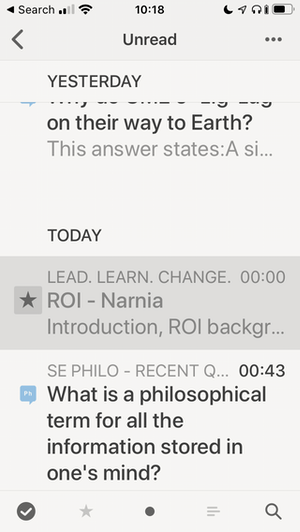
Here’s the “stream” of RSS items. Sorry, I have the font size on my phone super-huge; so this only shows a few items. But the first one, under “Today”, is from a podcaster friend’s show.
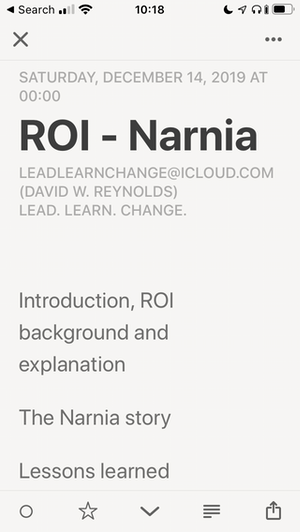
Touching it leads me to the full RSS item’s view. Exactly what you see in this view depends on exactly what each RSS feed chooses to include.
I’m still not on the web here—still simply looking at the data in the RSS feed.
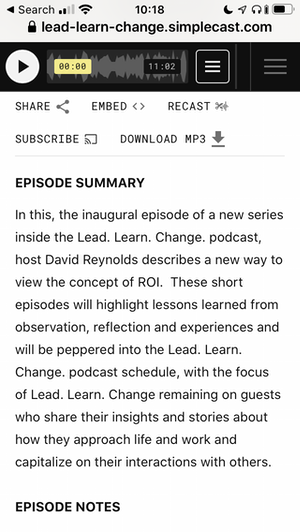
At this point, my brain goes, “oh yes! David put out his next episodes!” Let’s see what he’s written up… (swiping left) I get an in-app web browser view of the item from his web site.
I could even press play, right here, if I had 11 minutes.
If this were an episode I wanted to listen to—in my “I’m listening to podcasts” mode, as I described above—then I’d flip over to my podcast app and search for this episode and add it to my listening queue. In reality, it’s even easier: My podcast player app remembers the shows I’ve listened to before, so I can just touch the show, scroll to the episode and hit ‘download’ for later listening.
You can keep an eye on a LOT of podcasts this way—looking at their descriptions—without piling up more in your podcast player than you can possibly listen to.
You’ve spent years learning how to read and write, years learning how to speak. But what about listening? What training or education have you had that enables you to listen so that you really, deeply understand another human being from that individual’s own frame of reference?
It has to be territorial, not hierarchical. Meaning real success comes from the inside out, not the outside in. Real success is the process, not the product. It’s what we would do if there were nobody else in the world, yet it depends in the end on everyone else in the world. The essential expression of our art is that of a gift. We draw from that which is most ourselves–and then offer that essence to our fellow travelers on this planet, to help them, entertain them, show them they’re not alone … asking nothing in return (well, maybe enough to pay the rent, we hope.)
This is a classic that has nothing at all to do specifically with writing. If you are involved in creating anything, you will find this is a great article with a long list of elements of success. (“Elements of Success” is his title.) After you read this, you should run—not walk—and get a copy of his book War of Art; you can thank me later.
Anyway.
The paragraph above really spoke to me. The idea that “success is the process” is something I keep losing hold of. Like a swimmer who keeps forgetting that kicking effectively and continuously is a necessary part of staying afloat and getting there, I keep forgetting that the process is success and I begin to struggle.
Many realize that 50 years ago, on October 29, 1969, the first message was successfully sent over the ARPANET, which eventually evolved into the Internet. But few know the story that led up to that message.
The Internet as we know it today was really born in the early 90’s. I remember when web sites—”The Web”—was invented. I was a graduate student in Physics back then. There used to be a web site at UIUC where someone kept a list of all the web sites. (People would email them when they added a web site to the Internet.) I used to check that site every day—and get excited on the days when a new web site had appeared.
…at least, that’s how I remember it. ;)
Anyway, great little read about some of the people who started it all, and the very first message across the Internet v1.
ɕ
Rebecca Brightly: Parenting, gender, and representation →
How do personal experiences with movement practices and societal dynamics shape an individual’s perspective on gender roles, personal growth, and parenting?
Rebecca Brightly discusses the changing dynamics of going from Lindy Hop to motherhood and unpacks her parenting philosophy. She explains why she tolerates parkour and how the gender dynamics contrast with her experience in dance. Rebecca gives her thoughts on gender representation and why she wants women to see how capable they are.
My philosophy is overcoming challenges is what helps build self-confidence. In fact, my opinion is that overcoming challenges is the only thing that builds self-confidence.
~ Rebecca Brightly
Rebecca shares her journey transitioning from Lindy Hop to motherhood and then to parkour, reflecting on how each phase shaped her perspective on community, personal growth, and gender dynamics. She describes the challenges of navigating a dance community that lacked family inclusivity and the complexities of balancing parenthood with her passion for movement. Rebecca contrasts her experiences in Lindy Hop, which often adhered to traditional gender roles, with parkour’s individualistic approach, finding liberation in the absence of physical imposition.
Throughout the conversation, Rebecca goes into broader themes of societal expectations and personal empowerment. She explores how parenting intersects with her belief in the transformative power of overcoming challenges and discusses her observations on how gender norms impact training environments. Rebecca’s insights highlight the importance of fostering self-confidence through resilience and adaptability, as well as the value of introspection in breaking down mental barriers.