Their minds are still childish when they are surprised by old age, which they reach without preparation and without weapons, for they have stumbled upon it suddenly and unexpectedly without realizing that it was stealing upon them day by day.
I maintain that, while the number of bugs and problems users experience is linear, their understandable frustration is exponential. It’s no wonder they have learned to tolerate poor-quality work.
I maintain that this is a symptom of the rise of “good enough.” The rise of, “just ship it and fail faster,” has created a culture where “shipping it” is valued over doing something well. The only thing harder than the first 90% of a project is the second 90% of the project. To create something that is a delight to use requires an enormous effort.
Our culture is currently being reshaped by companies who are training us via the fast dopamine hit. In that arena, creating things is a vicious competition. It feels as if there is no time to do something well and bring it to market. In the time it takes to do it well (for example, create 85 episodes of a podcast, write 2,500 blog posts, fill a bookshelf with journals) you will expend an enormous amount of time, energy and money. Sometimes, what you create will be so perfectly in time with the culture that the capriciousness of the market will reward you. Sometimes it will not.
But you must do the hard work. Not because you will necessarily be rewarded, but because other people need to see you doing the hard work. That will encourage and inspire them to try something harder than their current efforts. And that ratchets the culture up, rather than down.
I’m process oriented. I want to figure something out once, and then move on to having other interesting thoughts or experiences. That leads me to a sort of, “do one, cross off two,” mentality; I try to do more work up front—do the more complicated things first—in an attempt to reap a larger gain in the long run. I’m a tool builder you could say.
But my power of process, can also be a problem. There is, of course, an XKCD for this lesson: https://xkcd.com/974/. I digress.
Today, I wanted to share a bit of the process that I use to distill the things I find, and to focus my thinking. (I’m not going to go into how I find things, nor how I ensure a fresh “stream” of those things is brought to my attention.)
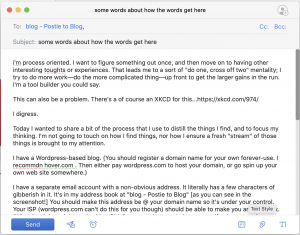
I have a WordPress-based blog using my own domain name. I also have a separate email account with a non-obvious address. It’s in my address book at “blog – Postie to Blog” [as you can see in the screenshot].
Whenever I see, read, or find something that inspires an interesting train of thought, I fire off an email to this special address. I simply brain dump my thinking. I insert bare URLs into the email. I put a “>” in front of blobs of text I want to show quoted. But I don’t bother with any formatting; it’s all just basic text.
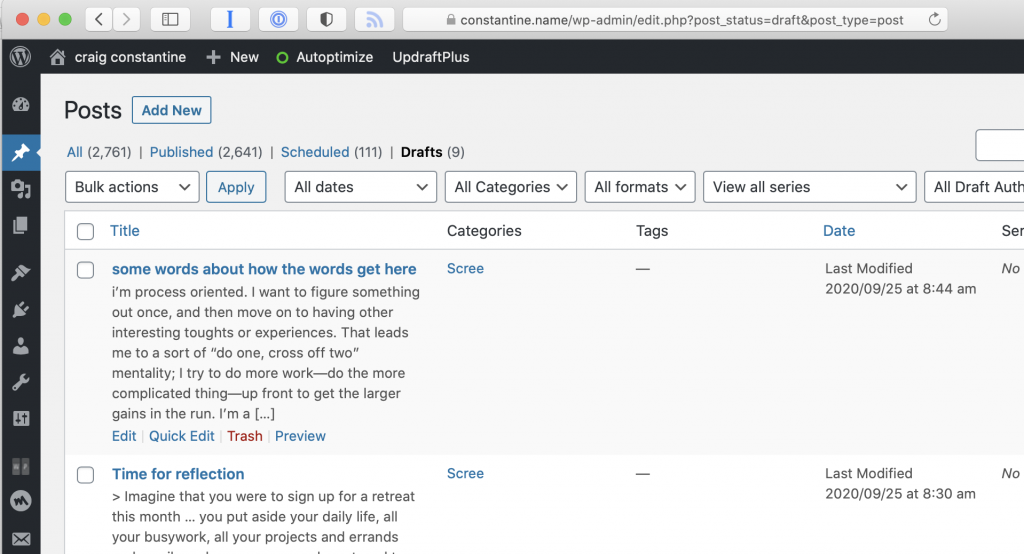
I use the Postie plugin for my WordPress site. It’s an email client which periodically looks in my special mailbox and creates draft posts on my site. It deletes the emails as it creates the drafts.
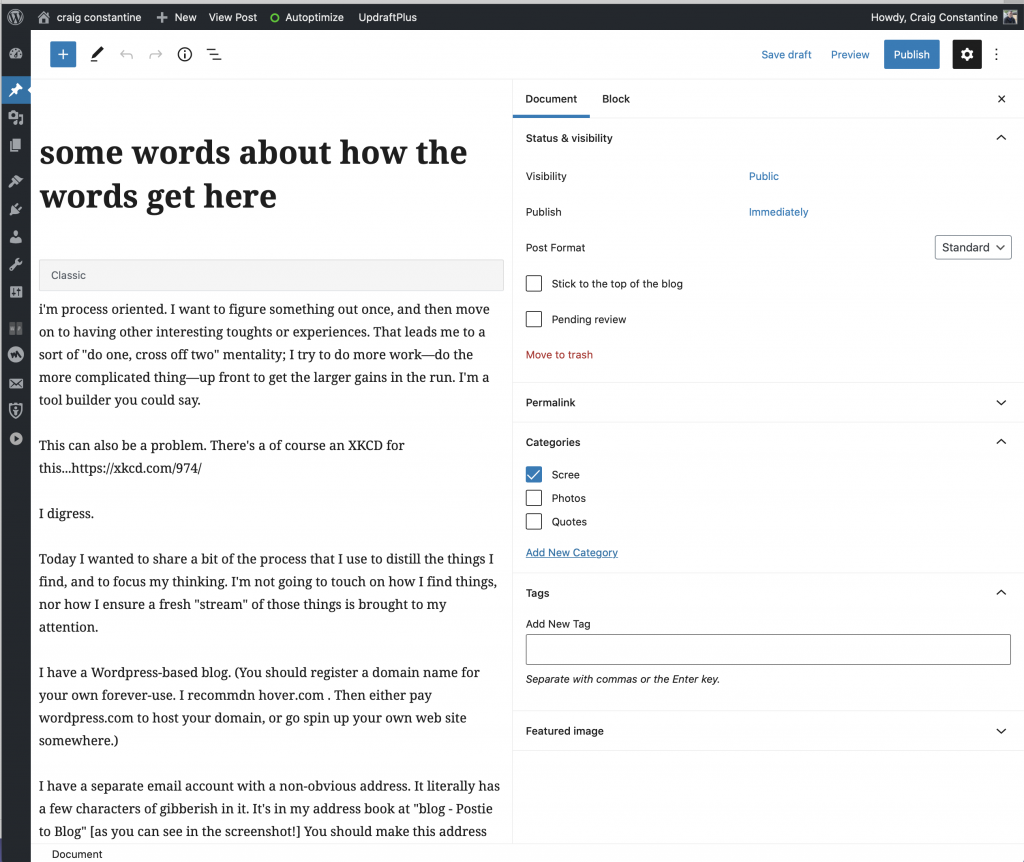
When I want to work on blog posts, I go into my WordPress site and look at my drafts. I clean up the draft—fixing anything that I couldn’t stand having out on the internet. I dress up the links, organize the quoted parts, season it with my personal style, etc.. Very rarely, I’ll simply delete a draft. This has the advantage of giving me a chance to review my ideas for posts at some distance from when I initially captured it. Most of the time, I can see ways to drastically improve the post, but I don’t bother preferring instead to post the snapshot I had originally captured. I schedule the post for whatever day I want it to go out on. I’m writing this blog for my own benefit—it’s part of my process of reflection. So it’s not usually important when any particular post goes public.
Finally, I have a Mail Chimp account that has a recurring Campaign. It follows the RSS feed from my site, and emails whatever it finds to be new at 11am every day.
Why? Well, that’s probably best left for another day.
There is always more to do than you can do, and you can do only one thing at a time. The key is to feel as good about what you’re not doing as about what you are doing at that moment.
Imagine that you were to sign up for a retreat this month … you put aside your daily life, all your busywork, all your projects and errands and emails and messages … and you travel to another place. In this place, you remove yourself from the busy world and find space for quiet. For reflection. For contemplation, setting intentions, reviewing how things have gone. For gratitude and appreciation for life.
Not only does hyper-connection alter our social relationships, it also makes us dumber, as pointed out as early as 2005. It threatens our health too. Twenty-first-century afflictions include digital fatigue, social media burnout or compulsive internet use. Cures for these rising internet-related disorders include such radical solutions as rehab centers, or disconnection.
Babauta’s take is from the Zen perspective of simply—as in: this is the only thing you have to do, and don’t overcomplicate it in the doing—creating space in your life. Lefeuvre’s is from a nuts-and-bolts perspective of facts and tactics.
I feel called quite often to take more time to reflect. I was going to write, “sit and reflect,” but it’s not quite always sitting. I believe this is also true for everyone else; some people are early on in their journeys and their need for reflection is small in total, but it is more than they are currently doing. With precious few exceptions, we could all use more time for reflection.
Do you have time for reflection built into your life?
When I arrived at the atelier, the canvas was blank and I simply began poking at making little pin-points of color. Poking just to see each little point. Sure, I avoided some entire areas of the canvas. That top-left corner didn’t interest me, but that area above the center caught my focus. Then my gaze wandered a few inches and I found I was putting points down in another, new-to-me, blank area. Day by week by month by year by decade I wandered up to the canvas. Curiously, I now realize I never looked each day at the canvas as I walked up—or walked away or simply past. I just headed to this atelier and— Although, come to think of it, I’m pretty sure I thought it was a video game Arcade at one point, and it looked like a snowy ski slope too for a while, and I recall breaking waves and some sea smells. That’s… interesting. When exactly did I realize that this place is a true Atelier? Sure sure yes yes, the particular dots are still very [very!] interesting; the minutia seems fractal and the more closely I peer, the more interested I become.
But just the other day—although, it quickly became a couple weeks ago, soon to be a couple months, a couple years, a couple decades…
But just the other day I peered over my glasses and looked at the whole canvas for what might have been the first time ever. Holy shit, it’s a Georges Seurat painting of some afternoon on some island! I mean: The overall composition is so blindingly freakin’ obvious and banal that I’m tempted to chuck the whole thing as trivial— …until I pear closely and see all the infinitely intricately interconnected dots and—bam!— VERTIGO!
My vision is a world where everyone can flourish.
My mission is creating better conversations that spread understanding and compasion.
If thought is something we share, then so is reason—what makes us reasoning beings. If so, then the reason that tells us what to do and what not to do is also shared. And if so, we share a common law. And thus, are fellow citizens. And fellow citizens of something. And in that case, our state must be the world. What other entity could all of humanity belong to? And from it—from this state that we share—come thought and reason and law.
Philosophers became insignificant when philosophy became a separate academic discipline, distinct from science and history and literature and religion.
Which is worth sharing just because it’s Freeman Dyson—I’m quoting a quote—in all his zany glory.
…but also, yeah. Why isn’t STEM today thought of as a branch of philosophy, (“love of truth” after all)? STEM degrees remain Ph.D.s, but beyond that vestigially appendix . . .
Pressfield’s example—I’m always assuming you’ve clicked-thru and read—is oversimple: the factory worker. But that laborer-for-hire mindset is real. The shift required is real, and really difficult. Hard like: This is the air I’ve always breathed. …and I want to be a fish, so I need to grow gills, get in the water and learn how to swim in water without seeing the water—in the same way I used to be oblivious to the air. That is to say: Impossible.
What will it matter to him if he notices that he is growing old? Has he any reason to envy the young people whom he sees, or wax nostalgic over his own lost youth? What reasons has he to envy a young person? For the possibilities that a young person has, the future which is in store for him? “No, thank you,” he will think. “Instead of possibilities, I have realities in my past, not only the reality of work done, and of love loved, but of sufferings bravely suffered. These sufferings are even the things of which I am most proud, though these are things which cannot inspire envy.”