Possibilities with David Nebinski

What is the role of podcasting in creating possibilities for connection, transformation, and personal growth?

A single email or podcast episode can spark life-changing connections and opportunities.

You don’t know what’s going to happen. You don’t know if there’s going to be a chance to talk to somebody. […] There is a big emphasis on possibility right? You are trying to reach out to somebody to have a conversation, and that space between an idea, to then having an incredible conversation, is full of possibility, full of uncertainty, full of potential.

~ David Nebinski (1:29)

This conversation examines the intersection of podcasting, creativity, and possibility. It begins with the idea that podcasting is more than conversations—it’s an exploration of potential. David reflects on how podcasts can create unique connections, foster trust, and spark transformative experiences. Possibility, in this context, is framed as the unpredictable and magical space between starting an idea and creating something meaningful.

The discussion also touches on practical and creative aspects of podcasting. Topics include strategies for sustaining creativity, managing constraints, and experimenting with formats such as roundtables, curated episodes, and thematic compilations. David emphasizes the importance of consistency, passion, and community support while highlighting how the medium inspires personal growth and strengthens connections with others.

Takeaways

The power of possibility — Podcasting provides a space for unexpected and transformative opportunities.

Connection and trust — Conversations in podcasting foster unique bonds that differ from ordinary interactions.

Creative experimentation — Exploring different formats keeps podcasting fresh and engaging.

Consistency and passion — Maintaining a regular schedule fuels the creative process and supports long-term growth.

Community and collaboration — Communities play a vital role in celebrating, supporting, and inspiring podcasters.

Sparking opportunities — A single email or introduction can open doors to significant relationships and collaborations.

The thrill of outreach — Reaching out to potential guests and reconnecting with old contacts energizes the podcasting process.

Resources

Portfolio Career Podcast — David’s podcast helping people build and grow their portfolio careers.

(Written with help from Chat-GPT.)

ɕ


Convince me

When one of the company said to him, “convince me that logic is useful,” he said, … Would you like me to demonstrate it to you? Then I must make use of a demonstrative argument? And how will you know, then, whether I am deceiving you with a sophism? And when the man remained silent, he said, … You see how you yourself admit that logic is necessary, since without it you cannot even determine whether it is necessary or not.

~ Epictetus

slip:4a313.


Word words werds

It begins to look, more and more disturbingly, as if the gift of language is the single human trait that marks us all genetically, setting us apart from all the rest of life. Language is, like nest building or hive making, the universal and biologically specific activity of human beings. We engage in it communally, compulsively, and automatically. We cannot be human without it; if we were to be separated from it our minds would die, as surely as bees lost from the hive.

~ Lewis Thomas from, Lewis Thomas on our Social Nature and “Getting the Air Right”

slip:4ufole1.

Lorem ipsum dolor sit amet, consectetur adipiscing elit, sed do eiusmod tempor incididunt ut labore et dolore magna aliqua. Ut enim ad minim veniam, quis nostrud exercitation ullamco laboris nisi ut aliquip ex ea commodo consequat. Duis aute irure dolor in reprehenderit in voluptate velit esse cillum dolore eu fugiat nulla pariatur. Excepteur sint occaecat cupidatat non proident, sunt in culpa qui officia deserunt mollit anim id est laborum.

I’m going to guess you just spent some time trying to work out what I mean to convey through this assembly of: my title, that pull-quote, who might Thomas be, and that bit of vaguely familiar Latin. Interesting.

ɕ


Real progress

If progress is real despite our whining, it is not because we are born any healthier, better, or wiser than infants were in the past, but because we are born to a richer heritage, born on a higher level of that pedestal which the accumulation of knowledge and art raises as the ground and support of our being. The heritage rises, and man rises in proportion as he receives it.

~ Will and Ariel Durant from, Is Human Progress Real or An Illusion?

slip:4ufohu1.

So much is written and discussed about history: recording it, studying it, learning (or not) from it, does it repeat or rhyme, etc.. But why don’t more people talk about each of our personal histories? The most important thing— The thing I unequivocally must do, and must do first, is to take care of myself. (“Put on your own oxygen mask before attempting to assist others.”) I must put myself first. I must be the change I want to see in the world. Only if I am healthy, empowered, and vigrously prepared can I sally forth to do good things.

Certainly, I can work on myself by studying humanity’s history for lessons. You know what works better? Studying my history, because there are so many questions I can usefully ask of myself. What couldn’t I accomplish if I spent decades studying my own history and studying humanity’s?

That would be real progress.

ɕ


24 by 365: Why?

Work will happen 24 hours a day, 365 days of the year, if you let it. We are all in that place where we are all letting it for some reason, and I don’t know why.

~ Shonda Rhimes

slip:4a375.


Hesperiidae

These small “Skipper” butterflies aren’t particularly rare, but I don’t believe I’ve ever noticed them before this season. On the other hand, I do spend a lot of time working at the table—the end of which is in the photo. And this year, in the bed adjacent, Tracy planted two plants about which all pollinators are passionate. It’s an unending air show of Lepidoptera and Apoidea.

ɕ


Straight-up magic

The aim of fusion research is to develop a climate- and environmentally-friendly power plant. Similar to the sun, it is to generate energy from the fusion of atomic nuclei. Because the fusion fire only ignites at temperatures above 100 million degrees, the fuel—a low-density hydrogen plasma—must not come into contact with cold vessel walls. Held by magnetic fields, it floats almost contact-free inside a vacuum chamber.

~ Max Planck Society, from The Wendelstein 7-X concept proves its efficiency

slip:4upyne14.

I’ve been following the phys.org syndication feed for, like 20 years. It kicks out a lot of posts. (About 840 each month in fact. Which I can tell by looking in my account at feedbin.com.) I’ve been watching from afar for decades as we humans try to figure out nuclear fusion.

The sun fuses light elements—Hydrogen mostly—creating slightly heavier elements—Helium mostly. Our bombs and nuclear reactors go in the other direction: They take very rare, very heavy elements—like Uranium-238 which is even more rare than it’s very rare “normal” Uranium that has 235 protons and neutrons in its nucleus—and break them apart releasing an enormous amount of energy. But breaking them apart is fairly easy. Uranium is such a big fat nucleus that it breaks apart on its own. (That’s what Radon gas comes from in your house.) Fission is pretty easy.

Fusion on the other hand is insanely difficult. You have to push two protons very close together before they decide to stick together. But when they do stick you get energy out. Hydrogen only has one proton in it’s nucleus, and the center of the sun is literally a churning soup of protons and free-roaming electrons. Gravity squeezes it more and more. Millions of degrees. Inconceivable pressures. The material is so dense, so opaque, that the light produced by the little Heliums getting created bounces around inside so much, it helps balance the gravitational crushing. In fact, the light that leaves the sun is only a tiny fraction of the energy being generated. Most of it just fights gravity off. Yes, the solar energy reaching Earth is a tiny fraction, of a tiny fraction of the total energy the sun produces.

Yeah. We humans have figured out how to do that. In fact, we have two very different engineering solutions—the “tokomak” and the “Wendelstein 7-X”. They work. We can put cheap, abundant, harmless Hydrogen in and it creates Helium. Yes, with a net outflow of energy. Years ago, we could do it for fractions of a second, but it consumed more energy than we got back out. But now, today, these two devices literally consume Hydrogen and spit out Helium. Pure, magic. You get so much energy out from Fusion, it’d be trivial to split good old water apart… push that little Oxygen in H2O off using electrolosys and send the Oxygen elsewhere. (It has lots of applications.)

Ever see some sci-fi movie where the people find alien technology? They’re all like, “ooooooh, look at this suitcase sized power supply that runs the whole ship” and “how’s that work” and “alien science.”

Yeah. That shit up top there in that phys.org article. BAM! Human science. Pure magic.

ɕ


The rational soul

Characteristics of the rational soul: Self-perception, self-examination, and the power to make of itself whatever it wants. … It surveys the world and the empty space around it, and the way it’s put together. It delves into the endlessness of time to extend its grasp and comprehension of the periodic births and rebirths that the world goes through. It knows that those who came after us will see nothing different, that those who came before us saw no more than we do, and that anyone with forty years behind him and eyes in his head has seen both past and future—both alike.

~ Marcus Aurelius

slip:4a461.


Who. What. When.

An embarrassment of riches swamps me. I have so arranged things that everywhere I turn I find inspiring ideas, growth-catalyzing goals, and outlandish opportunities.

This morning I tenderly cracked open a new-to-me book, (Community: The Structure of Belonging by P Block, 2nd ed., 2018,) and inserted a bright blue, ribbon bookmark. I turned past the first page, then past the second page, and read the dedication:

To Maggie — In appreciation for your commitment, intelligence, love, and integrity that make what I do possible. You are a placeholder for all who give their talents and love in support of others. Your question “Who will do what by when?” changes the world.

~ Peter Block, ibid.

slip:2co1.

I have never had that particular formulation in mind. But I’ve had that sentiment as a driving force for decades. Thank you “Maggie” and Peter Block for making something so long fuzzy for me, perfectly clear.

Yes, indeed! Who will do what by when?

ɕ


Thank you, Miss Merrill

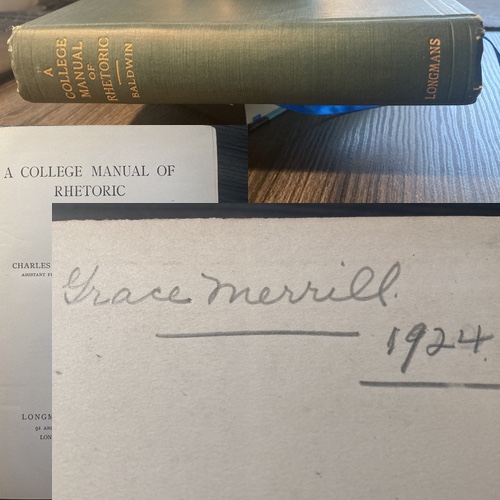
Last weekend, while helping friends pack-house, I found this book:

Wait! Don’t do the math on a book from 1907, and a college student taking Rhetoric in 1924. :)

Instead of packing it, I borrowed the book wondering if this James Sears Baldwin might just be the Baldwin. This is a dry book. But it’s also teaching me a ton about writing. The author hasn’t cracked even the slightest smile in the first 37 pages of this 400+ page tome. But the Baldwin quote I’d love to find within, might just be the sort of pithy thing this author would drop near the end.

Yes, I am willing to read a 400+ page tome on the off chance that I find the quote and get the once-in-a-lifetime thrill of finding an original attribution for a well-known quote. I digress.

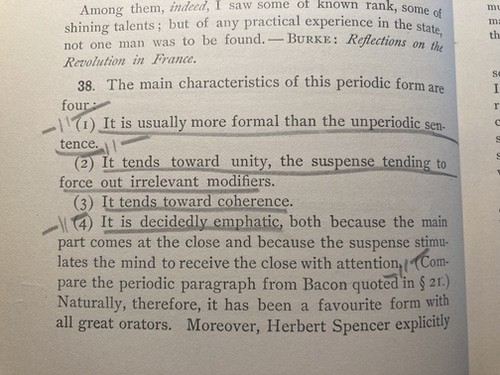
By page 30, I had seen a whole bunch these little diagonal marks, but hadn’t really figured out what she was trying to imply.

Then it hit me. Quotes! It’s a diagonal line with a quote on the diagonal line. She’s delineating quotations. I’m guessing that she must have written a paper—who’d expect that in a Rhetoric class, right?—and I bet she came back through and marked the quotation sections. At the same instant that I figured it out, my up-to-then habit of drawing a full line across the page, (often a long line, then up or down a line, and then finish going across, to “cut” in the middle of a line,) seemed dumb.

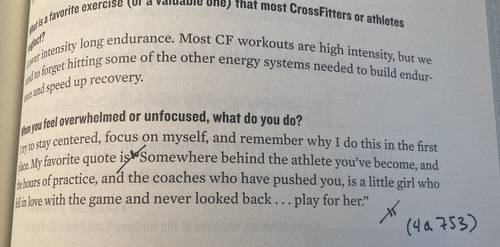
Thank you Miss Merrill. This looks just way cooler:

ɕ