The idea that we should focus on disruption rather than the new value that we can create is at the heart of the current economic malaise, income inequality, and political upheaval. The secret to building a better future is to use technology to do things that were previously impossible. The point of technology isn’t to make money. It’s to solve problems!
I’m not sure when we started sending out holiday cards. You know, the old fashioned way, in envelops with a stamp. But, it might be 20 years that we’ve been doing it. Some parts of it are a simple process; For example, we have a digital address list and I simply print the addresses on labels.
The two hardest parts however have always been finding holiday stamps that we liked—that sounds silly, but there it is. So this year, we’re breaking with tradition and simply using the generic postage stamps that we keep on hand.
And finding cards we like. By the time we get around to starting on our holiday cards, it’s too late to really do any custom ordering. Besides, neither of us is willing to buy something we can’t see/touch. And there’s the debate about do we print a photo of ourselves to include? …and what about including a sort of “this past year…” summary letter? Or perhaps those simple photo montages with a simple holiday slogan—we’ve been getting a higher number of those in recent years and it’s nice to see everyone’s photos…
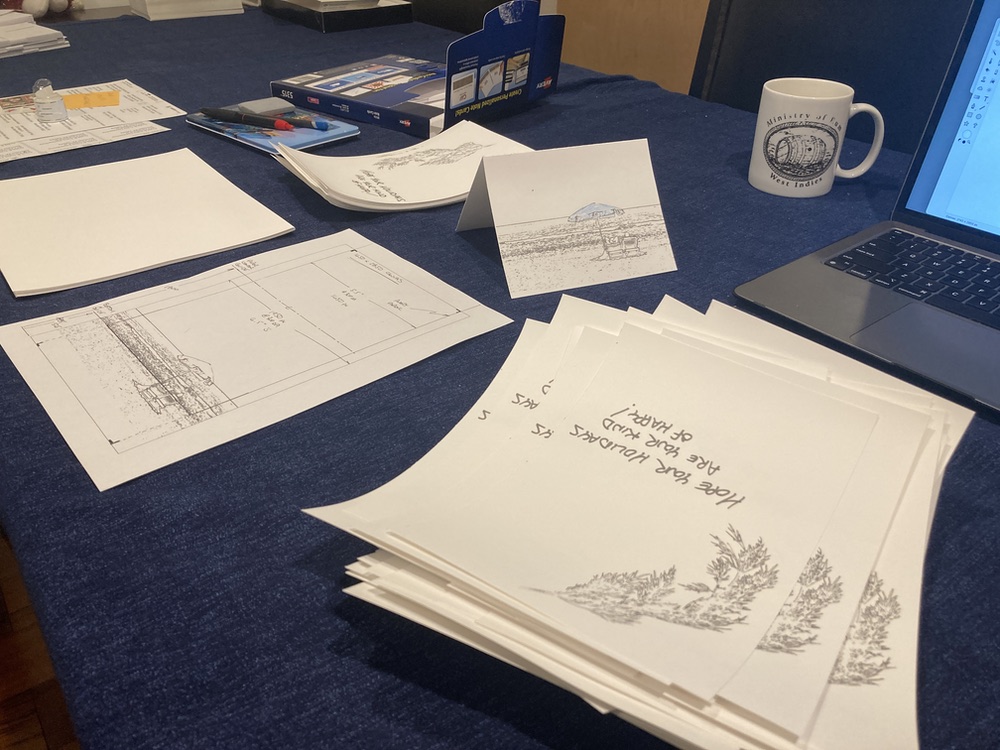
This year we decided to do something different. We spent all of the time we would have spent finding the “right” stamps and finding the “right” cards… and bought cheap-ass plain Avery card stock and spent the time making them ourselves. The card is a solid mediocre job, as far as holiday cards go. But it’s exactly the card we wanted to send out.
How does the practice of design, particularly in cover art and podcasting, bridge functionality and storytelling?
Discover the parallels between designing podcast cover art and packaging consumer goods.
It’s like a very tiny story in a square footprint, and of course it should reflect you. And then, also, once your audience gets used to it, [it will] be like a shortcut to finding your new episode.
~ Hernán Braberman (2:18)
The conversation explores the relationship between storytelling and design, focusing on podcast cover art as a form of visual storytelling. Hernán explains how the design parallels packaging consumer goods, both requiring an ability to draw attention and convey meaning within a small space. He discusses how the elements of design—shapes, colors, and typography—can embody the emotional and functional attributes of a podcast’s narrative, making the artwork a recognizable shortcut for audiences.
Hernán shares personal anecdotes, including inspiration from Spanish designer Javier Mariscal, whose philosophy of “design without surname” influenced their perspective. He also draws an analogy between podcasting and scuba diving, emphasizing the unique medium and altered sense of time in both. The discussion reflects on how creativity in podcasting is an open-ended process, comparable to the iterative nature of design, and how sound and structure play critical roles in storytelling.
How do the dynamics of conversation and storytelling impact podcasting and personal connection?
Effective podcasting techniques rely on balancing preparation and adaptability during interviews.
A lot of people never answer those questions, until somebody asks them. And, actually, you asking them often brings them insight they didn’t necessarily have.
~ Simon Ratcliffe (17:23)
The conversation explores the nuances of podcasting and the emotional dynamics of meaningful dialogue. One focus is the emotional highs and lows experienced in podcast production, from the joy of recording to the challenges of editing and releasing episodes. Another topic is the value of acknowledging guests’ individuality, with examples of how thoughtful questioning can lead to deep, meaningful exchanges.
The discussion also examines group dynamics, especially in the context of facilitating group interviews or research discussions. Key insights include the importance of recognizing and engaging all participants and the transformative power of contextual understanding in conversations. The conversation reflects on how certain techniques, such as effective pauses and unscripted interactions, contribute to authentic connections.
Those things are easy now. They might cost more than we’d like, but you can put them on a check-list and they’ll get done. What’s hard now is breaking the rules. What’s hard is finding the faith to become a heretic, to seek out an innovation and then, in the face of huge amounts of resistance, to lead a team and to push the innovation out the door into the world. Successful people are the ones who are good at this.
Despite having been published in 1910, Arnold Bennett’s book How to Live on 24 Hours a Day remains a valuable resource on living a meaningful life within the constraints of time. In the book, Bennett addresses one of our oldest questions: how can we make the best use of our lives? How can we make the best use of our time?
I’ve mentioned Arnold Bennett before, and my opinion remains the same: How to Live on 24 Hours a Day, is a delightful little read. Although this post from Parrish isn’t where I first heard of the book, it remains a terrific summary. If you’ve ever thought, “I wish I could find time to…” you should read Bennett’s thoughts.
Not just that every day more of our life is used up and less and less of it is left, but this too: If we live longer, can we be sure our mind will still be up to understanding the world—to the contemplation that aims at divine and human knowledge? If our mind starts to wander, we’ll still go on breathing, go on eating, imagining things, feeling urges and so on. But getting the most out of ourselves, calculating where our duty lies, analyzing what we hear and see, deciding whether it’s time to call it quits—all the things you need a healthy mind for… all those are gone.
So we need to hurry.
Not just because we move daily closer to death but also because our understanding—our grasp of the world—may be gone before we get there.
The function of education is to teach one to think intensively and to think critically. Intelligence plus character—that is the goal of true education.
Most see excellences as some grand aspiration. Wrong. Dead wrong. My two cents: Excellence is the next five minutes or nothing at all. It’s the quality of your next five-minute conversation. It’s the quality of, yes, your next email. Forget the long term. Make the next five minutes rock!