What they find honorable

Good people will do what they find honorable to do, even if it requires hard work; They’ll do it even if it will bring danger. Again, they won’t do what they find base, even if it brings wealth, pleasure, or power. Nothing will deter them from what is honorable, and nothing will lure them into what is base.

~ Seneca

slip:4a695.


Dignity and potential

Acknowledging our fundamental dignity, recognizing our potential and actively working towards its blossoming with sincerity, patience, and integrity, is what makes a life worth living. There will be challenges, and new gaps will constantly open, but recognizing and closing these gaps will make a difference in absolutely everything we undertake.

~ Vincent Thibault

slip:4a694.


Another one

Saint-Exupéry extends the invitation to reorient to this particular skyborne machine — and, by a proximate leap of imagination, to technology in general — as something that, rather than alienating us from the rest of nature, could bring us into more intimate and conscientious contact with the world of clouds and creatures.

~ Maria Popova from, Recovering the Wonder of Flight

slip:4ubasa1.

The Little Prince is one of those books that has been on the to-read pile for so long. And now Wind, Sand and Stars seems to be another. One of these days! So many good books, so little time.

ɕ


Outrageous

From a very early age, perhaps the age of five or six, I knew that when I grew up I should be a writer. Between the ages of about seventeen and twenty-four I tried to abandon this idea, but I did so with the consciousness that I was outraging my true nature and that sooner or later I should have to settle down and write books.

~ George Orwell

slip:4a693.


Reading for ‘hunh’

But if you only remember six things after reading this article, it should be the following truths about reading:

~ Shane Parrish, from How to Remember What You Read

slip:4ufore2.

Those six points are right near the top, too. It’s a great article about reading. —about a certain kind of reading. I’m not certain what to call the type of reading, but for today “reading to learn” will do as a label. Well, there’s another type of reading which I’ll call “reading for ‘hunh‘”.

There’s deep value in a ‘hunh’. When you find one, you can be sure you have just learned something. I spend a lot of time every day reading for ‘hunh’. I cast a wide net and then haul the contents up onto the fishing boat deck. I shuffle through the contents in muck boots; you don’t want to get this arbitrary stuff really on you. Using a squee-gee I push some of it around in an only vaguely interested fashion. I’m not super-focused. I’m paying attention for sharp edges but I’m not expecting any particular outcome. If I find a ‘hunh’ it’s just that; no more and no less than something simply interesting for the time it’s in my realm of awareness. And then I drop it back on the deck. Soon enough I wash it all overboard.

What kind of reading is that?

ɕ


What is it?

What is it—this thing that now forces itself on my notice? What is it made up of? How long was it designed to last? And what qualities do I need to bring to bear on it—tranquillity, courage, honesty, trustworthiness, straightforwardness, independence or what?

~ Marcus Aurelius

slip:4a692.


Urgency

As always, I continue my project of self-improvement. I’ve long been aware that I take on too much— and yet, all efforts to “take on less” only seem to lessen the problem; Like pulling Dandelion weeds but not getting the entire root out. I’ve made an insane effort in countless ways over several decades to make progress towards “take on less.” I’ve long known there must be something underlying.

I love to use a tool I refer to as a “wedge”, to affect changes by altering the normal sequence of things. A wedge can be used to create a space for consideration, to divert my thinking, or to initiate (or change) an activity. It works because the presence of the wedge alters the mental context. My mind proceeds from idea to idea, with an evolving context for that thinking. As the context changes, it constrains—or maybe, “helps select” is a better description—what ideas are going to come to the fore of my mind next. Trains of thought develop this way. The inserted wedge causes, (if it’s done right,) enough of a shift in my mental context.

It’s really difficult to have the wedge be a thought. But orange sticky notes work well. (Until you no longer notice them, of course.)

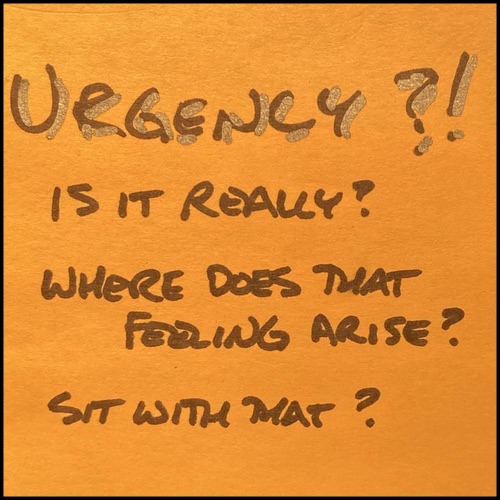
The action of this wedge is to make me think about why I’m about to do this next thing that feels so urgent.

“Is it really [urgent]?”
…like, how a smoke detector sounding off is urgent? Okay, so it’s not that urgent.

“Where does that feeling [of urgency] arise?”

And that is where my train of thought shifts. (So far it has been every time I’ve felt urgency to do something.) Because the feeling comes from my desire for control; There are countless examples. That explains why I’m forever taking on too much.

“Sit with that?”
Sit with that realization that the urgency is a reaction to a desire for control. Sit with the knowledge that every attempt at control—all types, all sizes, all shapes, all degrees… attempted control of anything external—has never ended well for me.

That’s not hyperbole.

ɕ

I write to

I write to dream; to connect with other human beings; to record; to clarify; to visit the dead. I have a kind of primitive need to leave a mark on the world. Also, I have a need for money.

~ Mary Karr

slip:4a691.


Opportunity in adversity

One of the most important factors, are we to be happy and whole human beings, is our ability to see opportunities in adversities. That is one of the most powerful lessons in Parkour and ADD: Learning, whenever needed, to thrive on obstacles. Our discipline indeed tells us of the fundamental difference between a fixed mindset and a growth mindset. The former believes, “I am bad at this,” the latter proposes, “I am better than this; I can learn something.”

~ Vincent Thibault

slip:4a689.


Naica

The aim was to detect the possible presence of ancient bacteria encapsulated inside fluid and solid inclusions present in the calcium sulfate matrix from its formation. […] At the 2017 meeting of the American Association for the Advancement of Science, researchers, including Dr. Boston, announced the discovery of bacteria found in inclusions embedded in some of the crystals. Using sterile methods, the researchers were able to extract and reanimate these organisms, which are not closely related to anything in the known genetic databases.


~ Wikipedia from, Cave of the Crystals

That sounds like the first paragraph from a newspaper article appearing about three days before the world ends. It’s been four years though, so I guess it’s okay?

How did I stumble on that… I found Podcast: The Naica cave in one of my RSS feeds. I didn’t listen, but I did quickly find the Wikipedia page for the Naica Mine. And from there it’s just one click to the Cave of Crystals.

This all reads like something the Dwarves would do, leading to their eventually having to abandon Khazad-dûm. Or the beginning of The Andromeda Strain.

ɕ