The other day—I forget why—I decided to put on some music, and I just happened to be working standing-up (at my adjustable height desk.) An hour later, having made huge strides on work and on changing my mood, this occurred to me.
ɕ
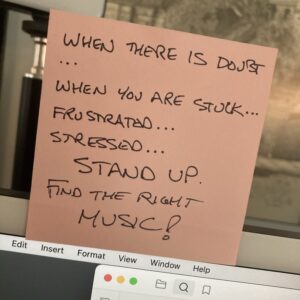
The other day—I forget why—I decided to put on some music, and I just happened to be working standing-up (at my adjustable height desk.) An hour later, having made huge strides on work and on changing my mood, this occurred to me.
ɕ
If you’re regularly having arguments with well-informed people of goodwill, you will probably ‘lose’ half of them–changing your mind based on what you’ve learned. If you’re not changing your mind, it’s likely you’re not actually having an argument (or you’re hanging out with the wrong people.) While it can be fun to change someone else’s position, it’s also a gift to learn enough to change ours.
~ Seth Godin from, How to win an argument with a toddler
Elsewhere, this is 4useho4. — slipbox
It warms my heart whenever anyone describes an argument—what an argument actually is, not rather a fight which too many people refer to as an “argument.”
I’m not the tantrum-throwing child Godin is (among others) referring to— but too often I can be the next child over in the stereotypical classroom: The petulant one. Yikes!
ɕ
These are examples of what we call “friendterpreting.” We use this term to describe the times when a hearing or deaf signer steps into a spontaneous, informal, or conversational interaction to play some sort of language-facilitating role with another hearing or deaf friend, usually a signer as well.
~ Rachel Kolb and Timothy Y. Loh from, How Deaf and Hearing Friends Co-Navigate the World
Elsewhere, this is 4usala1. — slipbox
I remember when seeing someone using ASL was unusual—At first, TV programs that were important, or which really wanted to reach deaf people—that the signer was all I could really see. Now, ASL is so common that it’s just people talking; arguably, it’s even more polite than regular talking which is always audible, versus ASL which is easily out-of-sight. I’ve even considered advocating my wife and I start learning ASL now… partly because eventually one of us will be deaf enough that we’ll need it. But—and I would never have thought of this 40 years ago—it’s also extremely useful for communicating in situations where one cannot be heard.
ɕ
Watching a fire, too, fills the eyes and releases the imagination to drift.
~ Matt Webb from, Beach daydreams, lost at sea
Elsewhere, this is 4uieho7. — slipbox
For a few years now we’ve had a standing date for camping near a beach at the end of summer. This little collection from Webb touches on some of the why.
ɕ
If it’s used in the right way, I love it, of course! I mean, I used to joke that the goal of a filmmaker is to be Fellini-esque, you know, when your name means something in that way? We often say something was a very Fellini-esque experience. So if you say a film is Cronenbergian… I like that. The thing that does bother me a little bit is “body horror,” because I never use that term! It was a young journalist who invented that term and it stuck, it’s out of my hands. But I would never have thought that what I did was body horror.
~ Patrick Heidmann from, David Cronenberg – The Talks
Elsewhere, this is 4uteie54. — slipbox
I recently managed to get caught up on The Hansel and Gretel Code, a podcast from my friend Curtis Cates. (I started years behind, so that I had 42 hour+ episodes to listen to.) It was so worth it. First off, great podcast on a very interesting to me topic. Also, I learned about the concept of metalepsis.
Reading the Wikipedia page doesn’t really do it justice. But listening to Curtis talk about metalepsis, and in particular unpacking all the context around some innocent seeming word or phrase really made it clear. For example, in certain centuries and in certain circles of well read people, “planing the planks of our coffins” isn’t just an interesting phrase… for those certain people it brought to mind a whole other complex social and political issue complete with its own colorful players.
ɕ

There are these quite large, spiny plants along a trail I frequent. Even those of use who are thorny and unfriendly occasionally dress up nice.
ɕ
Around the U.S., about 90,000 tons of nuclear waste is stored at over 100 sites in 39 states, in a range of different structures and containers.
~ Gerald Frankel from, How and where is nuclear waste stored in the US?
Elsewhere, this is 4uteho4. — slipbox
This is probably silly, but I’ve always imagined that one day we’d master nuclear fusion. (Fission is “splitting” versus fusion which is “combining.” Our currently nuclear generation is a very complex chain reaction of the fission variety.) To run a fusion reactor requires—literally—the temperatures inside the sun. I’d always hoped we’d be able to dump (teeny tiny amounts) of our current nuclear waste into our fusion reactors… we’re everything is stripped apart to protons and electrons. The perfect waste disposal system. ¯\_(ツ)_/¯
ɕ
And then the light of an older heaven was in my eyes
~ Doug Muir from, Occasional paper: The Light of an Older Heaven
and when my vision cleared, I saw Titans.
— Alan Moore
Elsewhere, this is 4ucooa2. — slipbox
A wonderful quote to open a wonder-filled article.
ɕ
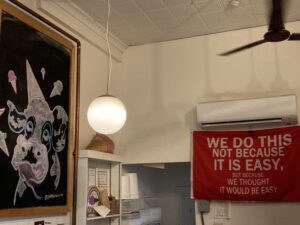
I don’t often snap photos in ice cream parlors, but when I do it’s because their character is clearly on display.
ɕ