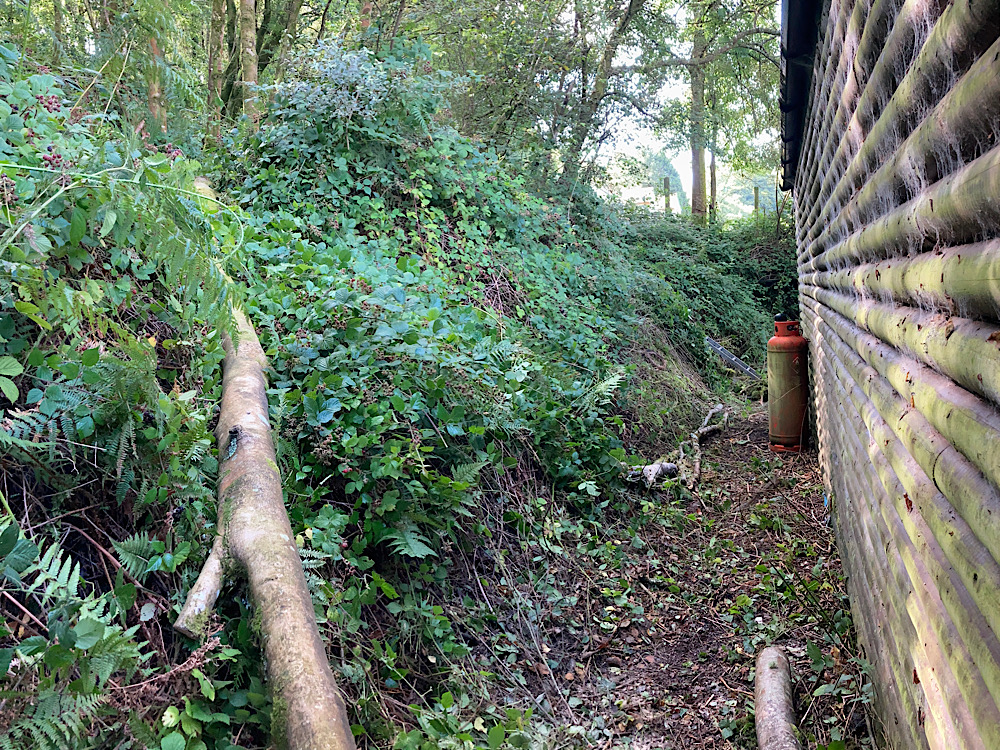
At least the pace was sub 12-minute, bit faster than my trail “runs”. (I’m thinking running every-other day is prob what I should be doing.) Tomorrow: Lawn mowing (with the human-powered push-mower.)
noun : an accumulation of loose stones or rocky debris lying on a slope or at the base of a hill or cliff.
I don’t collect many souvenirs. Sometimes I buy postcards when I visit places… and then I tape those into my journals. But in a very real sense a lot of what I write in my journals is meant to be a souvenir. Either way, the physical or the notational souvenir, is meant to trigger some memory.
Even institutions built for the express purpose of information preservation have succumbed to the ravages of time, natural disaster or human conquest. The famous library of Alexandria, one of the most important repositories of knowledge in the ancient world, eventually faded into obscurity. Built in the fourth century B.C., the library flourished for some six centuries, an unparalleled center of intellectual pursuit. Alexandria’s archive was said to contain half a million papyrus scrolls — the largest collection of manuscripts in the ancient world — including works by Plato, Aristotle, Homer and Herodotus. By the fifth century A.D., however, the majority of its collections had been stolen or destroyed, and the library fell into disrepair.
~ Adrienne Bernhard, from Shining a Light on the Digital Dark Age
slip:4uloie11.
Always I’m thinking: Do I really want to add this thing to my pile? There’s a timeframe of only a few decades where any thing, or notation, has the chance to jog my memory. Sometimes I think of taking a photo… and then I think, why? Why this image right here? Maybe it would be better (I continue thinking) to just relax and enjoy the moment. Even the Library at Alexandria’s enormous collection was surely only a minuscule fraction of what humanity had created to that point. Why take a photo? Why make a notation? Why build a web site? :)
ɕ

In the tradition of the literary and philosophical movements, each Open + Curious Salon is an opportunity to gather in real-time. It is a space where the exchange of ideas flourishes, where minds come together in spirited discussion, and where conversation skills are honed and practiced. Within the walls of the salon, the spirit of intellectual curiosity reigns supreme.
Details at https://openandcurious.org/
What if I don’t know how to take something apart? One option is to apply excessive force and break the thing open. That works, but obviously sacrifices the thing; this is particularly useless if I wanted to take something apart because I need to fix it, or understand it. Generally, the smash method always works, but is almost never useful.
Yet thought also goes wrong somehow, and produces destruction. This arises from a certain way of thinking, i.e., fragmentation. This is to break things up into bits, as if they were independent. It’s not merely making divisions, but it is breaking things up which are not really spearate. It’s like taking a watch and smashing it into fragments, rather than taking it apart and finding its parts. The parts are parts of a whole, but the fragments are just arbitrarily broken off from each other. Things which really fit, and belong together, are treated as if they do not. That’s one of the features of thought that’s going wrong.
~ David Bohm from, On Dialogue p56
I’m perpetually on a journey of self-awareness. I’m quite often applying my mind to understand things. This idea from Bohm about fragmentation, and in particular fragmentation being bad because it misses out on the relationships and inherent properties of the natural parts (in the sense of disassembled-watch parts versus smashed-watch bits). This idea of fragmentation is a warning against my running with the first way I manage to understand something; just because I’ve found one way to understand (smash) something into understandable pieces, doesn’t mean that’s the best way.
ɕ
I expend a lot of time and energy thinking about technology. I’m often trying to share some idea with others, or trying to make a change in the world. But year by year I’m shifting to spending more of that time and energy simply deciding what technology I want to adopt. Mastodon and the corresponding ActivityPub technology which creates the Fediverse is a great example. Should I join in on that new technology and create a presence there?
Grasping the value of new technology requires imagination. But unless you have skin in the game that doesn’t seem worth the effort because technology is supposed to make things easier and simpler, not wrack your brain.
~ Morgan Housel, from Why New Technology Is A Hard Sell
slip:4ucobo16.
Housel’s covers that, and three other intriguing points about why new technology is a hard sell. I’m left wondering could I use the points raised in the article to help me make decisions about technology? If I flip the article’s thinking over (from an others-directed “why doesn’t technology get adopted” direction to a self-directed “why I might not adopt technology” direction) then I can ask myself corresponding questions. For example, for the quoted point above, I can ask: Am I engaging my imagination at all when considering some piece of technology? (Aside: I decided, yes, and you can search for @craig@constantine.name wherever you are in the Fediverse.)
ɕ
The idea is to post here every day to report that I did what I was supposed to do. I’ll include what I plan to do for the next day’s activity. That forces me to plan ahead a bit. That’s the magic sauce because when I fail to plan, I fail.
This is not going to be a 45-day sprint of insane challenges. The idea is to be disciplined. Each day, plan something that is appropriate for me to do.
This post also presents a gallery of the ALL images in this series of posts. The gallery is dynamic so it will automatically grow as I add more posts to this series.