Obliged to respond

I recently heard a conversation between Brian Koppelman and Steven Pressfield (circa 2019 in Koppelman’s podcast, The Moment) where Pressfield mentioned a few great things for creatives to remember: Being a professional has nothing to do with getting paid. Resistance is real, it’s myself, and is waiting for me to invite it to stop me. The Muse is real.

The muse really does reward me for being found working. I’ve learned, no matter the work, the muse approves when finding me ready with pen and paper close. But if the muse taps me and I fail to treat the gift appropriately—if I think, “I’ll remember that. I don’t need to write that down.”—then I hear the muse scoff, “we shall see.” We shall see if I remember. And we shall see if the muse waits a bit longer before checking on me again.

That, of course, was the reason for the pen all along: it’s a physical reminder that you are not reading merely to consume the words of others passively, but that you have an obligation to respond.

~ Mandy Brown from, Ways of writing

slip:4uaowi6.

I’m realizing that books themselves also need room to sprawl. If I keep them shelved upright, or even more simply stacked flat, they still seem to be squished into submission. When I am able to lay a few of them out, with some room for them to wave their invisible tendrils, they seem to taunt me: go ahead, pick me up! If there’s a tablet or some writing scraps at hand, or garish sticky notes for flagging pages, then it begins to feel like its own room with unfolding conversations. In the end, it’s almost a composition just having the books lying about.

ɕ

Software power-tools

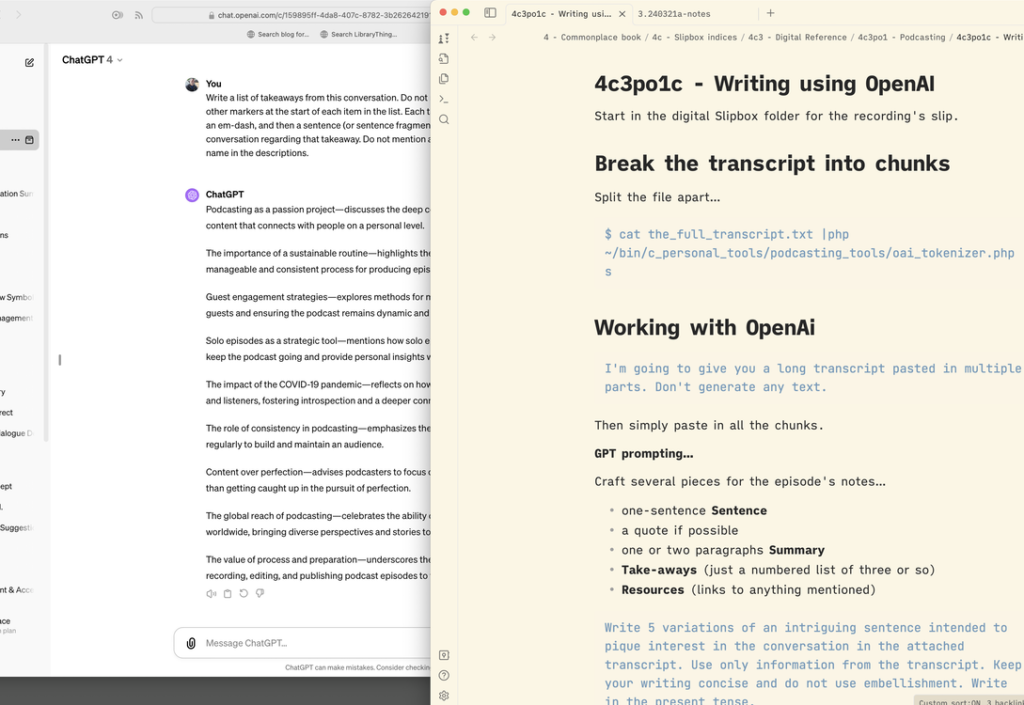
There’s a lot I can say about episode notes for individual podcast episodes. I have trouble writing them from scratch. But I’ve been using OpenAI’s LLM for a while now and tinkering on some prompts that work well. It takes me at least half an hour of writing (me writing and revising) to go from a raw transcript to solidly useful episode notes.

ɕ


Voices with Leticia Latino van Splunteren

What are the key insights and lessons shared during a conversation with a podcast creator about sustaining creativity, connection, and the joy of podcasting?

Leticia Latino van Splunteren joins Craig Constantine to explore the relentless pursuit of podcasting excellence and the art of staying true to one’s essence.

The one thing people have always told me— […] I connect people. My friends, even from high school and elementary school when I go back home, […] I’m the one planning, making everybody see each other. I’ve always been that person.

~ Leticia Latino 10:05

Leticia Latino and Craig discuss the essence and challenges of podcasting. Leticia shares her journey of producing over 250 episodes of her podcast “Back2Basics,” highlighting the dedication and passion required to maintain such a consistent output. She emphasizes the importance of creating a sustainable podcasting routine that aligns with one’s lifestyle and commitments.

I think a lot of people get discouraged by seeing, sometimes the numbers and the statistics, and I don’t look at them. I don’t look at them because I look at the map of where it has been downloaded. And when I see it has been on every single continent [that’s] encouraging and empowering for me because I’ve reached a place that I will have never dreamt about reaching.

~ Leticia Latino 35:20

Their discussion shows how podcasting, while a solitary endeavor at times, blossoms into a fulfilling venture through connections made and stories shared, showcasing the intrinsic value and joy derived from engaging deeply with guests and audiences alike.

The conversation also explores guest engagement and the sometimes meticulous process behind selecting and interacting with guests. Leticia offers insights into her approach to guest outreach, and how she tries to ensure a balance between introducing new voices and maintaining a steady flow of content. She discusses the strategic use of solo episodes as a method to keep the podcast alive during guest droughts, inadvertently discovering the audience’s appreciation for her personal insights.

Finally, the conversation touches on the impact of the global pandemic on podcasting dynamics. Leticia notes a shift towards introspection among podcasters and listeners alike, suggesting a deeper engagement with content that resonates on a personal level, even today as the world again accelerates post-pandemic.

(more…)

The payoff

If I think about how some project or effort of mine affects the world, it’s hard to imagine the effects that I would never know about. A tree falls in the woods; if no one hears it, does it make a sound? Does it make a sound a microphone would pick up? Yes, of course. Does it make a sound that affects someone? No, of course not. The answer depends on what we mean when we ask the question. If I do something creative, and no one that I know of benefits from it, does it matter?

Why? Because anyone who has ever done anything worth a damn, knows that they probably weren’t the main beneficiaries of their efforts. Our work may have lit up the world, but we still remain down in the mud, somehow.

~ Cierra Martin from, What Samurai Teach Us About Service

slip:4ugawa2.

For some reason, I liked the overall shape of that little article. But I don’t like the imagery of “we still remain down in the mud.” I feel like the thankless creative work that I do, doesn’t leave me “down in the mud.” A better metaphor—the way I think of it—is that I’m “still in the workshop.” I’m in the workshop. I’m being creative. My work has affects (I presume), but the fact that I don’t see those affects doesn’t make them any less real.

ɕ


Putting pen to paper

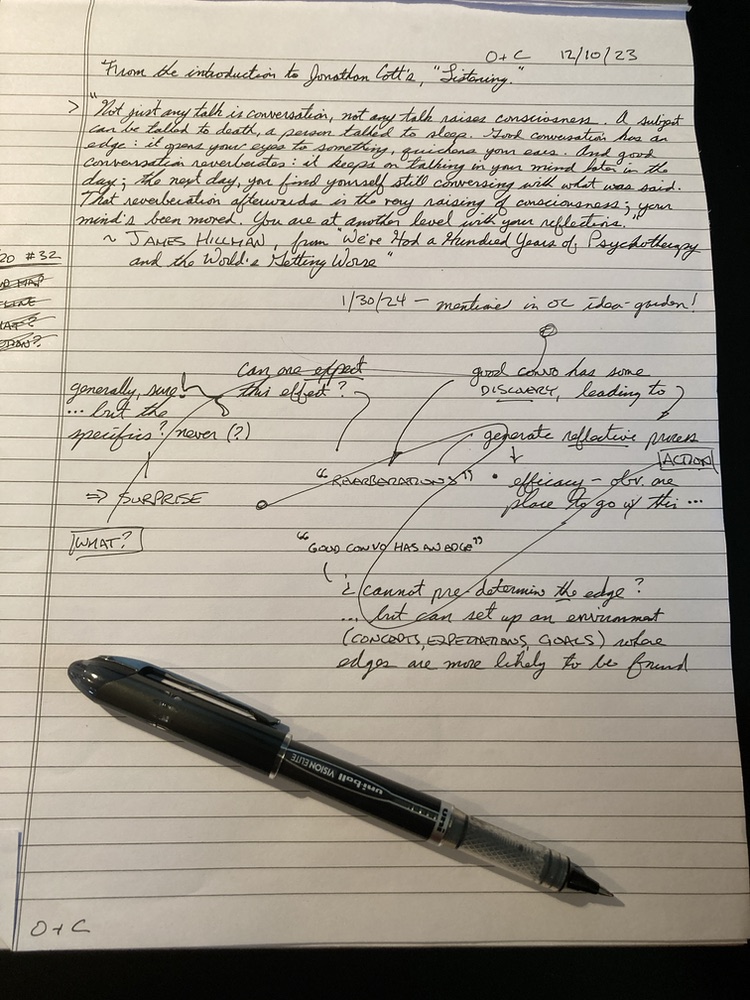
I’ve tried to do digitally the thinking and creative part of writing. It just doesn’t work as well as scribbling on paper. I use these tablets to capture ideas. This seed has been bumping around for 3 months (if you zoom in, it’s interesting that this seed happens to be _about_ reverberations!) Today it gets turned into a new something for Open + Curious.

ɕ


Perspective with Jamie Holmes

What strategies can individuals use to manage administrative tasks efficiently while maintaining their creativity and productivity in other pursuits?

Jamie Holmes joins Craig to discuss life’s admin tasks, her journey through holistic healing from melanoma, and insights into the world of circus arts and personal fitness showcasing her multifaceted life and philosophies.

I think it was three months from when I had my first, initial consult with my surgeon, and he said, “okay I can get you in. It’s going to be a bit harder because you’re doing both hips at once, but I can get you in within three months.” And that was horrid to me! I was like, “I have to live three more months like this!?” It wasn’t just that it hurt a little bit when I walked— I couldn’t move— I could not move— I was having weird panic attacks all the time, because if I dropped something and had to bend over, it was— I’m a bit of a tough cookie, but that? That broke me pretty hard.”

~ Jamie Holmes, 35:15

Not your average bears, Craig and Jamie begin in left field discussing ways of managing life’s “admin” tasks. Jamie professes integrating everything into her daily flow, rather than reserving them for a single day. Her approach, she explains, allows her to work at a high speed, avoiding the buildup of dreaded tasks. Her method emphasizes efficiency and the mental ease that comes from staying ahead of administrative duties, reflecting a deeper understanding of personal productivity and time management.

The conversation shifts into Jamie’s profound journey through holistic healing after a melanoma diagnosis. Rejecting traditional treatment paths, Jamie opts for a holistic approach, guided by her conviction in the body’s healing capabilities and her passion for health and fitness. This segment of the discussion not only highlights her resilience but also serves as an inspiring testament to the power of our minds and bodies.

Jamie also shares insights into the world of circus arts and her studio, The Circus Fix, illuminating the challenges and rewards of managing a fitness and arts studio. Her narrative encompasses the delicate balance of artistic passion with the pragmatism of business management, underscoring the significance of adaptability and understanding in leadership roles.

(more…)

Transcendence

Maybe, if I was feeling really brave, I’d say that there is just one thing that I need to get beyond. If I was feeling that brave, I’m not, I’d say it’s the drive drive drive I feel to do do do.

What we usually do is either be driven, driven, driven by this fear … or we conclude that we need to abandon everything and start with a fresh slate. With this fear, it can feel like these are the only two options.

~ Leo Babauta from, Transforming the Constant Feeling of Being Behind

slip:4uzesi4.

As Babauta of course goes on to point out: There aren’t, in truth, only two options. I’m still not feeling brave, but the idea that there’s a third-way sounds delightful.

ɕ


Pre-flight checklist? Check!

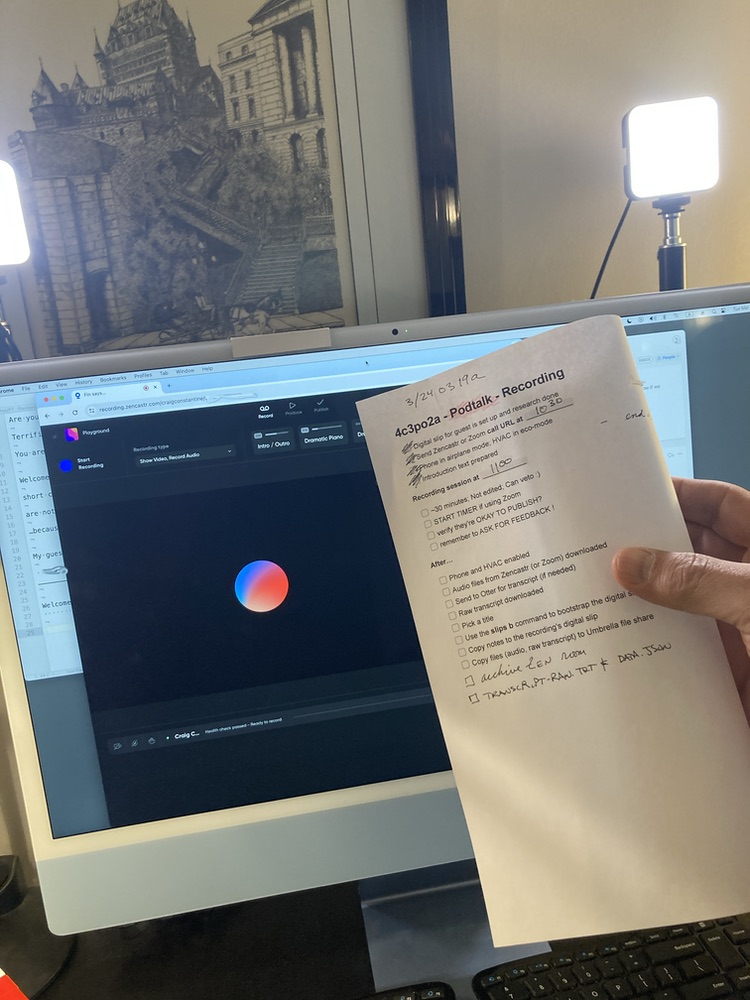
I’m a major process-person. Process is discipline. For me, inspiration always runs out. But process enables me to put one dumb foot in front of the other— and then course correct as I go. Pre-flight checklist here minutes before a guest joins me for a recording.

ɕ


Transition with Alasdair Plambeck

What is the value of embracing transitional or “in-between” spaces in life and creativity, and how can these moments shape personal growth and future endeavors?

Explore the journey of creative transformation and the profound shifts that come from embracing the spaces between, as Alasdair Plambeck navigates the end of a significant chapter to discover what lies beyond the familiar boundaries of identity and purpose.

I knew there was a general sense. It’s like, “I’m meant for something more than this,” and I think a lot of people feel that when they’re in what I would call the over-culture. I was very much steeped in— trained for— prepared for— programmed by, all that kind of thing. I work with a lot of people who are maybe in that, but transitioning out, or wanting to transition out, or just maybe feeling that.

~ Alasdair Plambeck, 26:35

Alasdair Plambeck joins Craig Constantine to discuss the nuanced journey of personal and creative transformation. Alasdair shares his thoughtful approach to scheduling, aiming for times that harness his creative energy most effectively. His decisions reflect a deeper stance on being attuned to one’s energy levels and the optimal conditions for creativity and meaningful engagement.

The conversation extends into Alasdair’s personal story, illuminating his shift from feeling confined within the “over-culture” to embarking on a path that resonates with his true self. This transition is sparked by a profound moment of realization while working as a general manager, where success and societal expectations no longer aligned with his well-being and aspirations.

The dialogue also ventures into the realm of podcasting itself, exploring the evolution of Alasdair’s own podcasting journey and the decision to conclude his show after a significant run. This choice underlines a theme of knowing when to let go, to make space for new beginnings and growth. Alasdair reflects on how the podcast served as a medium for connection, self-discovery, and the cultivation of a deeper relationship with his wife through shared creative endeavors and discussions.

Further, Alasdair and Craig touch on the concept of the “in-between” spaces in life — those transformative periods where one is neither here nor there but in a state of becoming. Alasdair views these phases not as voids but as fertile ground for introspection, learning, and eventual emergence into new stages of life and identity. Through these varied topics, the conversation paints a vivid picture of the ongoing journey of self-exploration, the power of mindful changes, and the courage to pursue a life aligned with one’s authentic self.

(more…)

Noses

Have you ever tried to read Gray’s Anatomy? I tried to read a modern printing of a 1901 edition that was given to me. It’s 1,200+ pages in a perfect-bound book! That might have been 30 years ago and I’m not sure if anything from that adventure stuck… and yet, I bet a huge amount of knowledge has stuck. I recall it was an endless succession of interesting rabbit holes.

Nasal congestion, I’ve learned in all this, is far weirder than I ever thought. For starters, the nose is actually two noses, which work in an alternating cycle that is somehow connected to our armpits.

~ Sarah Zhang from, Everything I Thought I Knew About Nasal Congestion Is Wrong

slip:4utehe2.

I’m struggling to resist the urge to see what Gray’s has to say about the nose. I do know that even the most fleeting search of the ‘ol Internet turns up a huge amount of material around this topic. I will also say that I’ve long known that lying on one’s side tends to open the opposing nostril’s nasal whatsit-stuff. Which I know only because I have a long history of sinus and allergy problems and have necessarily tried to sleep with a plugged schnozz, leading to creativity and experimentation.

ɕ