Practicing mindfulness

This entry is part 15 of 37 in the series Study inspired by Pakour & Art du Déplacement by V. Thibault

Mindfulness is an inward directed practice of contemplation. It is a continuous process of being present. For me, because it was initially unfamiliar, it was more difficult to approach than the obvious physical activities such as running, jumping, and climbing. But after some practice, it became a critical part of the foundation on which I’ve placed many other parts of Parkour.

There are many ways to practice mindfulness at large in one’s life. For example, Leo Babauta, of Zen Habits, has a great piece titled, 9 Mindfulness Rituals to Make Your Day Better I am a firm believer that mindfulness across the full breadth of daily life yields big benefits. But in this post, I’m focusing on the practice of mindfulness within Parkour.

In many ways, mindfulness is like any other skill that you can practice intentionally. But unlike other skills, failing to be mindful leaves me with blindspots. These blindspots, which are closely related to the Dunning Kruger Effect, create space for “unknown unknowns” to lay hidden.

Worse, lack of mindfulness is akin to: Failure of attention, which leads to injury; Failure to notice moods and emotions, which leads to loss of interest in the short term and training plateaus in the longer term; Failure to notice signals from my body, which leads to chronic injury and developmental imbalances.

Options for practicing mindfulness

One option would be to set out explicitly to practice mindfulness. (“Today, instead of practicing vaults, I’m going to practice mindfulness.”) Unfortunately, I would need to be highly mindful in order to stay on task working on being mindful. But, if I could be that mindful, I wouldn’t need to practice being mindful. (Which is a Catch-22 that makes my brain hurt before I even start doing anything.) In the end I find that saying, “I’m going to practice mindfulness,” is simply too vague to be motivating.

Another option is to passively rely on fellow traceurs, or coaches, to call me out for “not being mindful”. (Or for them to set up specific “mindfulness practice.”) But mindfulness is too important for me to simply rely on other people to hold me to it. It’s much better for me to practice it intentionally.

To make the options more complicated, it is not at all clear how I switch from being NOT mindful to being mindful enough to notice that just-a-moment-ago I was NOT being mindful. Heavy stuff that. In reality, I usually notice my mind has wandered, (“I’m paying attention to irrelevant things around me,”) or I notice my practice has become unmotivated, (“When did this get boring?”)

Shoelaces

So how do I practice mindfulness? I think of it like tied shoelaces. It’s important my shoelaces be tied, but I don’t obsess over them by constantly checking my shoes. I simply tie them when I notice they are untied.

I practice mindfulness when I notice I’m not being mindful.

My mindfulness drill

So when I notice, what can I do, exactly?

I locate a small jump. The jump needs to be well within my ability; not something risky or overly tiring. I want a relatively easy jump that I know I can do without thinking. It must be any easy jump, because there can be no nervousness or doubt. I’m purposely selecting a jump to set myself up to be lulled into NOT being mindful.

I physically prepare to jump. I position myself, arrange my limbs, engage muscles, etc. Eventually I arrive at that point in space and time which would normally be the last point before I jump. At this exact point, I wait. I am poised, comfortable, ready, willing and perfectly able to jump. I know I’m in at the correct point when I suspect that if someone startled me, I would jump involuntarily.

I find my thoughts are like birds flitting around a cavernous room. Some thoughts are on-task as they seem related to the jump: The way my body feels; The anticipation of being in the air; The expectations of the landing. But depending on how mindful I am, there are more or less other “off-task” thoughts flitting about the room.

The sky is blue.
How much time is left?
I’m thirsty.
There’s an ant where I’m going to land.
What’s for dinner?
People must be looking at me funny.
…and on and on and on.

I am alone with my thoughts, and I am simply an observer in a room with these harmless, incorporeal, flitting birds. I notice as many of the thoughts as I can, taking special notice of the ones that I believe are related to the jump. I don’t fight with the thoughts, because I cannot catch nor chase away any particular bird. In fact, chasing them is worse than useless because they simply loop around to become “the thought about the thought I just tried to chase away.”

Gradually, some of the extraneous birds fly away. When I think the number of extraneous thoughts in my head has reached a point where it’s as good as it’s going to get . . .

I jump.

ɕ


§5 – Moment to moment

This entry is part 14 of 37 in the series Study inspired by Pakour & Art du Déplacement by V. Thibault

I reached section 5, and got stuck.

It’s obvious the key idea of section 5 is mindfulness. So I started by thinking about “mindfulness in Parkour practice.” But I wasn’t able to find a compelling thread to unify my thoughts. I came away from a few writing sessions with nothing of value. Eventually it occurred to me to circle back and reconsider my writing process.

I reread this whole series and — aside from, “Wow, I suck at writing!” — it struck me that I have been “unpacking” each of the first four sections. My process has been to sift each section for a key idea, and then simply spend time thinking about that specific idea:

What exactly does the idea mean?
Do I already know and understand the idea?
How does it relate to my Parkour practice?
What other areas of knowledge does it relate to?

But section 5 is already short and to-the-point and doesn’t need to be unpacked.

I’m so META Even This Acronym:

Stop the presses! It seems I have just discovered the concept of being mindful of the writing process. /sarcasm

Next up:

I am actually writing something about section 5 now that I have a different plan.

ɕ


Point “B”; the me of tomorrow

This entry is part 13 of 37 in the series Study inspired by Pakour & Art du Déplacement by V. Thibault

Over the last few years it seems I have — finally! — learned some key lesson about pace; the idea of enjoying the journey. The idea of focusing on what I can control. The truth that some of these projects I will not finish, some places I will not see, and some people I will not manage to spend enough time with. These ideas are patently obvious and unequivocal, but learning the Lesson, and deeply and truly making it part of your work-a-day life and personal philosophy takes effort.

When once you have tasted flight, you will forever walk the earth with your eyes turned skyward, for there you have been, and there you will always long to return.

~ Leonardo de Vinci

Years ago I started journaling as a form of self-reflection. It enables me to look back. Sometimes it’s a travel log, but mostly it’s a “this is what I was thinking” log, a glimpse at what I was working on, inspired by, or frustrated by. After a large amount of writing and thinking I gained enough perspective to start removing some things, and changing others. I learned to say ‘no’ to some things I would have taken on in the past, and learned how to rearrange other things to make more space.

I always wonder why birds stay in the same place when they can fly anywhere on Earth. Then I ask myself the same question.

~ Harun Yahya ( https://en.wikipedia.org/wiki/Adnan_Oktar )

But only recently have I found myself turning more often to look forward, rather than back.

What would the best possible version of myself do?
Walk the Earth with eyes turned skyward.
Point A to point B, efficiently.

Close the gap.

ɕ


§4 – Close the gap

This entry is part 12 of 37 in the series Study inspired by Pakour & Art du Déplacement by V. Thibault

“What would the greatest version of myself do?”

I can think of no better personal compass than that simple question. I whole-heartedly agree with its sentiment; that exploring your own concept of “greatness” is the single most important thing you can do. Each of us will come to a different answer; potentially very different answers. But, the act of honestly exploring your own conceptions, and the act of self reflection, are what will move you in a positive direction.

I had already begun embracing this idea of seeking the greatest version of myself. As part of that effort, I took up a personal Oath which clearly reflects the idea.

What is Parkour?

Thibault’s section 4 is about seeking personal greatness and striving to constantly improve. That’s clearly a “big picture” goal involving one’s entire self. But we can also use this idea of “closing the gap” to investigate our every-day description of what Parkour is.

When asked, many people say that Parkour is about “efficiency”. They say that Parkour is about “moving efficiently” or “getting from A to B efficiently.” (“Quickly” is also used.) Alternatively, there are many people who dislike the “efficiency” description. Some prefer “personal expression through movement”, “pushing the boundaries of human movement”, or even simply “freedom”. There are many alternatives to the “efficiency” description, but it is undoubtedly one of the most dominant descriptions.

Where did I stand before reading this section?

If you practice Parkour, you will be asked (and often!), “What is Parkour?” I realized I would do well to have a one-sentence answer to that question. I’ve found that people are pleasantly surprised when I have a clear, one-sentence answer. Almost everyone asks further questions and a conversation about Parkour grows naturally from there.

My one-sentence answer is: Parkour is using challenges to improve oneself.

And now?

When I read Thibault’s section 4, it struck me that Parkour is exactly about “getting from point A to point B as efficiently and quickly as possible.”

Point “A” is here; the me of today.

Point “B” is there; the me of tomorrow.

ɕ


Others’ thoughts on what exactly is resilience

This entry is part 11 of 37 in the series Study inspired by Pakour & Art du Déplacement by V. Thibault

A key point from the following podcast is the idea that resilience is not a “broad” skill, but rather something that you develop in a particular aspect of your life. Being resilient in social circumstances is not directly related to being resilient in a violent (eg, combat) circumstance. So that’s something to keep in mind: In Parkour, we’re practicing and developing our resilience in the context of MOVING, and moving is something we do every day.

So that’s what we’ve taken, that idea of resilience and we’ve applied it to human beings and we tell people, you should just bounce back. Bounce back, bounce back. I actually believe human beings can’t bounce back. The reason why you can’t bounce back is because you can’t go back in time. So the 19 year old Marine who leaves for Afghanistan is never going to be 19 again. Parents who lose a child are never going to be the same parents again. The entrepreneur whose business goes bankrupt is never going to be the same entrepreneur again. So what resilient people are able to do is not to bounce back from hardship but they’re able to integrate hard experiences into their lives in such a way that they become better. That’s what I think is really at the heart of resilience.

~ Eric Greitens, from “Resilience With Eric Greitens

slip:4uaopo2.

The link it to a transcript of a podcast, (I recommend just skimming the transcript,) from my ridiculously long queue of podcasts. I was skimming through the list culling a few episodes and realized this one was apropos of the current section from Thibault’s work.

ɕ


Was that resilience?

This entry is part 10 of 37 in the series Study inspired by Pakour & Art du Déplacement by V. Thibault

Sunday’s class contained a block of time where we were told to set a specific goal for ourselves, and then go work on it.

There’s a particular technique that I’ve been stuck on for nearly two years. It’s completely a psychological issue. Each time a coach brings up this technique, I equivocate, and they drop me back to the progressions for the technique. But, I can do the progressions, and every coach then says, “Then just do the technique.” Usually, they manage to encourage me enough to eek out a few tentative iterations of the technique. At which point I’m all like, “Yeah! Progress! Awesome!”

And the next time the technique comes up I have the EXACT. SAME. PROBLEM. I profess inability, the coach assesses the progressions, and then coaxes me through getting the technique. Over and over and over and over and over with too many coaches, way too many times.

Nemesis: n., this technique.

So on Sunday, armed with 15 minutes of time and delusions of making progress on my own, I set off to work on my nemesis.

(Here, there would be a montage and inspirational music.)

13 minutes later I had managed to scare the crap out of myself several times, and had accomplished absolutely nothing. I’d stared at it, fiddled with variations of feet and hands, and jiggered every adjustable parameter. Basically, I spent 13 minutes trying to avoid my fear. It was exceedingly frustrating because I’ve done this countless times: Every single variation, every attempt, every change, telling myself the things coaches would say, my worries, my self-reprimands.

So I’m standing there, mentally kicking myself thinking: “Yes yes, I’ve even tried mentally kicking myself countless times before. Fine. All I have to do it screw around for two more minutes and then this can be over.”

At which point I finally had a different thought: Section 3! Resilience! How can I specifically use resilience in this situation?

Truthfully, I had no idea how to apply resilience. I tried looking at the obstacle differently. I literally laid behind the wall and looked up from where I should land. I sat astride the wall and imagined the technique from the side.

I eventually tried again and — I have no idea why anything was different — I actually made one. Then a second. And then a third. And then, in fact, 13 in a row, banging out the last few repetitions as the instructor called us back together.

NOT comfortable: Even the success freaks me out so badly that my palms are sweating days later as I type this.

NOT impressive: It’s a simple technique. The 13 I did were teeny tiny baby versions with a low obstacle, and most of them had poor landings. Worst of all, I’m not the LEAST bit certain I can do it again.

Was it resilience? Was it stubbornness? Luck? Finally just strong/flexible/whatever enough to make it? I have no clue. I was jammed so far up in my “head space” that I haven’t the slightest idea what actually happened in those last two minutes.

Do I have a point here? I’m not even sure about that. This is just a story related to section 3.

meh.

Some days, Parkour is like this; It’s not all unicorns and rainbows.

ɕ


Long was I Marcellinus!

This entry is part 33 of 72 in the series My Journey

Nevertheless I shall brave this danger and be bold enough to show [Marcellinus] his faults. He will act in his usual way; he will have recourse to his wit, – the wit that can call forth smiles even from mourners. He will turn the jest, first against himself, and then against me. He will forestall every word which I am about to utter.

~ Seneca, from Letters From A Stoic: Letter 29

slip:4ulele2.

Many of Seneca’s letters are pretty obtuse after all this time. But this one… this one jumped out at me as being really apropos of modern life. And, uh, painfully on point for myself.

ɕ


§3 – The rose that grew from concrete

This entry is part 9 of 37 in the series Study inspired by Pakour & Art du Déplacement by V. Thibault

Resilience.

Why does Parkour so effectively teach resilience? Because your regular world and your regular life are DESIGNED for your interaction. Stairs are a certain height, walking surfaces are smooth and even, door knobs are convenient, chairs, air conditioning, trains and autos; Everything you interact with is designed for human interaction. In a very real sense, that’s what “civilized” means.

Have you ever stopped to consider something as simple and common as doorways? What would life like, if – just for some historic reason – every doorway was only 4 feet high? Life would be much better simply because everyone would have to bend over regularly!

What if stairs were the norm? What if walking was the norm?

When you begin exploring your world through the lens of Parkour, you are told to intentionally seek out challenges. In Parkour practice, you’re exposing yourself to a hard choice: Bend your mind and body to the challenge, or face pain and injury. A good coach sets you up for success, but you’re still told to go under that railing, climb over that wall, and put your hands on that rough concrete. You have to teach your mind and body how to be resilient so that you can rediscover the ways already within yourself to interact with an environment that is, at best, indifferent to your wellbeing.

Once you see things differently, you can start interacting with things that were specifically designed for some reason other than human interaction. You start by looking at your world this way as part of a specific practice; “I’m going to class and the instructor makes us do this”. Eventually, the mindset becomes comfortable on its own without prompting, and you begin to automatically practice a mindful resilience in your daily life.

How could I get to that place over there without using that obvious pedestrian route? How would I get down there, or up there? Why am I eating inside when it’s so nice outside? What would I do if an emergency happened right now?

Once you are well and truly comfortable with the resilient mindset, your body relaxes and the physical uncertainty, or even fear, that you were unconsciously feeling goes away. In it’s place wells up good old natural Human Curiosity. Your mind says, “Sure, let’s go this other way,” and, “Let’s take this road less travelled.” It really does make all the difference.

I shall be telling this with a sigh
Somewhere ages and ages hence:
Two roads diverged in a wood, and I—
I took the one less traveled by,
And that has made all the difference.

~ Robert Frost, from The Road Not Taken

ɕ


Resilience?

This entry is part 32 of 72 in the series My Journey

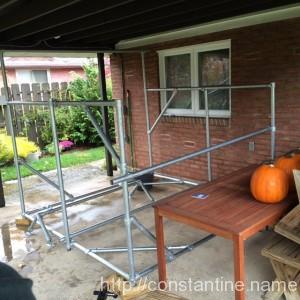
Resilience also requires downtime for recovery. Changing up my scaf routine today to take advantage of the lingering awesome weather.

ɕ


10,000 repetitions

This entry is part 2 of 36 in the series 10,000 Reps Project

Today (Friday, Sept 25) was day number 66, and without realizing it, I did pushup number 999.

Way back in June, I read about someone who was going to “celebrate” their 30th birthday with a year-long challenge: They were going to try to complete 30,000 pushups in one year.

That would be 82.19 pushups per day, every day. (81.97 if it’s a leap year.) That’s crazy. That’s crazy like repetitive-stress-injury crazy. Especially since their point was that they were out of shape and wanted to get into shape.

Celebrate: n., to torture oneself?

I chuckled, and sipped my coffee. But the wheels were turning. With my 44th birthday approaching, I briefly considered 44,000 as a goal. Briefly. Very briefly. But then I was thinking: …well, I can do 10 pushups, easy. So doing just 30 per day wouldn’t be too crazy, and that should get me to about 10,000 in a year. (Calculator’ing happens.) Actually, about 27 pushups per day would get me to a nice round 10k in a year.

And over the next few weeks the idea grew.

It seemed clear that completing 10,000 pushups would be eminently possible without injury. Maybe I should try doing 10,000 repetitions of something I currently suck at? That would force me to get from “I can do zero of these,” to a competent 30-or-so per day. This started to sound more interesting and useful. It would be like a race, but a long-term race with me pitted against the calendar.

(It also fits very well with my Oath.)

Eventually I settled on five exercises which would be a serious challenge, AND would yield major improvements:

1. pushups
2. squats
3. pullups
4. bar-to-bar precisions
5. handstands (10k seconds in a handstand)

I’m not going to describe the exercises in detail. I’m not going to brag about how great I’ve gotten at them. (Which is, “not very.” But I’m still working on them.)

I decided up front that I would do whatever it took to reach the goal. To me, that means, doing enough to get stronger, but not hurting myself. It means continuously thinking about the form of the exercise and striving to do them well. But I do NOT fixate on perfection. Build it. Refine it. Lather. Rinse. Repeat.

What I really want to share is HOW MUCH FUN THIS IS!

Every time I do one of the exercises I am acutely aware of how much I’ve improved. Early on, I had little variations to everything to make it possible; I’d do 3 crappy, negative versions of a pull-up (climb up, and fight the fall for as long as possible) and happily mark “3” completed in my spreadsheet. Now I do sets of three reasonably good pull-ups and I think, “boo-YEAH! Pull-ups! Who’s ‘da man?!” I can’t wait to see what it’s like to crank out a clean set of 10 in a row.

Did you say spreadsheet?

Yes I did. Of course I went to the trouble of making a full-geek spreadsheet. It has a row for all 365 days. I enter the reps completed and it has columns for the cumulative number completed, the number remaining to reach the goal, and it does the math to tell me the rate-per-day that I’d have to continue at to reach the goal. (So if I do 10 pull-ups and it says the required rate is 27 per day, I know I’m digging a hole. If I do 40 pushups and it says the rate is 30, I know I just banked 10 for a day off.)

Well, here’s what day 66 looks like. I entered 42 under pushups and 999 popped out. What a neat surprise! :D

10k-reps-spreadsheet

ɕ