Garrett Moore | Teaching Beginners

On Castbox.fm — Garrett Moore | Teaching Beginners

How can personal storytelling be used as a tool to motivate others to take action and drive community change?

One individual’s experience with chronic pain and Parkour became the catalyst for teaching others to harness their stories for change.

It’s the classic challenge of anyone who’s trying to organize at the grassroots level for any societal change: How to build enough of a consensus amongst a large enough group of people. […] You have to find the group that shares your common values.

~ Garrett Moore (12:07)

The conversation explores the application of personal storytelling as a tool to drive collective action, particularly within the Parkour community. Garrett details his experience leading a workshop at Art of Retreat. He recounts how his session, designed to teach the power of personal narratives in inspiring social change, led to unexpected levels of participant engagement, with multiple attendees voluntarily sharing personal stories long after the session had concluded.

The conversation expands to include broader topics, such as the importance of honesty and vulnerability in leadership, the challenges of grassroots organizing, and the relevance of these skills in non-political spaces. There is also discussion about the intersection of movement practice and social activism, with reflections on how Parkour communities can benefit from organizational tools commonly used in electoral and nonprofit campaigns.

Takeaways

Personal narrative — Sharing personal stories can motivate others to take meaningful action.

Community action — Grassroots organizing benefits from shared values and collective storytelling.

Workshop engagement — A successful session can spark spontaneous participant involvement beyond the planned agenda.

Leadership vulnerability — Acknowledging personal nervousness or imperfection fosters a stronger connection with audiences.

Broader applications — Storytelling tools developed for political campaigns can drive change in local communities and niche groups.

Resources

Garrett Moore @garrett_moves

Art of Retreat — Parkour leadership and education retreat where the workshop took place.

(Written with help from Chat-GPT.)

ɕ

Finding the balance

Too warm: Solve all the problems. Do all the things. Turn every idea into an action or object in the real world. And do it perfectly.

Too cold: Relax. Talk to people, occasionally. Read great books. Savor the moments between. How you do this one thing is how you do everything.

Just right:

…nope sorry I got nothing no way in the world I can possibly figure out what’s between these two extremes there’s nothing in the middle warm is perfect until it’s not cold is perfect until it’s not gee if only there was some way that one could find something that was hunh I don’t know maybe a little bit of both meh no warm is perfect oh wait no cold is perfect.

Right. It’s so patently obvious where the balance would lie. And yet, when I’m polarized one way or the other… now, where is that damn forest?! All these trees are blocking my view!

ɕ


What is the air speed velocity…

So, I’ve been wondering—to those of you who do interviews—does anyone else find they tend to ask overly complicated questions, or do you somehow manage to make them concise?

All through my podcasting and interviewing journey it’s been illuminating to listen to my finished work after a significant amount of time has elapsed. Often I end up with many weeks or even months between when we record something and when it comes out. There’s nothing quite as motivating—at least for me—as hearing my own work… and cringing and wincing and being horrified… anyway. Along the way I’ve been sniping my most egregious problems as best I can.

…and the current issue I’m trying to work through is my use of questions structure as “A, or B?” You see I did it at the top…

So I’ve been wondering—to those of you who do interviews—does anyone else find they tend to ask overly complicated questions, or do you somehow manage to make them concise?

I do this all the time.

So no more of…

I’ve been wondering, what do you think air speed velocity of an unladen swallow, or do you think that in order to ask that we need to know if it’s the African or European variety?

No no no Craig stop asking complicated questions…

What is the air speed velocity of an unladen swallow? …and then shut. up.

ɕ


Disaster is virtue’s opportunity

Do not, I beseech you, dread the things which the immortal gods apply to our souls like goads; disaster is virtue’s opportunity. Those whom an excess of prosperity has rendered sluggish may justly be called unfortunate; a dead calm holds them fast, as it were, on a motionless sea. And whatever befalls them comes as a surprise. Cruelty presses hardest on the inexperienced; the neck chafes at the yoke.

~ Seneca

slip:4a434.


Focus

I’ve touched on the importance of focus frequently. Today I just wanted to remind myself of two ways that I often lose focus.

First, shiny-distraction syndrome gives me the urge to try all the things, do all the things, build all the things, fix all the things, improve all the things… This does not end well for me. I’ve been getting much better at sitting with, (as Leo Babauta would say,) the urge to chase the shiny thing. Like a dog being trained to resist an urge; OH A SQUIRREL! …no, sit! …wait …wait (the squirrel moves out of sight) …good boy!

Unfortunately the second way I lose focus is pernicious; I’ll call it shifting-sands syndrome. This happens when I decide to take something on—maybe it’s something small, maybe it’s big, whatever, it’s something I feel moves me towards some goal. “Ok, yes, this is a good thing to work on. This is definitely not shiny-distraction syndrome. I’m in. Let’s do it.”

And then someone else moves the goal posts.

I fall for this all the time. It’s like the sunk-cost fallacy. “I was going to do 42 units of life-energy-work, what’s 2 more?” Hey Craig! I’ll tell you what 2 more is: 2 more is 44 units. Stop and think! Don’t make the decision based on, “it’s only 2 more.” Rather, I need to start over: What’s the task/thing/etc., how much work is it (now 44 units, not just 42), do I want to do it, is it worth it, and so on.

ɕ


Scratch the itch

While it’s true (and wise) that…

Not to be driven this way and that, but always to behave with justice and see things as they are.

~ Marcus Aurelius

slip:4a1068.

…counsels a steady hand on the rudder of one’s life, it is equally important to know when to tack.

There’s a terrific bit of “life wisdom” you learn from sailing which goes as follows. But first you need the four rules for sailing:

  1. Keep the water out of the boat, lest you transition from sailing to swimming.
  2. The wind will try to set you in the direction it blows, just as the wind will push a tumbleweed.
  3. The water, (if there’s any current,) will try to make you drift in the direction it flows, just as the current will float you downstream when rafting on a river.
  4. One cannot sail directly towards the wind. There’s an arc of directions to either side of the direction from which the wind blows that are impossible.

The “trivial” exercise of operating the sailboat in various conditions is left for the reader.

Your challenge then is to get to your destination while following the rules. Interesting journeys will involve being near land, (beware Rule 1 because it’s the wet land that always gets you!) or cover long distances, (beware Rule 2 and 3 because their affects are cumulative and vary with time.) Interesting journeys will involve a specific destination which, thanks to unwritten Rule 5 are always to windward, so you cannot go directly there as per Rule 4.

…but you can go sort of towards it if you aim to the left of the wind’s source. And then you can tack, by turning quickly through the wind and going sort of towards your destination aiming to the right of the wind’s source. Doing so is called “tacking to windward.” Modern sailboats are pretty good at doing this. Ancient sailboats had to switch to rowing, or wait for different wind.

Finally, I can get to this part:

You’re going to be paying a lot of attention, sitting relatively still and watching the sailboat sail. You will also be paying attention to your destination which is almost certainly not directly in front of you. Untrained observers, (if they know your destination,) will be thinking, “why are you going in that direction?” Tacking isn’t very hard, but it slows you down and takes time and effort—you’d rather be sailing along, than tacking many times. (Perhaps at this point you’re thinking about geometry and those related-speeds word-problems you saw as a kid?)

While it’s true (and wise) that, “Not to be driven this way and that, but always to behave with justice and see things as they are.” counsels a steady hand on the rudder of one’s life, it is equally important to know when to tack.

ɕ


Rafe Kelley | The Adaptive Athlete

On Castbox.fm — Rafe Kelley | The Adaptive Athlete

How can ecological dynamics and adaptive learning principles enhance movement training and skill development?

Skilled athletes show more variability in their movement patterns, contradicting the idea that precision comes from rigid consistency.

What matters isn’t that you did a jump. It’s what the jump did for you. So that’s the first realization. And once you make that realization, then the way that you look at it changes.

~ Rafe Kelley (14:52)

The conversation explores the application of ecological dynamics and adaptive learning in movement training. Rafe explains how human movement is not mechanical but emerges from the interaction between the body and its environment. He emphasizes that movement training should focus on fostering adaptability by creating environments where athletes self-organize solutions to physical challenges, rather than relying solely on prescriptive coaching.

A significant part of the discussion centers on the emotional and social dimensions of training. Rafe highlights how effective coaching requires not only designing physical tasks but also cultivating supportive emotional spaces that encourage growth. He shares stories of students whose personal growth through movement translated into other areas of life, reinforcing the broader value of movement practices as tools for character development.

Takeaways

Movement practice serves personal growth — The goal is not the jump itself but the transformation that occurs through achieving it.

Ecological dynamics shapes learning — Adaptive movement stems from interaction with the environment, fostering natural self-organization.

Emotional space in coaching — Creating a supportive environment allows athletes to thrive and explore beyond physical limitations.

Variability is key to mastery — Skilled athletes demonstrate variability in their movement paths, showing adaptability rather than strict repetition.

Storytelling enhances teaching — Sharing personal stories and experiences deepens the impact of lessons and connects with students on a human level.

Social connection strengthens practice — Incorporating partner-based or group training creates relational growth alongside physical development.

Insight generation through journaling — Reflecting on training experiences solidifies lessons and integrates personal growth.

Resources

Evolve Move Play — Rafe Kelley’s website featuring workshops, podcasts, and movement resources.

Art of Retreat — Information about the event series focused on Parkour leadership and education.

(Written with help from Chat-GPT.)

ɕ


Just write on the walls

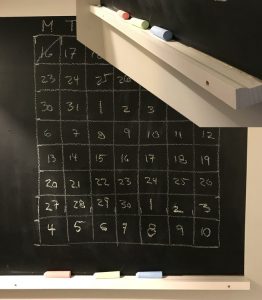
Sometimes you just need to scribble on the walls. In recent weeks, I’ve fallen off of a morning exercise habit—long story. Just takes a few seconds for me to scribble out a calendar grid so I can begin a “don’t break the chain” reboot.

We have three of these chalk boards in our house now. It’s simply paint, (it actually has a lot of blue in it, as real slate does,) and you can probably find labeled-as “chalk board” paint anywhere you buy paint. The trick that no one mentions is that you have to sand the wall with fine sandpaper—chalk boards are smooth, and walls are actually not very. Then a few feet of what’s called “brick mould” cross drilled and screwed to the wall, and finally a few sticks of sidewalk chalk.

Oh, one more trick: If you look closely at the image, midway down on the left, there’s a tiny, smooth, rounded nail head barely visible. I drove that fully into the wall, before I painted the chalk board. It enables me to stick magnets to the wall in a few places, so it’s easy to tack up pieces of paper with little magnets too.

ɕ


Old dog

I don’t think that anymore. Those fantasies are silly really. As the character Judge Smails played by Ted Knight in Caddyshack so aptly put it, “The world needs ditch diggers too.” … Accepting the fact that you are a contributor to a larger community as opposed to being a Demi-God uberman is not just humbling…it’s a huge relief.

~ Steven Pressfield from, «https://stevenpressfield.com/2014/10/old-dog-new-tricks-2/»

But my biggest challenge is the closely-related problem of continuously thinking about all the things I “should” do. Where, “should,” is a self-evaluated judgement that arises from my thinking about all the things I could do. …and HFS I could do all sorts of things.

Having happily set down all the Big Picture “shoulds,” I’m currently trying to pick off all the true “shoulds.” I’ve learned to stop looking to the stars, and to instead set my sights on the next hilltop. I should put the finishing touches on the garden we built last year. I should get that tree trimmed professionally so it’s good for another 10 years. …those aren’t so bad. But some: I should finish going through all this photography. I should find a home for this pool table. …I’ve been trying to get done for like 10 years.

Overall, there’s a pretty big list, but importantly, the list has not been growing in recent years. On the other hand, it weighs on my mind none the less.

ɕ


Soap works best

Because soap really does work best, we continue to hear the medical profession instructing we wash our hands with warm water and soap.

But how can your grandmother’s soap—that ancient and simple human technology—work so well?

What is a lipid? A lipid is a substance that repels water, the way a great raincoat repels water. Fats—all of the types of fat you can think of—are lipids. Lipids stick together and make impenetrable stuff like you find baked onto your casserole dish.

What’s in soap? Some of the molecules in soap are surfactants. Surfactants are certain molecules which actively separate lipids. Surfactants separate lipids the way bouncers break up bar fights: They forcefully insert themselves and separate the individual lipids. That’s why soaking your casserole dish in soap and water magically turns the impossibly-baked-on gunk into easily-rinsed-away gunk.

How are lipids relevant to viruses? Viruses have an outer envelope—imagine a rain coat shaped into a beach ball—that surrounds and protects the contents of the virus. That outer envelope is made from lipids. It’s tough like the baked-on-gunk on a casserole dish is tough.

What’s inside a virus particle? Viruses contain a long string of instructions. Your cells contain your personal set of instructions, called your DNA. Viruses contain a set of instructions similar enough that your cells can follow those instructions. When a virus’s instructions get into your cell, the cell is duped into making more viruses rather doing whatever it normally would do.

What does soap do to the lipid envelope of a virus? It does the same thing soap and warm water do to the crud stuck on your casserole disk. Soap makes the lipid envelope fall apart, exposing the virus’ payload of instructions.

What happens to the virus’ instructions without the protective lipid envelope? The instructions are quickly damaged and made useless. The instructions in the virus are extremely delicate. Exposure to oxygen, (1/5 of our atmosphere is Oxygen,) or light, (we have a lot of that too,) or several things found in soap, will quickly destroy the instructions. The DNA in your cells is just as delicate, but your cells have structures and processes to protect and repair your DNA. But unlike your cells, viruses are very simple; all they have protecting their instructions is a lipid envelope wrapped around the outside.

ɕ