Interactive with Jeff Revilla

What happens when podcasters leave the safety of their studios to record in front of a live audience?

A physical space changes how podcasters, guests, and audiences engage with the medium.

You could actually just get out of your comfort zone, do this thing that you do in your house— do it live at a park and just see what happens.

~ Jeff Revilla (33:02)

This conversation with Jeff Revilla centers on the creation and impact of a physical podcasting theater, which offers independent podcasters the opportunity to record in front of live audiences. We explore how the controlled, familiar environment of home studios contrasts with the dynamic, unpredictable energy of live performance. The discussion covers how live podcasting challenges hosts to let go of production control and embrace spontaneity, leading to new experiences both for them and their listeners.

The logistics of creating the theater space are discussed in detail, including sourcing materials on a budget and designing the space to be flexible and immersive. The benefits of such live recordings are explored from multiple angles: audience feedback, performance energy, and personal growth for podcasters. The conversation also touches on the potential for this model to spread to other cities, encouraging podcasters to seek out or create similar spaces using resources like parks, coffee shops, and libraries.

Takeaways

Getting out of the studio — Shifting from a home setup to a live environment introduces discomfort but creates richer experiences.

Designing live podcast spaces — Flexible theater design enables immersive, close-range audience experiences with podcast creators.

Building on DIY culture — The physical space is assembled with minimal cost and creativity, reflecting a do-it-yourself mindset.

Live audience engagement — Audience reactions offer immediate feedback and energy, unlike the delayed response of online downloads.

Performance dynamics — Mistakes are part of the experience, and audiences are generally more forgiving than podcasters expect.

Hosting in person — Podcasters experience personal and creative transformation by stepping into a live setting.

Reimagining podcast venues — Parks, libraries, and coffee shops can serve as accessible, low-cost venues for live podcasting.

Community activation — Live events create tangible moments that draw friends and family into direct support roles.

Local expansion — There’s a growing opportunity for similar spaces in other towns, creating regional performance circuits.

Monologue vs. conversation — Structured content often falls flat in a live setting; spontaneous conversation resonates more.

Hybrid event strategy — Combining livestreams with in-person seating balances reach and intimacy.

Emerging infrastructure — Mid-sized live venues can help prepare independent podcasters to scale toward larger performances.

Resources

Poduty — The dedicated podcast theater space created and operated for live in-person podcasting.

My Guest Tonight — Jeff Revilla’s podcast.

Poduty Live 2025 — The two-day live podcasting festival planned for the last weekend in September, streamed and staged in-person.

International Podcast Day — An annual celebration of podcasting referenced as part of the event timing.

Indie Pods United — An earlier initiative mentioned in connection with previous live streaming events. (No public web site, but has a presence on various social platforms.)

Todd Glass — A comedian whose ideas on theater design helped influence the speaker’s stage setup.

Marketing Over Coffee — A podcast noted for being recorded in coffee shops.

(Written with help from Chat-GPT.)

ɕ

Podcasting ‘process’ videos?

I have tons of ideas. That’s the source of my greatest challenge: trying to decide what not to do. The first step is to fully think through an idea.

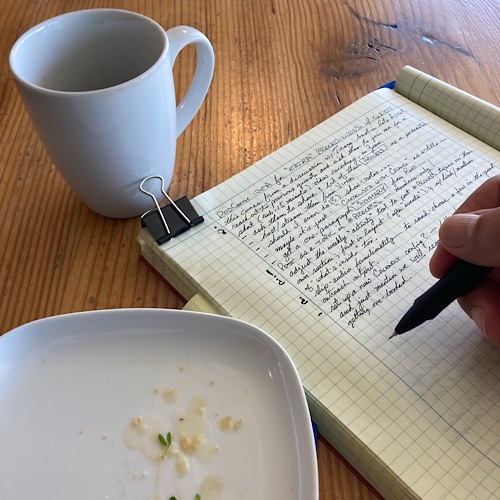
This one is about an idea for little bonus videos for the supporting members in the Podcaster Community. It’s been simmering in my head for a few weeks. This morning, walked in the glorious weather, to my fave little cafe. An hour of thinking to paper powered by coffee and a sandwich. :)

Now… should I do it? …or leave it in my notebook? 🤔

ɕ


Show your work

I return often to Kleon’s matra of “show your work“.

I always fade out from the process. I think the reason is that I’m not necessarily doing something related to podcasting every day. (Which is fine.) Without a strong habit of podcast-specific work (for example, “I do podcast stuff at 9am every day”) I don’t get in the habit of doing the extra little bit of work to capture something showing my work…

I’m convinced, my work would be better—and it would help others too—if I showed my work more. But I can’t seem to crack this nut.

Zooming out, away from podcasting . . .

I keep thinking: I don’t have a clear, single thing that is “my work” — it’s not podcasting, it’s not blog writing, it’s not community building [here], … For example: Here’s some notes I took, over the course of an hour thinking about coaching movement, based on a long conversation I had with a coach I respect. We had a coffee meeting where I wanted to pick his brain…

I post all sorts of things here, on the ‘ol blog. In recent years, my posting grew, become a weekly thing which I cleaved off to be the 7 for Sunday weekly email. Here I continue to post new quotes from my collection, copies of all the podcast episodes I do [all shows, anywhere], and a lot of “this is interesting” links that I find.

This morning, I’m thinking: My blog has long been the place where I work with the garage door up. Maybe I should lean into that?

…develop the habit of showing something (anything, from any project I’m working on) there on my blog. 🤔

ɕ


Private

But it’s consciousness in the experience sense – what philosophers refer to as phenomenal consciousness – that I’ll be focusing on in the remainder of this Guide. This kind of consciousness serves as a fundamental part of our existence, perhaps even the most fundamental part of our existence. But despite its fundamentality, and though we are intimately aware of our own conscious experience, the notion of consciousness is a perplexing one.

~ Amy Kind, from How to think about consciousness

slip:4upygu4.

The current tools so breathlessly referred to as artificial intelligence, are still only tools. They have no agency, no goals, and critically they are not consciousness. Or, so we think. “Is conscious” is exceedingly important to determine, and it turns out it’s really hard to do the less like us (think: bats, dolphins, octopus, bacteria, …) some living thing is.

ɕ


The discard pile

I think part of being a designer is to fail every day, to try things that don’t work out. In a way, every project fails every day until it succeeds! That’s what the iterative process of design is about. The projects that don’t launch, this is sometimes due to the fact that they’re too early but that doesn’t mean they don’t come back a few years later as ideas integrated in different projects. Timing in many ways is key.

~ Yves Béhar, from Yves Béhar – The Talks

slip:4uteie53.

I’m reminded of the idea of one’s discard pile. Béhar’s work can fail (the idea of success versus failure in trading with others is baked into the way we use the word “work”), so he’s aware of “failure” as a salient feature of his creative efforts. Here on the ‘ol blog, this isn’t about “work” so it’s not possible for it to “fail.” But I do often think about the discard pile: I don’t actually create blog posts and then discard them rather than post them. But I do often read and find things, imagine what I could post about them… and then I don’t post it.

ɕ


Deep dive into agency

Over the last decade, I’ve watched AI challenge — and augment — humanity in astonishing ways. Every few years, a new innovation seems to raise the same questions: can we compute human intelligence? Can our labor be automated? Who owns these systems and their training data? How will this technology reshape society? Yet there is one question I rarely hear asked: how will AI change our understanding of ourselves?

~ K Allado-McDowell, from Am I Slop? Am I Agentic? Am I Earth?

slip:4uloie13.

This article—from the ever-interesting halls of The Long Now Foundation—got me thinking about intelligence from a new direction: instead of a tool or collaborator for us, a new way to learn about ourselves.

ɕ


Fonts. 600 photos. omg

In 2007, on my first trip to New York City, I grabbed a brand-new DSLR camera and photographed all the fonts I was supposed to love. I admired American Typewriter in all of the I <3 NYC logos, watched Akzidenz Grotesk and Helvetica fighting over the subway signs, and even caught an occasional appearance of the flawlessly-named Gotham, still a year before it skyrocketed in popularity via Barack Obama’s first campaign.

But there was one font I didn’t even notice, even though it was everywhere around me.

Last year in New York, I walked over 100 miles and took thousands of photos of one and one font only.

~ Marcin Wichary, from The hardest working font in Manhattan

slip:4uaete1.

What. WHAT? WAT?! Words fail me… there are 600 photos in this article. I couldn’t stop staring at the technology parts, and keyboards—so much of that reminds me of my youngling days. I leaned in for the photography, which is gorgeous macrophotography. And fell headlong into the nostalgia.

ɕ


What is the actual thing?

As someone who writes a lot about knowledge work in the digital age, I’m fascinated by this model of cooking, which I define as follows: a workflow designed to enable someone with a high-return skill to spend most of their time applying that skill, without distraction.

~ Cal Newport, from Let Brandon Cook

slip:4ucale1.

For a decade I’ve been aware of this point. I’m, basically, a one-person creative process. If one leans into this way of thinking, then you immediately want to start figuring out how to not do all the other things. Which is fine if I were a one-person business process. But I am not. I’m not only a creator of valuable (in some sense other than money) work. I’m also the person who is nourished, enabling said creative work, by the random other parts. Whichever way you think of it though, Newport makes interesting points.

ɕ


Automatic, clickable time-references in our show notes?!

Well this is interesting! I’ve been adding time-references to quotes when I include them in show notes. I simply put the <minute>:<seconds> after the quote.

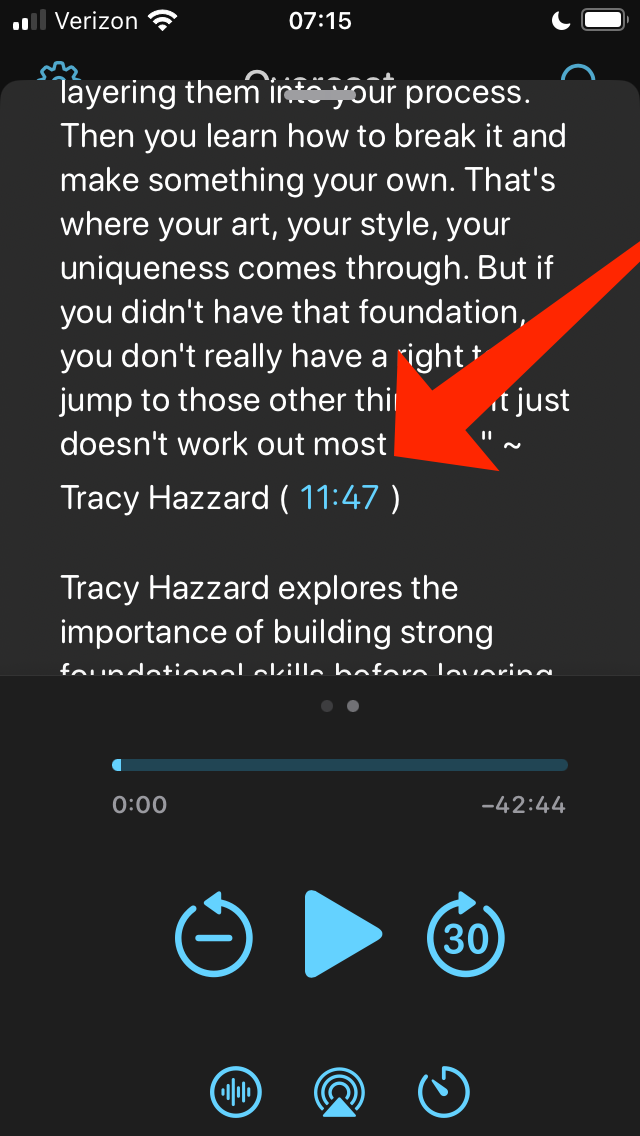
Today I realized that Overcast auto-magically makes those time codes clickable — touching the time code jumps play right to that point!

This is amazingly great for the listener.

For years there’s been discussion about chapters in podcast episodes. They are supported, yes. But there’s complicated to actually set up. The original way, is to embed the information within the mp3 audio file—that requires either special software which does just that, or your DAW has to support marking the chapters as you’re editing. Either way, a bit tedious.

But if this little feature of link-up-time-references in the notes works across more players… this is HUGE.

So: Take a look at your favorite player. Find an episode (any episode of Podtalk, for example) that has time-references in the show notes… and tell me if it works in your player.

ɕ


Two different purposes

There’s two different main purposes for routines, and advice-givers mix them up. They lump these two quite different things under “morning routine” and it causes trouble when you try to design your own.

~ Mckinley Valentine, from The Whippet #185: Shielded and flower-like

slip:4utesi3.

Partly, I include this because The Whippet is a sometimes quirky, often insightful, but always interesting little missive that I enjoy following/reading.

But also, WAIT WAT! …how is it I’ve never heard this idea/distinction before? Scroll down about 2/3 in issue № 185 to find this neat stuff about habits.

ɕ