Suffering is that moment when you see reality exactly as it is. When you can no longer run away from it, when you can no longer deny it.
~ Jiddu Krishnamurti
Elsewhere, this is 4a592. — slipbox
Suffering is that moment when you see reality exactly as it is. When you can no longer run away from it, when you can no longer deny it.
~ Jiddu Krishnamurti
Elsewhere, this is 4a592. — slipbox
So you want to achieve greatness. You’ve decided that ho-hum mediocrity is not for you. Alrighty then. Well, if you’re going to do that, you have to make a choice: whether to take The Big Road or The Little Road.
~ Hugh MacLeod from, «https://www.gapingvoid.com/blog/2020/09/18/go-big-go-small-just-go/»
Elsewhere, this is 4ugabo13. — slipbox
It turns out that this rhymes with my vision and mission. (Please start here if you just thought, “what vision and mission?”) I was deep in the workshop trying to find my vision and mission, when this post from MacLeod drifted through my sphere of awareness. I think if I hadn’t already been in the middle of doing the hard work of orienteering, this post would have tipped me into starting the hard work.
So my question for today is: If you don’t feel like you have a clear vision and mission, what would you have to expose yourself to which would be likely to make you tip into being compelled to find them?
ɕ
Fewer are aware that the PC wasn’t IBM’s only internal-politics-driven value giveaway; one of the most important software applications on those mainframes was IBM’s Information Management System (IMS). This was a hierarchical database, and let me pause for a necessary caveat: for those that don’t understand databases, I’ll try to simplify the following explanation as much as possible, and for those that do, I’m sorry for bastardizing this overview!
~ Ben Thompson from, Oracle’s Cloudy Future – Stratechery by Ben Thompson
Elsewhere, this is 4usaoa1. — slipbox
And, today this web site is a tech blog.
I’ve read, (technically I am in the process of reading,) everything Thompson has written. I skimmed through this long article since it wasn’t news to me. However, if you take about 10 minutes to read this, you’ll know more about Databases and the Big Kids who made the things which became the things you now use every day, than pretty much everyone else on the planet.
/techblog
ɕ
I maintain that, while the number of bugs and problems users experience is linear, their understandable frustration is exponential. It’s no wonder they have learned to tolerate poor-quality work.
~ Nick Heer from, People Tolerate Bugs and Problems Because Technology Is Still Confusing – Pixel Envy
Elsewhere, this is 4upoli2. — slipbox
I maintain that this is a symptom of the rise of “good enough.” The rise of, “just ship it and fail faster,” has created a culture where “shipping it” is valued over doing something well. The only thing harder than the first 90% of a project is the second 90% of the project. To create something that is a delight to use requires an enormous effort.
Our culture is currently being reshaped by companies who are training us via the fast dopamine hit. In that arena, creating things is a vicious competition. It feels as if there is no time to do something well and bring it to market. In the time it takes to do it well (for example, create 85 episodes of a podcast, write 2,500 blog posts, fill a bookshelf with journals) you will expend an enormous amount of time, energy and money. Sometimes, what you create will be so perfectly in time with the culture that the capriciousness of the market will reward you. Sometimes it will not.
But you must do the hard work. Not because you will necessarily be rewarded, but because other people need to see you doing the hard work. That will encourage and inspire them to try something harder than their current efforts. And that ratchets the culture up, rather than down.
ɕ
I’m process oriented. I want to figure something out once, and then move on to having other interesting thoughts or experiences. That leads me to a sort of, “do one, cross off two,” mentality; I try to do more work up front—do the more complicated things first—in an attempt to reap a larger gain in the long run. I’m a tool builder you could say.
But my power of process, can also be a problem. There is, of course, an XKCD for this lesson: https://xkcd.com/974/. I digress.
Today, I wanted to share a bit of the process that I use to distill the things I find, and to focus my thinking. (I’m not going to go into how I find things, nor how I ensure a fresh “stream” of those things is brought to my attention.)
I have a WordPress-based blog using my own domain name. I also have a separate email account with a non-obvious address. It’s in my address book at “blog – Postie to Blog” [as you can see in the screenshot].
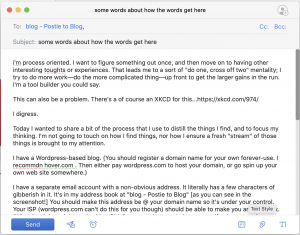
Whenever I see, read, or find something that inspires an interesting train of thought, I fire off an email to this special address. I simply brain dump my thinking. I insert bare URLs into the email. I put a “>” in front of blobs of text I want to show quoted. But I don’t bother with any formatting; it’s all just basic text.
I use the Postie plugin for my WordPress site. It’s an email client which periodically looks in my special mailbox and creates draft posts on my site. It deletes the emails as it creates the drafts.

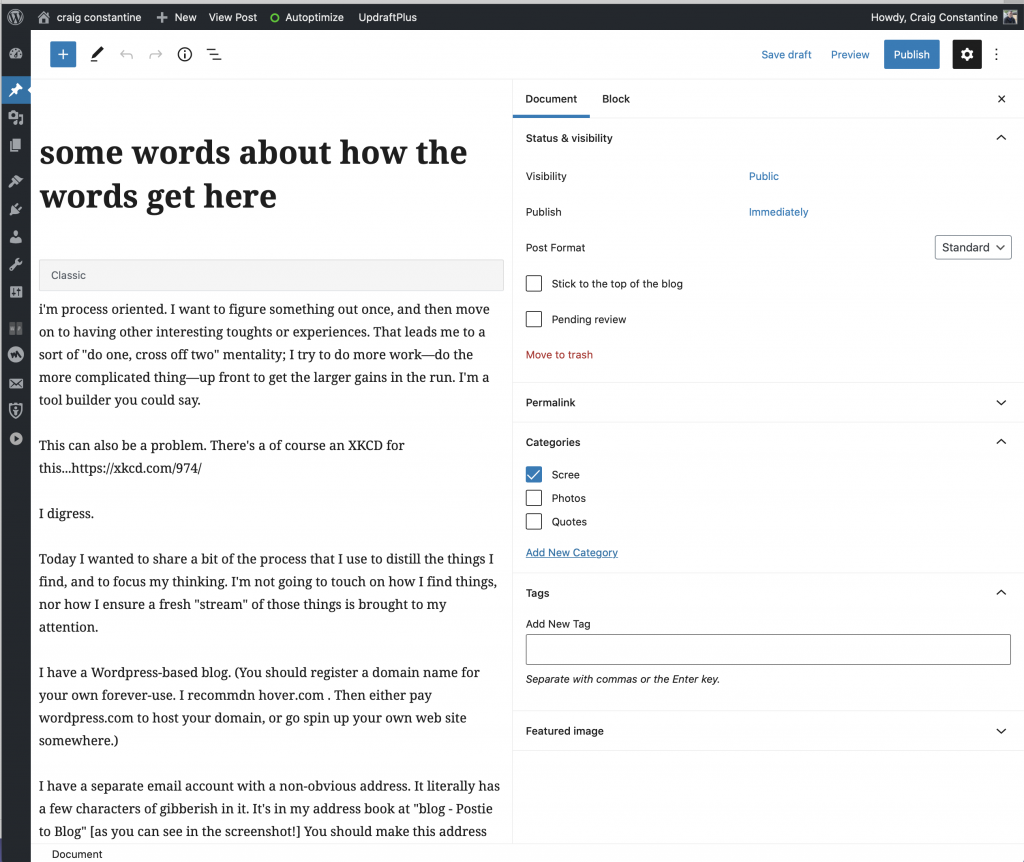
When I want to work on blog posts, I go into my WordPress site and look at my drafts. I clean up the draft—fixing anything that I couldn’t stand having out on the internet. I dress up the links, organize the quoted parts, season it with my personal style, etc.. Very rarely, I’ll simply delete a draft. This has the advantage of giving me a chance to review my ideas for posts at some distance from when I initially captured it. Most of the time, I can see ways to drastically improve the post, but I don’t bother preferring instead to post the snapshot I had originally captured. I schedule the post for whatever day I want it to go out on. I’m writing this blog for my own benefit—it’s part of my process of reflection. So it’s not usually important when any particular post goes public.
Finally, I have a Mail Chimp account that has a recurring Campaign. It follows the RSS feed from my site, and emails whatever it finds to be new at 11am every day.
Why? Well, that’s probably best left for another day.
ɕ
There is always more to do than you can do, and you can do only one thing at a time. The key is to feel as good about what you’re not doing as about what you are doing at that moment.
~ David Allen
Elsewhere, this is 4a386. — slipbox
Imagine that you were to sign up for a retreat this month … you put aside your daily life, all your busywork, all your projects and errands and emails and messages … and you travel to another place. In this place, you remove yourself from the busy world and find space for quiet. For reflection. For contemplation, setting intentions, reviewing how things have gone. For gratitude and appreciation for life.
~ Leo Babauta from, The Practice of Using December for Retreat, Reflection & Letting Go – Zen Habits Website
Elsewhere, this is 4uzede2. — slipbox
Today, a rare two-fer’…
Not only does hyper-connection alter our social relationships, it also makes us dumber, as pointed out as early as 2005. It threatens our health too. Twenty-first-century afflictions include digital fatigue, social media burnout or compulsive internet use. Cures for these rising internet-related disorders include such radical solutions as rehab centers, or disconnection.
~ Antoine Lefeuvre from, Designing for Post-Connected Users — Part 1, the Diagnostic – A List Apart
Elsewhere, this is 4uaico2. — slipbox
Babauta’s take is from the Zen perspective of simply—as in: this is the only thing you have to do, and don’t overcomplicate it in the doing—creating space in your life. Lefeuvre’s is from a nuts-and-bolts perspective of facts and tactics.
I feel called quite often to take more time to reflect. I was going to write, “sit and reflect,” but it’s not quite always sitting. I believe this is also true for everyone else; some people are early on in their journeys and their need for reflection is small in total, but it is more than they are currently doing. With precious few exceptions, we could all use more time for reflection.
Do you have time for reflection built into your life?
ɕ
If thought is something we share, then so is reason—what makes us reasoning beings. If so, then the reason that tells us what to do and what not to do is also shared. And if so, we share a common law. And thus, are fellow citizens. And fellow citizens of something. And in that case, our state must be the world. What other entity could all of humanity belong to? And from it—from this state that we share—come thought and reason and law.
~ Marcus Aurelius
Elsewhere, this is 4a345. — slipbox