Albert Camus on the Three Antidotes to the Absurdity of Life

In a world whose absurdity appears to be so impenetrable, we simply must reach a greater degree of understanding among men, a greater sincerity. We must achieve this or perish. To do so, certain conditions must be fulfilled: men must be frank (falsehood confuses things), free (communication is impossible with slaves). Finally, they must feel a certain justice around them.

~ Albert Camus from, Albert Camus on the Three Antidotes to the Absurdity of Life – The Marginalian

slip:4ubaae4.

ɕ

slip:4a601.


Not mine

Not my circus.
Not my monkeys.

~ Polish proverb

slip:4a85.


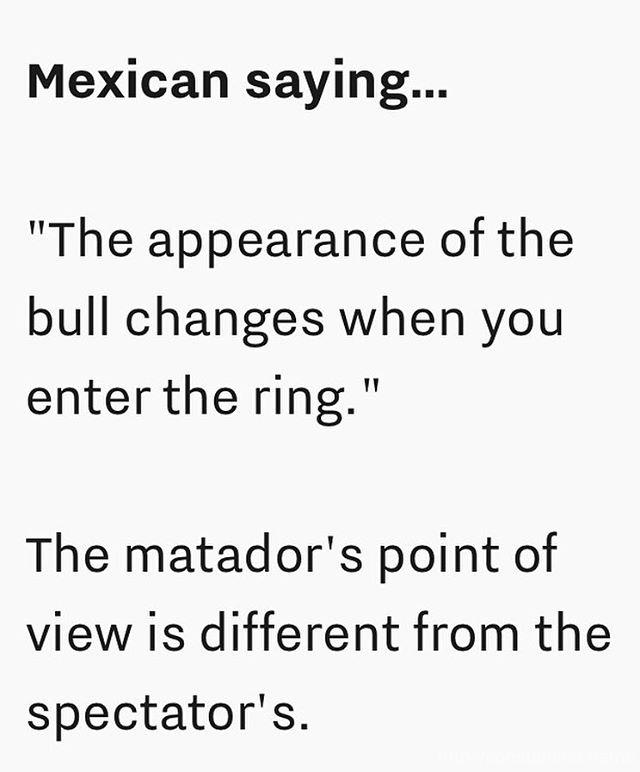
The bull looks different

Encountered this for the first time today while reading a book. I share this not for the parkour/non-pk dichotomy, but for the younger/older dichotomy.

ɕ


Key to success

I don’t know the key to success, but the key to failure is trying to please everybody.

~ Bill Cosby

slip:4a326.


§11 – Half Measures

This entry is part 23 of 37 in the series Study inspired by Pakour & Art du Déplacement by V. Thibault

The keys to life are running and reading. When you’re running, there’s a little person that talks to you and says, “Oh I’m tired. My lung’s about to pop. I’m so hurt. There’s no way I can possibly continue.” You want to quit. If you learn how to defeat that person when you’re running. You will know how to not quit when things get hard in your life. For reading: there have been gazillions of people that have lived before all of us. There’s no new problem you could have–with your parents, with school, with a bully. There’s no new problem that someone hasn’t already had and written about it in a book.

~ Will Smith

Coming up short because of half-measures is not a problem I have. On the other hand, I am stubborn to a fault. Sure, I’m not stubborn every moment of every day, but I can easily muster my inner Bulldog when I need to dig my nails into the earth and push through things. I don’t think anyone has ever called me a “quitter.”

Self-injury? Behavior corrosive to interpersonal relationships? Mindlessly bashing myself on challenges both mental and physical? Being critical of others from a myopic view-point? Wearing my stubbornness as a badge of honor? Pride? Hubris? On all counts: Guilty as charged!

Clearly, I should continue to practice dialing-down the stubbornness. But, is there an appropriate amount of stubbornness?

Is play, or joyfulness, the key to finding the balance?

If I’m happy and having fun, does that rule out being stubborn?

Thibault’s section is urging us to avoid half-measures. But maybe I should occasionally practice putting in only a half-measure of effort. Maybe — just to practice not following through — I should try abandoning something for no particular reason?

ɕ


On the shortness of life

Relax the straitened limits of the time which is allotted me. Show me that the good in life does not depend upon life’s length, but upon the use we make of it; also, that it is possible, or rather usual, for a man who has lived long to have lived too little. Say to me when I lie down to sleep: “You may not wake again!” And when I have waked: “You may not go to sleep again!” Say to me when I go forth from my house: “You may not return!” And when I return: “You may never go forth again!” You are mistaken if you think that only on an ocean voyage there is a very slight space between life and death. No, the distance between is just as narrow everywhere. It is not everywhere that death shows himself so near at hand; yet everywhere he is as near at hand.

~ Seneca

slip:4a891.


§10 – Undershoot Overshoot

This entry is part 22 of 37 in the series Study inspired by Pakour & Art du Déplacement by V. Thibault

Thibault uses the phrase, “mindful resource management,” which resonates with one of my frequent avenues of thought.

Today, I can easily take one thousand steps without risk of injury, and I could take one thousand steps every day without developing chronic injury. In fact, such regular walking is improving my general health. (Although I expect that at some point it will simply be maintaining my general health.) Clearly then, these resources are well-spent on walking. But what about some specific running precision? How many can I do well? How many can I do before I’m tearing down my tomorrow-self more than will benefit my next-week-self? What about some other challenge? Where is the tipping point where I go from, “sustainable growth,” to “acute or chronic injury?”

To answer my own questions I must apply mindful resource management and calibrate my efforts. These concepts are important, explicit and obvious in Parkour. With movement, success or failure is usually obvious, and I can continuously calibrate my movements as I over-/undershoot. Initially I “throw myself at it” with flat trajectories and smash-crash-bang landings, but eventually I learn to “float in” with higher trajectories, more power, and more control.

In a larger sense, this applies not only to my Parkour efforts, but to my everyday life. Much of what I do could be calibrated: Food consumption; Listening skills; Speaking skills; Time spent interacting with others versus time spent alone; Self-reflective thought versus philosophical discussion; Mindful meditation and recovery work versus high-intensity physical training.

In the largest sense, this calibration tracks a life-span.
Beginning with the frenetic activity of youth, actively trying to carve my life through the universe: Overshooting. Then comes the inevitable, timorous, mid-life reversal to a hyper-aware, hyper-reflective approach: Undershooting. And then finally — hopefully! — a calibrated, broad, world-view.

A balance of give and take.
Power and control.
Life and death.
Yin and yang.

ɕ

How art can change your life

No, I don’t think you’re born with it. You have to hear stories and you have to live stories. You have to have a bunch of experiences and be able to say ‘Here’s something that happened to me yesterday….’ And if you can make people laugh by telling them what happened to you, then you are telling the story well. So that’s what I learned in improv.

~ Bill Murray

slip:4a879.


Why I’m always in a hurry

So what is going on? Why do I hurry so much? I’ve been reflecting on this, and the answer seems to be that my mind has a tendency towards greed. This isn’t greed in the sense that I want a lot of wealth … but my mind finds something it likes and it wants more. Always more.

~ Leo Babauta from, Why I’m Always in a Hurry, & What I’m Doing About It

slip:4uzehu2.

ɕ


Hermann Hesse on little joys, breaking the trance of busyness

A stretch of sky, a garden wall overhung by green branches, a strong horse, a handsome dog, a group of children, a beautiful face — why should we be willing to be robbed of all this? Whoever has acquired the knack can in the space of a block see precious things without losing a minute’s time… All things have their vivid aspects, even the uninteresting or ugly; one must only want to see.

~ Herman Hess from, Hermann Hesse on Little Joys, Breaking the Trance of Busyness, and the Most Important Habit for Living with Presence

slip:4ubahe1.

ɕ