A phrase for 2025

2025? Inconceivable! Still, it’s time to settle on my yearly touch phrase for 2025.

SERENITY

In 2012 I began selecting a phrase or word to use as a guide. David Bourne pointed out there’s a word for that: Cynosure.

When I picked the phrase in 2012, I didn’t imagine it would become a yearly ritual. It required significant reading through my journals to realize I even had chosen cynosures for 2012 and 2015. Over the years I’ve used the following:

2012 – Will-power and self-possession
2015 – simplify
2017 – “A dream is just a dream. A goal is a plan and a deadline.” ~ unknown
2018 – hell yes! or, NO.
2019 – NO.
2020 – get less done
2021 – festina lente
2022 – choose wisely
2023 – choose today
2024 – HUMILITY

There are echoes. For example 2022’s is effectively a refinement of 2012’s. And there’s an over-arching story of simplification and increasing self-awareness. What more could I ask for?

Mostly I use these cynosures in my journaling. I generally end each entry by writing it, followed by memento mori. Here’s the end of 2024…
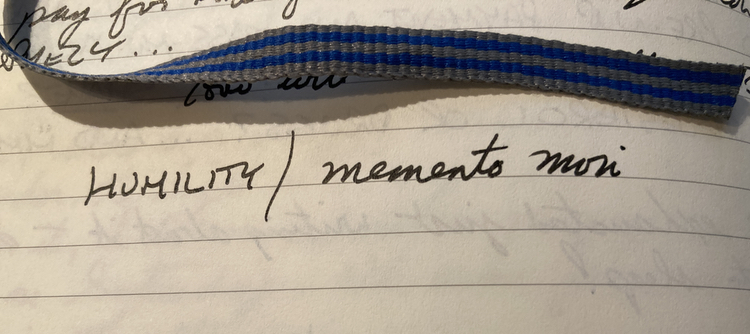
I’m obviously reminding myself of these ideas. I’m also preparing for my certain death. I will one day write a final journal entry, and it would be fitting to have “memento mori” be my final journaled words.

My choice for 2025 is meant to be aspirational. In some journal entries in December I was writing about themes I might seek more of in the new year; Tranquility, contentment, or perhaps gratitude? Serenity won out because I’d like to maintain my serenity, at all times. Even when active. Even in the midst of chaos.

ɕ


It’s not you, it’s me

Life is rich and colorful but to justify the habit you tell yourself that your phone will somehow be more interesting. This is an excuse. If you’re bored by the situation you’re in it’s your own damn fault.

~ Tom Critchlow, from The Art of Being Switched On

slip:4utote1.

Yes, absolutely. There are levels to this art of being switched on. First is to be come self-aware enough to notice that you are generally off. Second, being able to notice in the moment when you are off. Third, being on. Fourth—and this makes the first three seem easy—being truly happy when others around you are switched off.

ɕ


Leadership

Freedom, by definition, is people realizing that they are their own leaders.

~ Diane Nash

slip:4a1474.


Peculiar thinking

Every man has some peculiar train of thought which he falls back upon when he is alone. This, to a great degree, molds the man.

~ Dugald Stewart

slip:4a1468.


Benevolence

Benevolence and self-direction (described below) are usually near the top of the values we all share. Each of us also has an internal hierarchy of values, where we rank our values based on those we find extremely important to those that don’t really motivate us at all.

~ Chris Bailey, from There are just 10 basic values

slip:4ucite3.

Benevolence—in my opinion—only pops up on our radar once we have enough time, energy and resources. Whether or not it’s clear in that moment, that’s because we, for the first time, manage an honest look back and actually realize all the places where we’ve received help from others. So that’s nice for ourselves, but also for the entire human race.

ɕ


Open to

It’s a rare person who wants to hear what he doesn’t want to hear.

~ Richard Cavett

slip:4a1458.


Improvement

People try to do all sorts of clever and difficult things to improve life instead of doing the simplest, easiest thing—refusing to participate in activities that make life bad.

~ Leo Tolstoy

slip:4a1443.


Self

I should not talk so much about myself if there was anybody else whom I knew so well.

~ H. D. Thoreau

slip:4a1438.


Hey, pay attention

I have a routine with my journaling. Over time, that routine has changed a lot and I’m sure it will evolve farther. Currently, I start a clean A5-sized face of a page for each day. I do not read the previous day’s entry; I’m never trying to continue where I left off in my thinking as I journal. No, the journal is simply a place for me to talk to my future self. Here’s why I did that thing I did. Here’s this really great idea… but I’m letting go of it, and writing it down hoping future-me gets a chuckle at the dumb idea I was wise to drop. Sometimes I record really big wins. Sometimes I record really big losses. A wedding! A birth! A death! But mostly, I’m just capturing how I feel, why I feel, what I think, why I think, … Sometimes I spend hours painstakingly handwriting long texts. Sometimes it’s just 60-seconds and a bulleted list. Vanishingly rare is a sketch. Occasionally a flourish of colored-penciling. There are often inset headings in block letters at the sides as signposts—first instance of this, last instance of that.

It helps me pay attention to my life.

~ Austin Kleon from, Why I keep a diary

slip:4uauwa1.

Yes, there’s much paying of attention to my life that happens in the writing.

But the true wizardry is in the years-later rereading.

ɕ


Cogito

I don’t think ego is good or bad, it simply is. What matters (to me) is what I do, and what I do with my ego. Do I project my ego out onto the world (the way one can project a film onto a live scene in daylight: You can see the original people and things, but the film adds color and shape and, possibly, changes one’s perceptions) and examine and evaluate others colored by my own ego? …or do I try to go deeper and imagine what others might actually be experiencing, what their ego might be like?

Foremost, you must make a decision about your ego.

~ Paul Niquette from, Recommendations: Packing for Ego-Trips

slip:4unibo1.

That insanely deep dive by Niquette is a refreshingly self-aware attempt at proving who should be given credit for inventing the word “software”. The part I’ve linked, isn’t even the last part. I found myself reading and knowing there was a time when I could easily have fed my ego in such a protracted journey— but I don’t think I would have been able (back at that time) to do the self-aware zoom-out that Niquette attempts. Possibly interesting to you; Definitely the sort of thing I find myself mulling over these days.

ɕ