My way?

For me, all these complex valences reach their peak in one song. And you know which one I’m talking about.

Ted Gioia, from “My Way” or the Highway?

slip:4uhopy2.

There was a time—20 years ago, I’d say—when I sang along. It was of course aspirational— or— I’m looking for a word; not quite “aspirational.” I was singing along as if the song in any way represents my actual story. In reality, I’m only acting as if I’d actually tried to do even a few of the things expressed, let alone actually accomplished all the things expressed. Is that posturing? …playacting? …attempting to borrow someone’s bravado?

I’m going to go with: self-deception.

There was a time, not too long ago, when I sang along in self-deception. Now the song reminds me that I’ve never actually even tried to do anything… let alone accomplished anything worth singing about.

ɕ


Morse Code in music. Maybe.

Years ago, I had this [in hindsight] rather silly idea about creating running intervals from Morse Code.

Just the other day I learned about the 5/4 time of the original theme to Mission: Impossible. And there’s a possibility that Morse Code is involved.

The Morse code for M.I. is two dashes followed by two dots; if a dot is one beat and a dash is one-and-a-half beats, then this gives a bar of five beats, exactly matching the theme’s underlying rhythm.

~ from Theme from Mission: Impossible

ɕ


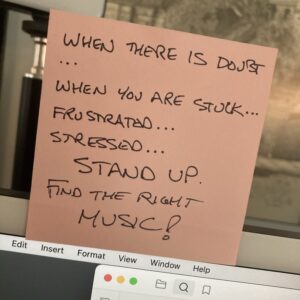
Stand up. Turn it up.

The other day—I forget why—I decided to put on some music, and I just happened to be working standing-up (at my adjustable height desk.) An hour later, having made huge strides on work and on changing my mood, this occurred to me.

ɕ


Not fun, but still pleasurable

Fun is not the right word. It is demanding, but somehow I also find pleasure in that.

~ Seong-Jin Cho, from Seong-Jin Cho – The Talks

slip:4uteie32.

While rock climbing (outdoors, on real rocks, at real heights) I was once told that there are three types of fun: Type-1 fun is when something is fun, right now. Type-2 fun is when it’s not fun now, but is nonetheless great because of the experience, stories and learning being gained. …and then there’s Type-3 fun when nope, this is bad, mistakes have been made, and I want out of here.

I wonder if a big part of what draws me to be professional about what I do is that it’s really just Type-2 fun?

ɕ


Cohorts

You just have to use what you have, and have great cohorts. I have people that I’ve played with a very long time. We are connected by our common understanding of what we’re doing, all the experiences we’ve had over the years… And most of all, there’s a friendship between us which allows us to do it without having to explain everything with a huge long manifesto. It has a lot to do with the trust I’m able to place in them to do our work.

~ Elvis Costello, from Elvis Costello – The Talks

slip:4uteie26.

Time after time I hear creatives talk about that. How they have an inside circle of peers. Of people who are also friends. Creatives need to have a group of people which somehow form a scene; They have access to a place where others like them freely associate.

ɕ


Music

We can set our deeds to the music of a grateful heart, and seek to round our lives into a hymn—the melody of which will be recognized by all who come in contact with us, and the power of which shall not be evanescent, like the voice of the singer, but perennial, like the music of the spheres.

~ William Mackergo Taylor

slip:4a1381.


Well-composed

A well-composed song strikes the mind and softens the feelings, and produces a greater effect than a moral work, which convinces our reason, but does not warm our feelings, nor effect the slightest alteration in our habits.

~ Napoleon

slip:4a1358.


What to do with twenty minutes

I recently realized I’ve wasted 23 years. Way back in 1990 a good friend gave me a CD of MCMXC A.D. by Enigma. It was mind bending, and remains so; to this day, I use it when I really need to zone out and not quite sleep, but rest. It’s an album which I have never once listened to a single track separately. I’ve only ever started at the front and gone straight through.

The other day, I thought: I should see what else Enigma (the brain child of Michael Cretu) may have done since 1990. Followed by my ordering all of the other seven albums. I buy the CDs used, and that means they tend to trickle to my doorstop over a few weeks. Oh. I’ve turned into a lunatic, listening to music far too loud in the house. I’ve recently done this with other artists and suddenly I’m up to my eyeballs in great (in my opinion) music.

So, why 23 years wasted? The Screen Behind the Mirror was released in 2000. I’ve therefore wasted 23 years worth of opportunities to play it.

Basically I had just aged myself by twenty minutes. Two virtual cigarettes, and not even a fading buzz to show for it. I learned nothing, gained nothing, made no friends, impacted the world not at all, did not improve my mood or my capacity to do anything useful. It was marginally enjoyable on some reptile-brain level, sure, but its ultimate result was only to bring me nearer to death. Using my phone like that was pure loss of life — like smoking, except without the benefits.

~ David Cain from, Most Phone Use is a Tragic Loss of Life

slip:4uramo1.

I’ve no idea if you like Enigma. (You can thank me later if you just discovered Enigma and do like it.) But there simply must be some music that you do like! …find which music it is, buy a copy of it in whatever medium you prefer, and spend that twenty minutes—and the next 23 years, if you’re lucky—leaning into that stuff.

ɕ

By any measure, indeed

By any measure, David Bowie was a superstar. He first rose to fame in the nineteen-seventies, a process galvanized by his creation and assumption of the rocker-from-Mars persona Ziggy Stardust. In the following decade came Let’s Dance, on the back of which he sold out stadiums and dominated the still-new MTV. Yet through it all, and indeed up until his death in 2016, he kept at least one foot outside the mainstream. It was in the nineties, after his aesthetically cleansing stint with guitar-rock outfit Tin Machine, that Bowie made use of his stardom to explore his full spectrum of interests, which ranged from the basic to the bizarre, the mundane to the macabre.

~ Colin Marshall from, When David Bowie & Brian Eno Made a Twin Peaks-Inspired Album, Outside (1995)

slip:4uoewe1.

Somehow I just missed being really into David Bowie when I was in high school. He was definitely big, and popular, and part of the music I heard. To my detriment, it wasn’t until after he died that I started listening to more of his music from his wider catalog, and then watching a documentary, etc. It’s always inspiring to discover a creator who gets more interesting the more you learn.

ɕ


Looping and decay

In contrast to dramatically slowing a recording down and extending its length, artists have also explored the possibilities of repeating short recordings over and over. The history of looping in modern composing is a story of the accidental beauty of technological imperfection and decay.

~ Ahmed Kabil from, Transmissions from the Ambient Frontier

slip:4uloie8.

It’s worth the click just for the first photo, which has nothing directly to do with sounds nor music. And then further down you get a photo of a tape loop—the physical device that can play a section of tape forever without interruption. Along the way is a mention of sound art created as very-old [magnetic] audio tape sheds it’s coating. Plus 5 other sound-related shifts in perspective. I read this piece over and over, as if it were itself a tape loop. I see—hear?—several magnificent halls of exploration… which I’m running away from because I do not. need. another. hobby. New genres of music to explore, a full 24hrs [uninterrupted] that I could spend on Beethoven’s 9th, …

I’m a sucker for things which gift me with any shift of perspective. That’s a big part of why I love conversation: Every encounter with another mind is ripe with opportunity for my own growth.

ɕ