Quotations are difficult

Most of my blog posts are either a quotation which I leave to stand on its own, or a usually-longer-length pull-quote with a citation and my commentary. Things around here are very intentional. The freestanding quotations are meant to leave all the context and analysis to you, Dear Reader, without any of my thoughts coloring your thoughts. You may very well try to learn more about me based on my selections, but I’m trying to recreate—for your enjoyment—the experience of discovering the quotation. The pull-quotes both expose the seed of my reflections and try to lure you to something in the world I’d like to highlight.

Fires can’t be made with dead embers, nor can enthusiasm be stirred by spiritless men.

~ Baldwin

But there are the vanishing rare two-fer posts like today. There. Have a quote. And…

I discovered this quote in a book, (p17 of Get Together, 2019 Richardson et al if you must know.) I know this will surprise you, but I have a well-practiced process for “capturing” quotes. In this case, the vague attribution tickled a memory; “I’m pretty sure I have a quote from James Baldwin…” I checked, and I do. “I wonder if this quote is that Baldwin…”

What’s the simplest thing that could possibly work? Just type the quote, in quotes, into a search engine… and Quote Investigator has a page for it. (Going directly to Quote Investigator is step two, by the way, if the search fails. I search generally, first, because it often finds the phrase in the original source material right out of the gate.) It turns out that this quote has a second sentence!

Fires can’t be made with dead embers, nor can enthusiasm be stirred by spiritless men. Enthusiasm in our daily work lightens effort and turns even labor into pleasant tasks.

~ Baldwin

slip:4a732.

Oh, nice! I like that even more than the one I stumbled on. But who is this “Baldwin”… and then I read the Quote Investigator page. Their conclusion is ¯\_(ツ)_/¯ . It’s been attributed four different ways for nearly 90 years. And now I’m wondering if my James Baldwin quote— which is #380 in my collection of 700+ so it’s pretty old, although I think I recall where I got it, from Gaping Void . . . but don’t go there! It’s a wonderland rabbit hole of decades of cartoons. I digress. And I’m having images of the book authors doing this same rabbit hole deep dive.

Fine, executive decision: I’ll stick with “Baldwin.” But that makes for this wonky entry in my slipbox index of people… Now I have “Baldwin, James” and “Baldwin.” But you know what? I’m never going to forget about this now, if I ever look at that index slip again.

So now you know: When you see me casually drop a freestanding quote here, it’s not in truth casually.

ɕ

Two thousand nine hundred and six

Arbitrary milestones are just as useful as nice round numbers. This morning I decided I’d take some time to reflect on blogging.

I love grammar. I wonder if you thought that I meant this blog post would be my reflections on blogging? No, I took some time to reflect on my own. Today I’m yet again beating one of my favorite drums: It is life-critical to intentionally take time to reflect on the things one is doing.

What am I actually doing with my time? What is doing me benefit? What, harm? What things do I believe I must do? Why do I believe those are necessary? What promises have I made? …to myself, to others? What actually happens if I break one of those promises? …would anyone even notice? What could I do if I stopped everything and did some other thing with incredible focus? Why does that other some thing interest me? Could I more simply change what I’m doing to make a little room for it now? If I awoke to find all the things in my head, and on my lists, were done what would I do? …would I rush to add more things to do? …would I work on something new? …would I want to re-do something I’ve done before?

Discovery. Reflection. And then, go be efficacious.

ɕ


Craig Constantine: Experience, pruning, and benefit

What motivates and defines meaningful conversations in podcasting, and how does preparation and intentionality shape these interactions?

Doing the ‘same’ thing over 100 times seems like a lot, but feels like much less when each time is a unique and valuable experience. Craig discusses the process he uses to create space and have authentic conversations with each guest. He unpacks the idea of ‘pruning’ your projects and how reflection is integral to the process. Craig shares his personal reasons for creating the podcast, why video is not on the agenda, and changes we may see moving forward.

If you think about how… This is actually really hard to do, I think. If you think: ‘I am going to go over to my friend’s house at three o’clock on Tuesday, and I’m going to have a good conversation!’ With that, I mean, that’s basically what we’re trying to do.

~ Craig Constantine (14:17)

This conversation navigates the dynamics of podcasting, emphasizing the intentional shift from traditional interviews to organic conversations. Key points include the importance of preparation, balancing listener needs with authentic dialogue, and creating a space where guests feel seen and heard. Insights into reflective practices reveal how curiosity and follow-through shape meaningful exchanges.

The discussion also touches on challenges in managing creative projects, with pruning as a metaphor for intentional decision-making. The process of saying no to certain projects to create room for impactful endeavors highlights the speaker’s philosophy. Other topics explored include the importance of diversity in guest selection and the iterative process of refining the podcast’s mission.

(more…)


Better is better

I once asked someone a long, complicated question related to how I was currently doing something. I was considering changing the way I did the thing, and would “more” be better? …or would “less” be better? …or maybe something entirely different would be better? Their answer was:

“Better is better.”

As 2021 came around I found myself assessing what this blog is, why I’m investing all the time and effort, and what do I want you, Dear Reader, to get from it. It’s that last part that I’ve not specifically thought about in the past decade. 10 years of posting nearly 3,000 posts… and that’s all been done for my benefit. I realized I want this blog to help you become more reflective, and as a first step that’s why I created the previous 8 weeks of daily posts.

Going forward you’ll receive a single email from me on Sunday mornings. My hope is that a longer, but less-frequent email will encourage you to spend higher-quality time reading and reflecting.

I’ll see you on Sunday!

ɕ


A journey of small daily steps

Starting on Saturday, January 2nd you and I will be going on a journey of small daily steps. Today’s post is a preamble for you, my cherished regular readers.

I’ve prepared 60, daily posts designed as a journey of reflection for your new year. The final one will appear on March 1st. Tomorrow (Dec 31st) and Friday (Jan 1) will be two preliminary posts that set the stage for the sequence through March 1st.

The tone of these coming posts will be familiar, so I think you will be delighted. My hope is simply that these posts help you find tranquility as we head into 2021.

As always, I’m just a Reply-button away. I’m always delighted by any thoughts, feedback or conversations these posts instigate.

ɕ


Some current projects

A while back I reworked the front of my web site, https://constantine.name If you’ve not seen it recently, it used to be a list of recent blog posts, now it’s an overview of the various things I’m working on.

My work in the podcast space
I’ve updated my creator page on Podchaser. Podchaser is a web site that helps you follow shows or specific creators, hosts, guests, etc.. My latest appearance, (in a podcast as a guest,) is in Vivian Carrasco’s Within (U) podcast, in an episode titled, Cultivating Curiosity That Leads to Compassion.

ɕ


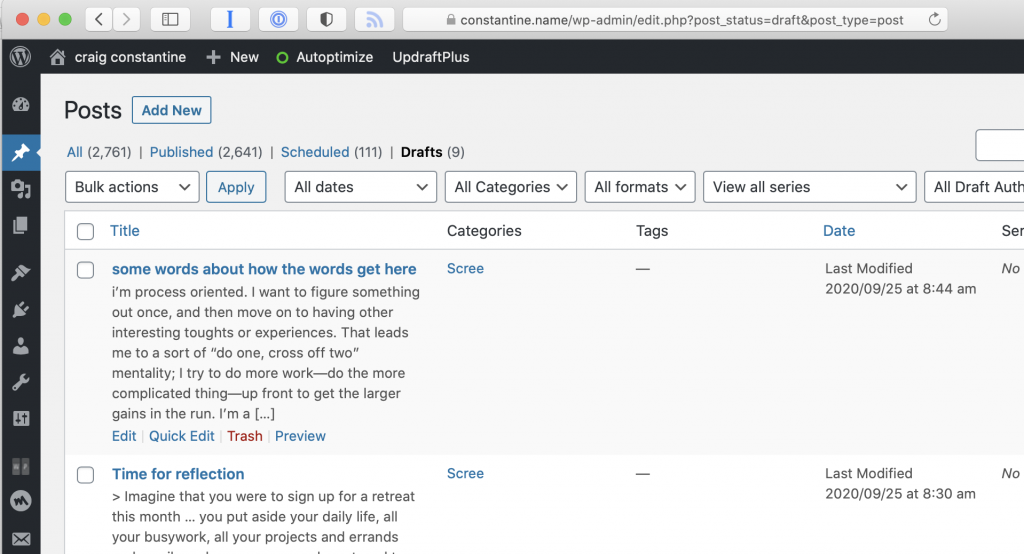
How the words get here

I’m process oriented. I want to figure something out once, and then move on to having other interesting thoughts or experiences. That leads me to a sort of, “do one, cross off two,” mentality; I try to do more work up front—do the more complicated things first—in an attempt to reap a larger gain in the long run. I’m a tool builder you could say.

But my power of process, can also be a problem. There is, of course, an XKCD for this lesson: https://xkcd.com/974/. I digress.

Today, I wanted to share a bit of the process that I use to distill the things I find, and to focus my thinking. (I’m not going to go into how I find things, nor how I ensure a fresh “stream” of those things is brought to my attention.)

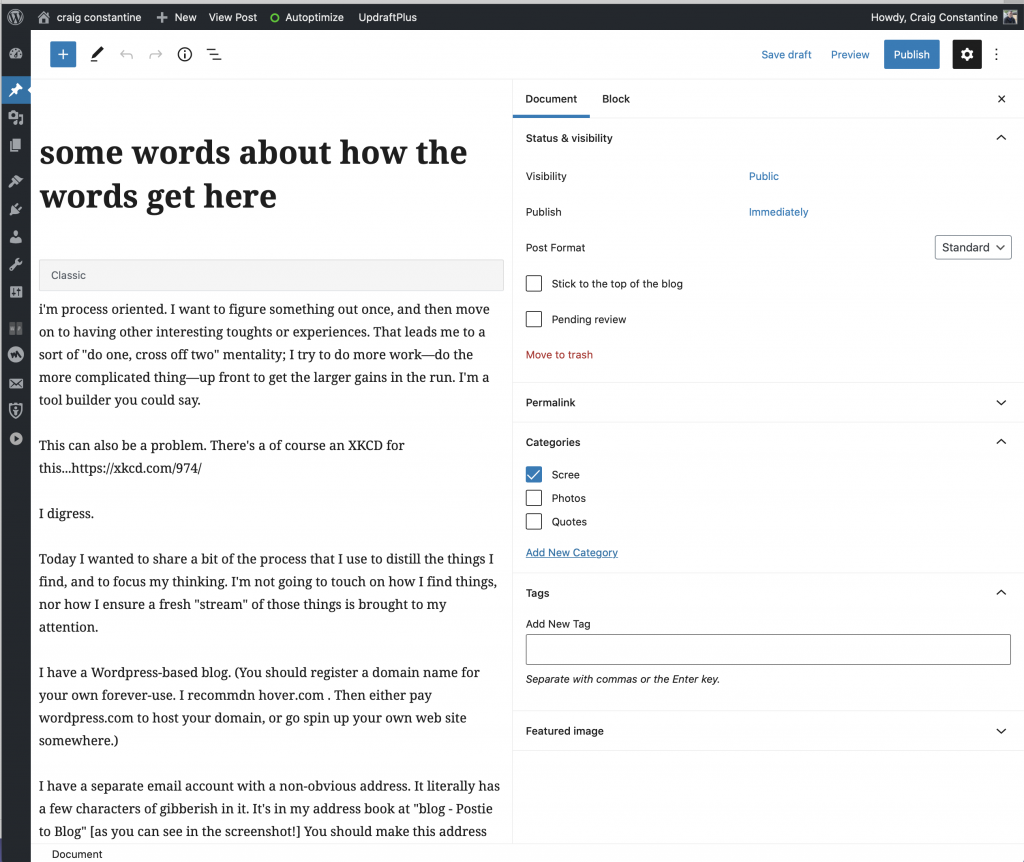
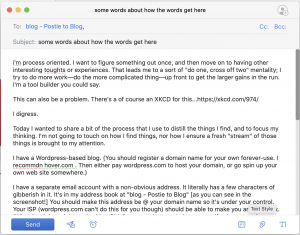
I have a WordPress-based blog using my own domain name. I also have a separate email account with a non-obvious address. It’s in my address book at “blog – Postie to Blog” [as you can see in the screenshot].

Whenever I see, read, or find something that inspires an interesting train of thought, I fire off an email to this special address. I simply brain dump my thinking. I insert bare URLs into the email. I put a “>” in front of blobs of text I want to show quoted. But I don’t bother with any formatting; it’s all just basic text.

I use the Postie plugin for my WordPress site. It’s an email client which periodically looks in my special mailbox and creates draft posts on my site. It deletes the emails as it creates the drafts.

When I want to work on blog posts, I go into my WordPress site and look at my drafts. I clean up the draft—fixing anything that I couldn’t stand having out on the internet. I dress up the links, organize the quoted parts, season it with my personal style, etc.. Very rarely, I’ll simply delete a draft. This has the advantage of giving me a chance to review my ideas for posts at some distance from when I initially captured it. Most of the time, I can see ways to drastically improve the post, but I don’t bother preferring instead to post the snapshot I had originally captured. I schedule the post for whatever day I want it to go out on. I’m writing this blog for my own benefit—it’s part of my process of reflection. So it’s not usually important when any particular post goes public.

Finally, I have a Mail Chimp account that has a recurring Campaign. It follows the RSS feed from my site, and emails whatever it finds to be new at 11am every day.

Why? Well, that’s probably best left for another day.

ɕ


On a mission

When I arrived at the atelier, the canvas was blank and I simply began poking at making little pin-points of color. Poking just to see each little point. Sure, I avoided some entire areas of the canvas. That top-left corner didn’t interest me, but that area above the center caught my focus. Then my gaze wandered a few inches and I found I was putting points down in another, new-to-me, blank area. Day by week by month by year by decade I wandered up to the canvas. Curiously, I now realize I never looked each day at the canvas as I walked up—or walked away or simply past. I just headed to this atelier and— Although, come to think of it, I’m pretty sure I thought it was a video game Arcade at one point, and it looked like a snowy ski slope too for a while, and I recall breaking waves and some sea smells. That’s… interesting. When exactly did I realize that this place is a true Atelier? Sure sure yes yes, the particular dots are still very [very!] interesting; the minutia seems fractal and the more closely I peer, the more interested I become.

But just the other day—although, it quickly became a couple weeks ago, soon to be a couple months, a couple years, a couple decades…

But just the other day I peered over my glasses and looked at the whole canvas for what might have been the first time ever. Holy shit, it’s a Georges Seurat painting of some afternoon on some island! I mean: The overall composition is so blindingly freakin’ obvious and banal that I’m tempted to chuck the whole thing as trivial— …until I pear closely and see all the infinitely intricately interconnected dots and—bam!— VERTIGO!

My vision is a world where everyone can flourish.

My mission is creating better conversations that spread understanding and compasion.

Will you join me?

ɕ


Anything but boring

…what I see is not chaos but home. A prose style that interrupts itself, that can’t seem to make up its mind, promises me the thing that I open a book looking for: a friend. That friend might be insufferable (Hello, Mickey Sabbath!) or maniacally self-involved (Bonjour, Marcel!), but what she won’t be, her parentheses assure me, is distant, withholding.

~ Ben Dolnick from, Opinion | (Let Us Out of This Clause) – The New York Times

slip:4unyoi4.

Say what you will about the Times—no really, go ahead, I’ll wait—but I am frequently glad that I keep the old Grey Lady in my RSS reader. skip skip skip skip yawn skip and then oh-hello! This piece is fun, and his perceptions about parentheticals and asides is something along with which I nod. (I shall torture my mother-tongue as I see fit.) Meanwhile, if I can get you to say, “not boring”—my goal isn’t so low, but while aiming for the stars I’ll settle for it—if ever asked to assess my blog. (Yeup, that sentence is broken just to make you read it multiple times.) A few days ago I was talking about texting. Today’s ramble through the brambles—is that a movie title? …it should be—feels like a postscript to my bit about how texting, (in it’s various forms,) slots in as sub conversation but supra full-on prose. Because I feel that my writing is as close as I can get to having a conversation… if you were a blind mute whom I couldn’t see.

End of line.

ɕ


The process of reflection

Much of the power of the Movers Mindset podcast’s signature question, “three words to describe your practice?” comes from thinking about one’s personal understanding of the word practice. In the podcast episodes, sometimes the guest’s discussion of that understanding is a profound part of their interview. Sometimes their surgical statement of three words is its sublime culmination.

In 2019, we posed the three-words question of the project itself. This turned out to be a surprisingly fruitful exercise. We came up with three words to describe our practice, and I subsequently adopted them as the three words to describe my practice:

Discovery. Reflection. Efficacy.

If those three words describe my practice—the journey of my whole life—then what is the purpose of this web site? Why go through all this work? It’s taken me 9 years and the previous 2,499 posts to understand:

It’s a vehicle for my process of reflection.

I used to think I wrote because there was something I wanted to say. Then I thought, “I will continue to write because I have not yet said what I wanted to say”; but I know now I continue to write because I have not yet heard what I have been listening to.

~ Mary Rueflé from, Madness, Rack, and Honey

ɕ