Hand-Write. Think Better.

A method for people who feel overwhelmed to start writing more on paper—which makes everything else easier

I’ve written a guide which shows how to use notebooks for clearer thinking: one notebook, simple practices, no elaborate systems. Written to help you stop re-thinking the same things and close open loops.

https://craigconstantine.gumroad.com/l/hand-write-think-better

ɕ


One slip at a time

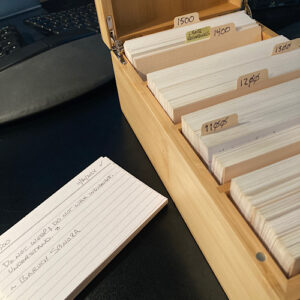
This morning I was working on adding some quotes to the ‘ol collection. I have a little box with the most-recent quotes, blank 3×5 cards and other little office-supply-ish things. Every now and then I pick up a bunch of those new quotes and move them back into these boxes. Today I realized, the second of these boxes is now nearly full—it seems like only yesterday that I moved the first few inches of cards (like ~400) into the first box. Time to order more of these storage boxes!

ɕ


Filed and lost

Taking notes on the books I read was a great start, but it wasn’t enough. It did me no good to leave those notes sitting in a software program like a musty filing cabinet in the basement, never to see the light of day again.

I realized if I wanted to benefit from my reading, I needed to engage with the books I read on a much deeper level. I needed to make something out of them. Otherwise, I would continue to passively consume information with no lasting memory of what I learned.

~ Tiago Forte, from The Ultimate Guide to Summarizing Books

Has anyone noticed that’s what I’m attempting to do with all my blogging and writing? Shirley, that’s obvious. (It’s not obvious, and don’t call me Shirley.)

I’ve always deeply loved movies. I was raised (on hose water and neglect) in the era when going to a movie was special. Remember when you had to use the phone (with a rotary dial, mounted on the wall) to call the theatre and listen to a looooong recording detailing what was playing and when? I could tell you so so so many stories about going to the movies. In more recent issues of 7 for Sunday, I’m feeling less inclined to stomp down the inside-joke movie references. If you find them even half as enjoyable to read, as I do to write them, then we’re both better off. I’m pretty sure that my recalling and retelling of all those stories about and around movies makes the entire movie experience more fun; yes the experience during the movie, but also all the stuff around it too.

No, I’ve not lost my own plot. Forte’s point about how to benefit from what one reads is the same thing. If you want to hold on to whatever it was that you’ve gotten from a book… you have to integrate it with the rest of your ongoing, lived experience. You have to go around telling the story of who gave you the book, what the book means to you in the context of your entire life, and what you think your interlocutor might get from it (like this, this, this, this, this, this or… you get my point.)

And as soon as you realize that’s fun for movies, and great for books, you should wonder if it could be a super-power for self-improvement if you could share the contents of your mind, with yourself, in that same fashion. Two suggestions: Start journaling immediately after reading this issue of 7 for Sunday, so you can then begin in a year, to regularly review your journals.

ɕ

Central tension

In college (which was before the Internet was readily accessible; before the Web was invented) was when I first encountered true information and opportunity overload. In hindsight, there really should have been a class about how that’s a real thing, and ways that one should embrace it. Not fight it. Not try to control it… but ways to embrace it.

The tradition of the commonplace book contains a central tension between order and chaos, between the desire for methodical arrangement, and the desire for surprising new links of association. The historian Robert Darnton describes this tangled mix of writing and reading […]

~ Steven Johnson from, The Glass Box And The Commonplace Book

slip:4usete4.

The point that it’s the tension that feels uncomfortable is the key that unlocked for me. Yes, there’s tension from all the complexity and voluminous information. That’s a feature to be used and leveraged, not a problem to be resolved.

ɕ


Personal liberation

I often remind myself that there’s nothing new under the sun. Of course, that’s not actually true, but it reminds me to temper my insanity. Enthusiasm is wonderful fuel for getting things done, but I’m too often sprinting up in the insanity range, rather than gleefully skipping along in the enthusiastic range. I digress.

Xanadu, the ultimate hypertext information system, began as Ted Nelson’s quest for personal liberation. The inventor’s hummingbird mind and his inability to keep track of anything left him relatively helpless. He wanted to be a writer and a filmmaker, but he needed a way to avoid getting lost in the frantic multiplication of associations his brain produced. His great inspiration was to imagine a computer program that could keep track of all the divergent paths of his thinking and writing. To this concept of branching, nonlinear writing, Nelson gave the name hypertext.

~ Gary Wolf from, The Curse of Xanadu

slip:4uwixa1.

I’ve spent a lot of time learning about, and tinkering with, personal knowledge systems. To my embarrassment, I don’t actually recall ever learning about Xanadu. I vaguely knew that the “hypertext” of the HyperText Transfer Protocol—the HT in the HTTP and HTTPS—wasn’t a fresh invention; The Web as we saw it invented did not also invent hyptertext. But I’d never seen this Wired article by Wolf.

ɕ


Where’s… everything?

It doesn’t matter how you store things, only that you do. If I know that, somewhere, I know something… and I can find it… that’s success. There are two parts to remembering (aka storing in such a way that it can be later found and used) everything: First, capture it in some form and put it somewhere intentional. Second, when you go for something and it’s not in the first place you looked (it’s instead in the 3rd place you looked), move it to the first place you looked.

These books helped educated people cope with the “information explosion” unleashed by the printing press and industrialization. They were highly idiosyncratic, personalized texts used to make sense of a new world of intercontinental trade, long distance communication, and mass media. Commonplace books could contain recipes, quotes, letters, poems, tables of weights and measures, proverbs, prayers, legal formulas, notes from sermons, and remedies for common maladies, among many other things.

~ Tiago Forte from, Commonplace Books: Creative Note-Taking Through History

slip:4ufobo4.

Of course, the hard part is getting in the habit of capturing things. Our minds are terrible at holding ideas. Our minds are for having ideas (and composition and creation and more.) The best day to begin capturing your knowledge was yesterday. If you missed that opportunity, today is also good.

ɕ


Knowledge management

I’ve spent decades wrestling with knowledge management. In the realm of systems administration, capturing obscure incantations, and the why’s and hazards that go with it are critical. I have a digital collection of notes going back more than 20 years. Yes, of course it’s named Grimoire. More recently, I started creating my own person knowledge system and ended up with my own variation of a slipbox.

For most of human history, knowledge was something completely inseparable from a particular person. It didn’t mean anything to point to a piece of knowledge without reference to the person from whose life experience it emerged. The idea of a “piece” of knowledge didn’t even make sense, as knowledge couldn’t be broken down into discrete units as long as it remained in someone’s head.

~ Tiago Forte from, Inventing the Digital Filing Cabinet

slip:4ufobo3.

My first learning around knowledge systems was that the very act of building them is incredibly helpful at learning. The effort of composing the notes (or whatever) requires careful thinking, rethinking, adding context, imagining the future where the knowledge will be used, etc. All of which is repetition and integration—key components of learning.

My second learning has just clicked into place as I read Forte’s article: Knowledge systems are tools for later use. I used to think that by building the system up, I was somehow creating something (something as yet unknown and unexpected.) Which was silly of me, because Grimoire has taught me, over decades, that any given incantation found therein can never simply be incanted. The knowledge within is only part of the magic. Only if the knowledge within can be combined with experience and expertise will it be useful in some current endeavor. The knowledge system is working and complete as it is, if when I’m doing something, I can find the knowledge I need to continue.

ɕ


Do not hoard ideas

Holding on to a lot of ideas takes a great deal of time and energy. If, like me, you’re a systems person you can make things much worse. I can build personal knowledge systems, slipboxes, databases, custom software and bend all sorts of technology into new shapes. It turns out—as I hope you’ve already guessed—that if you have too many ideas, and then build and deploy a bunch of clever tools and systems, you just end up with even more ideas. (There isn’t quite an XKCD for that, but number 927 is close.)

One of the few things I know about writing is this: spend it all, shoot it, play it, lose it, all, right away, every time. Do not hoard what seems good for a later place in the book, or for another book; give it, give it all, give it now. The impulse to save something good for a better place later is the signal to spend it now. Something more will arise for later, something better. These things fill from behind, from beneath, like well water.

~ Annie Dillard from, Spend it all every time

slip:4usupe3.

Building tools and systems is also a terrific way to hide. It’s a variation of the old idea that I cannot start on the real work until I get all this other stuff organized and cleaned up and set up and just so.

Instead, I’m so much happier if I simply take something that brings me joy, and share it.

ɕ


Upwards

As the edges of human knowledge are advanced, the total amount one must learn to be able to then contribute to further advancement grows. If there’s a proverbial mountain of knowledge, it grows taller as each contributor adds. If you start from the beach (at birth), wander inland in your early years of not-guided-by-you learning, and eventually decide to scale the mountain… well, it really matters in what epoch you happened to be born. Or maybe it doesn’t?

There is a growing mountain of research. But there is increased evidence that we are being bogged down today as specialization extends. The investigator is staggered by the findings and conclusions of thousands of other workers-conclusions which he cannot find time to grasp, much less to remember, as they appear. Yet specialization becomes increasingly necessary for progress, and the effort to bridge between disciplines is correspondingly superficial.

~ Vannevar Bush from, As We May Think

Bush played a complex role in the history of the United States. (It’s better if you form your own opinion about him and his work.) His short essay from about 80 years ago is these days seen by technophiles as heralding our own, current Internet and information age. In particular, a lot is read into Bush’s description of a desk which behaves like our modern Internet, information systems, and data processing. That’s fine. It’s like reading 80-year-old science fiction that became science fact.

Much more interesting to me is the point that with just a bit of squinting, it looks like nothing has changed in 80 years. Everything about this—the mountain of information, the tools [eg, Bush’s imagined desk, our internet], the people feeling overloaded, the specialization—feels fractal.

ɕ


Curated and random

I recall a little sign which was sometimes spotted on desks, back in the before-times when everyone had a desk and papers and ring-binders and books and a telephone that also sat upon that desk. The sign was: “A messy desk is a sign of genius.” (And sometimes it said, “…of a creative mind.” )

I’ve had a lot of desks. In every case, I’ve always swerved repeatedly between messy and organized. I get to a point where—sometimes with a literal scream—I stop working and reorganize everything. For a long time, I hoped that one day I would manage to be just comfortable enough, with just the right amount of clutter and chaos, to be able to reach a steady state.

One detail that drives me bonkers is in the digital realm, computers are perfectly organized. I use a tool (called Reeder) to manage a read-this-later collection. It’s a big collection often reaching 500 different things marked as possibly interesting. (Some are interesting enough to spend a few minutes on, some are interesting enough to spend hours on.) Sometimes I’ll randomly shuffle things in a digital list. But sometimes… the list is just ordered the way you assemble it. And you can look at the list in forward or reverse order. This gets to me. If it’s a big list, neither forwards or backwards is best. So instead, I do both: I read the item off one end (the thing that’s been in the list longest) and then the other (the newest), and I just alternate in a reading session.

Perhaps this seems like a silly or trivial thing to point out. But there’s a bigger lesson: Where do I have some specific structure (organization, ordering, etc.) that I didn’t actually intend? …is that structure holding me back or keeping me from experiencing something I’d prefer?

ɕ