Thank you, Miss Merrill

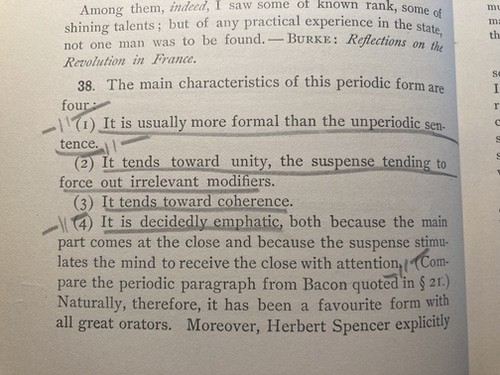
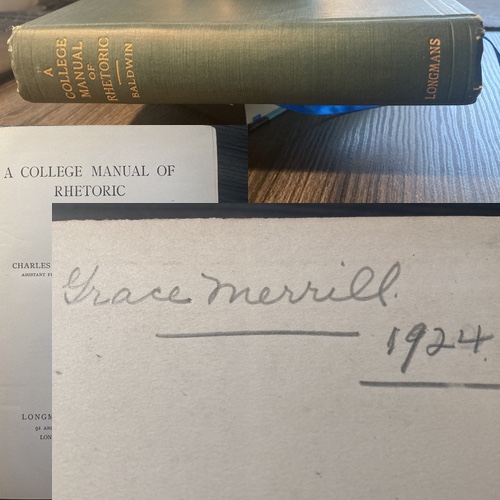
Last weekend, while helping friends pack-house, I found this book:

Wait! Don’t do the math on a book from 1907, and a college student taking Rhetoric in 1924. :)

Instead of packing it, I borrowed the book wondering if this James Sears Baldwin might just be the Baldwin. This is a dry book. But it’s also teaching me a ton about writing. The author hasn’t cracked even the slightest smile in the first 37 pages of this 400+ page tome. But the Baldwin quote I’d love to find within, might just be the sort of pithy thing this author would drop near the end.

Yes, I am willing to read a 400+ page tome on the off chance that I find the quote and get the once-in-a-lifetime thrill of finding an original attribution for a well-known quote. I digress.

By page 30, I had seen a whole bunch these little diagonal marks, but hadn’t really figured out what she was trying to imply.

Then it hit me. Quotes! It’s a diagonal line with a quote on the diagonal line. She’s delineating quotations. I’m guessing that she must have written a paper—who’d expect that in a Rhetoric class, right?—and I bet she came back through and marked the quotation sections. At the same instant that I figured it out, my up-to-then habit of drawing a full line across the page, (often a long line, then up or down a line, and then finish going across, to “cut” in the middle of a line,) seemed dumb.

Thank you Miss Merrill. This looks just way cooler:

ɕ


Deep dive into books

Today I thought I’d share a thorough explanation of what I do “to” a book these days. This process—which to be honest I don’t follow for every book I read—is the result of combining a few different ideas:

  • I love the physicality of books. The typography, the paper, writing in them, desultory bookmarks, (I add my own ribbon bookmarks,) and numerous sticky-notes poking out the side.
  • I love the peaceful, inertness of books. They literally sit there and do nothing. There are no alerts, and no interaction, (from anyone beyond the author’s original magic spell.)
  • I’ve always wanted to retain more of the knowledge from a book once I’ve read it.
  • I’ve wanted to be free of my self-imposed rule of reading every page.
  • These days I have a slipbox, and I want it to grow.
  • I love to collect quotes.
  • I’ve always wanted a set of crib notes, summary, or something that I could lay hand on after reading a book.

Arrival

Fortunately, books arrive slowly. It took practice, but I learned to do all of the following in a minute or two.

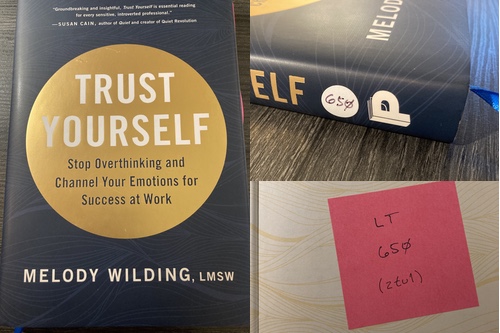
If it’s a new book, I take a few moments to prepare the spine. (Please tell me you know how to do that.) I affix a small, white, circular label on the spine, and I slap a sticky-note on the first face opposite the cover.

I skip over to librarything.com and find the book in “Your Books”—my books, that is. Most arriving books are coming in after already being in my “wishlist” collection; They get moved to the “library” collection. Otherwise they get searched for and added to my collection. Books get tagged as “physical,” (as opposed to those tagged “PDF,” “iBooks”, or “Kindle,” because, yeup, I track those too.) I see what MDS number Library Thing says the librarians of the world have chosen.

On the sticky-note, I write “LT”, (for “this book is entered into Library Thing,) and the MDS number. I write the main, three-digit part of the MDS number on the label on the spine.

Finally, I skip over to bookmooch.com and remove it from my Wishlist over there to ensure I don’t forget about it. (Lest I accidentally “spend” my Book Mooch points requesting a book I now have.) If this is a book that someone sent me because of Book Mooch, I hit the “Received!” button instead.

This book is now “ours.” And some amazing things are now possible just by having spent a couple minutes on each book as it arrives. (Please ignore the entire week I spent bootstrapping ~500 books when I started doing all this. :)

  • Physical bookstores are fun again! What books are on my wishlist? (500+ at the moment) …okay, what wishlist books are tagged, “priority”? (about 250 — yes I have a problem.) Picking up a book… “this looks interesting…” Do I already have it in the house, maybe now is the time to buy it? Did I once have it, and it’s no longer in our collection, (part of my collections in Library Thing is “had but gone now”)?
  • Long-term storage of books doesn’t mean they are lost. A big portion of the books in our house are here because we want to keep them. They sit for years untouched. Those are shelved by MDS number. Ask me for a book, and I can walk directly to it; It’s either laying about somewhere and top of mind, or it’s shelved where it can be found immediately.
  • This is morbid, but if the house burned down I could decide what books to replace.

Books are for reading

Well, technically, one can also build a thing called an anti-library. But eventually, hopefully, or at least this is what I keep telling myself: I start reading the book.

I do tend to read the entire book. But generally I read the table of contents first to see what I’m getting into. If I think the book is going to be a really deep read—something I want to read more than once, refer to, and really ingest—I probably read the Afterword first. The Afterword was written dead-last, after the book was done and the author is a different person at that point. Then maybe the Foreword, or some books have a Summary, or a Preface, whatever.

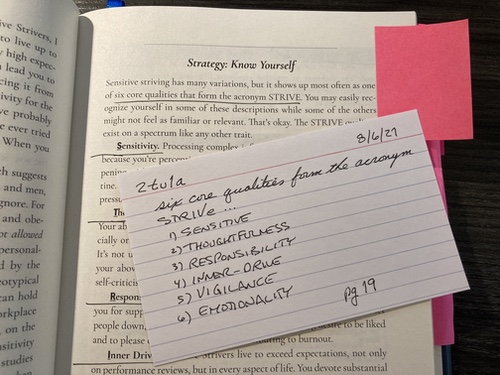
I’ve no qualms about skipping parts. For example, in books like Trust Yourself by M Wilding I skipped all the anecdotes and skipped all the workbook/exercises stuff. I ended up reading only about one-third of all of the pages. (Still, a good book by the way.)

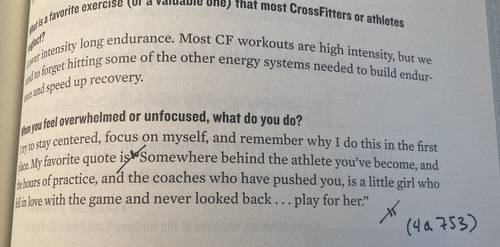
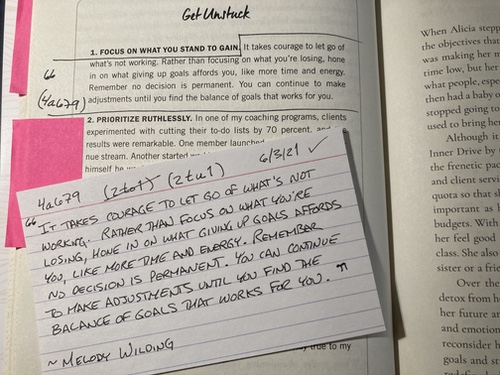
As I’m reading, if anything quotable jumps out, I’ll capture that on the spot. This leads to me making some marks, allocating a slipbox slip address, and I’ll leave a small post-it sticking out the side. I’ve never met a book worth reading that didn’t have at least one quotable bit awaiting me within.

Slipbox

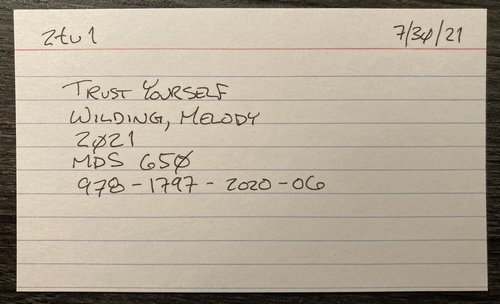
As soon as the first slip gets created from the book, that slip needs to refer to the book. That means the book itself needs to be in the slipbox. Apparently, I always wanted to be a librarian.

And now I can leave a “(2tu1)” reference on the quote’s slip.

So that’s a bit of detour, but it really only takes me about a minute. You’ll notice—first photo at top—that the sticky-note for this example book has a slipbox reference, “(2tu1)”—the parens mean “this is a reference”. I didn’t put that on the sticky-note when the book arrived. That was added when I put the book into the slipbox by creating slip “2tu1”.

But mostly, I’m just reading the book.

Identify summarizing bits

One day, I’m finished reading.

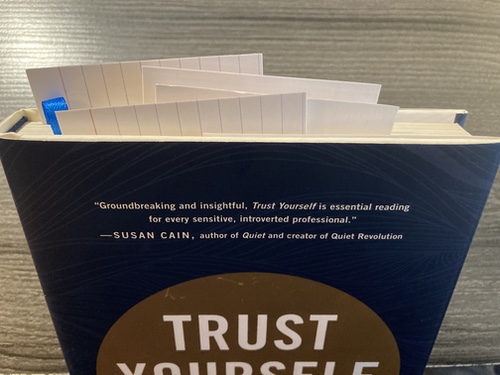
I find that even if it took me months to finish, the book’s contents remain pretty fresh in my mind. I flip through the book cover-to-cover, just skimming and noticing what I recall from reading. When I see a good, representative bit, I simply stick in a blank card at those spots. This lets me gauge how many slips my “summary” will be; Two is too few, and 20 might be too many.

Each spot has some key point that I want to include in my summary. I don’t write anything at this point. The goal is just to stick the cards into all the places that I want to include in my summary.

(I once tried using a printed template whose layout facilitated taking brief notes and had pre-printed page numbers. Folded, it doubled as a bookmark so I could build some notes as I read. When an idea leapt out, I’d find the page number on the sheet and jot a note. It was a neat idea, but didn’t work out for me.)

Summarization

Finally, I go through all the spots I’ve identified and I do a little underlining. I jot the basics of the idea on a slip and address it. So for this example book, whose slip is addressed “2tu1”, this first of the summary slips goes “below” as “2tu1a.” Next summary slip would be, “2tu1b”, “2tu1c” etc.

ɕ

Anything noteworthy since

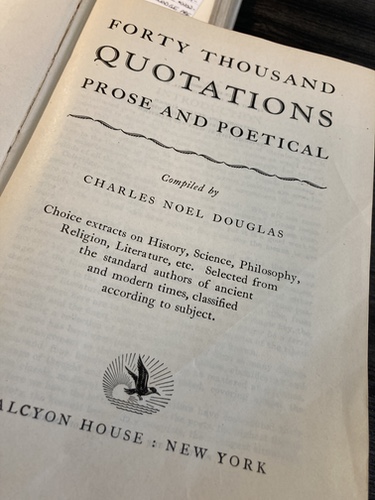
One of my recent acquisitions is this door-stop of a volume, Forty Thousand Quotations Prose and Poetical, published in 1940. Several thoughts spring to mind at this point:

Obviously, this book is 80 years old. Wait, no, that was not obvious to me. I was thinking, “1940… Wow, that’s like 60 years ago,” followed not as quickly as it should have been by, “…no wait, that’s 80 years ago.” So the first thought I’ll share here is that the years pile on like onion-skin pages. Year after year after year after year and before you realize it: Door stop. (Both you have a door stop, and you are a door stop.)

Upon arrival I immediately flipped through it to see what I’d gotten for my $14-plus-shipping. The book says, “prose and poetical,” but I don’t know diddly-squat about this Douglas fellow. There could be forty thousand stinkers better left forgotten. My verdict: The density is low. Perhaps 1 in 4 strike me as even worthy of inclusion in the book. Still, ten thousand quotations prose and poetical are worth 2/10 of one cent each, (in my book.)

It’s said—I’ve heard it said, I’ve said it myself now many times—that our favorite quotations say more about ourselves than of those we’ve quoted.

Is this book a snapshot of 1930’s America? Let this sink in: There’s not a single quote from anyone related in any way to World War II. There isn’t a single modern tech genius in here either. But wait! It was printed in 1940, yes. However the copyrights are 1904, 1914 and 1917. This book is a time machine come to me across more than a century.

I generally give books the page 88 test. That’s laughably near the front of a book which has— (Wait, wat?! This book has exactly 2,000 numbered pages! That’s another tangent I’m not following. Ahem.) Page 88 is laughably near the front of a 2,000 page book. As I carefully flipped towards 88, I was briefly anxious when I thought the entries under “anxiety” might run to page 88, but fortunately, no. The two columns of page 88 cover the tail end of, Apothegm (“a short, pithy and instructive saying or formulation,” honestly, I had to look that up,) then Apparel, and then Apparitions runs onward to page 89.

The first full entry on page 88 is:

A few words worthy to be remembered suffice to give an idea of a great mind. There are single thoughts that contain the essence of a whole volume, single sentences that have the beauties of a large work, a simplicity so finished and so perfect that it equals in merit and in excellence a large and glorious composition.

~ Joubert

slip:4a616.

ɕ


A structure to work in

Having a clear structure to work in is completely different from making plans about something. If you make a plan, you impose a structure on yourself; it makes you inflexible. To keep going according to plan, you have to push yourself and employ willpower. This is not only demotivating, but also unsuitable for an open-ended process like research, thinking or studying in general, where we have to adjust our next steps with every new insight, understanding or achievement—which we ideally have on a regular basis and not just as an exception.

~ Sönke Ahrens from, How to Take Smart Notes (2017)

I know I’m reading the right thing when—POW—I feel like a whole bunch of loose threads in my mind suddenly make sense. I’m a master at plans and organizing. (Outlines, processes, Allen’s GTD system, etc..) But my current quest for a knowledge system began in earnest when I could no longer ignore the aching feeling that there was something I’m missing; there’s something I’m not doing correctly. Ahren’s point about “imposing structure” on oneself is the insight. There’s a time for that. (And again, I’ve got that sorted.) I’m gleefully skipping off into experimenting with a new structure to work in. This isn’t all clear to me yet, so these blog posts aren’t going to be perfectly clear either. ¯\_(ツ)_/¯

ɕ

slip:4c2ko1a.


Mirror image of negative visualization

The fatalism advocated by the Stoics is in a sense the reverse, or one might say the mirror image, of negative visualization: Instead of thinking about how our situation could be worse, we refuse to think about how it could be better.

~William B. Irvine from, A Guide to the Good Life

I use negative visualization very often. “What could possibly go wrong?” is one of my favorite interjections. Everyone thinks I’m making a joke—and in part I am—but what I’m really doing is actually thinking about what could actually go wrong.

I’ve learned, (slowly after far too much struggle because: i dumb,) that the more simple I can keep my life, the better. I want to be clear: The complexity I wrestle with—and which wins and beats me down—is all stuff I’ve invented. Not simply accepted, but outright invented. Things I want to create or see get done or ways I can help when someone asks and on and on and on. My brain is a snow globe of ideas.

And that all springs from my apparently hardwired drive to make things better. So, practicing refusing to think about how it could be better.

ɕ

slip:4c2se1h1.


Now I feel like I can read this book

The things that worked out weren’t _supposed_ to work, so I realized on my birthday: I had no plan for after 40. As often happens at forks in the path—college graduation, quarter-life crisis, midlife crisis, kids leaving home, retirement—questions started to bubble to the surface.

~ Tim Ferris from, Tribe of Mentors

If you’ve not heard of this book, my pull-quote is from Tim’s Introduction… eight lines into the book. The book is 597 pages, and the pages of the book—not including the hard covers, just the pages—are 1-and-three-quarters inches thick. It’s can serve as a functional foot-rest in a pinch. (But interestingly, not as a doorstop since it’s mysteriously light for its size. I keep wondering if the back half of the book is hollowed out, as in a prison escape movie, hiding a whoopie-cushion full of Helium.)

Anyway, if you’ve not heard of this book, find a copy and start reading the Introduction.

This book arrived in our house November, 2018. I started into it and it is, as one would hope, chock full of stupidly interesting ideas from so many different people. I got through 64 pages before, for some reason which I only just today realized, I put it down one evening. And then I didn’t pick it back up for, well, two years. I mean I moved it around a lot, but whatever it was that made me _want_ to read the book, there was something else that made me _not_ want the book.

You ever have sand slipping through your fingers? I didn’t realize it, (until today,) but that’s what made me walk away from the book. Yes there’s some malarky and woo-wu in the book; But there’s so much that I want to dig further into. Back in 2018, what was I going to do with that? …blog about every other page? Instinctively I knew that wouldn’t do _me_ much good.

But today? Today I’m comfortable knowing that I can bump into ideas, mull them over, and produce a contextualized, reduced to something I’m interested, idea… and drop that into the Slipbox.

ɕ


The last lecture

The Last Lecture is a summary of all Pausch had learned and all he wanted to pass along to his children. The lecture, entitled “Really Achieving Your Childhood Dreams,” wasn’t about dying rather just the opposite. It was about dreams, moments and overcoming obstacles because “time is all you have…and you may find one day that you have less than you think.”

~ Shane Parrish from, Achieving Your Childhood Dreams

slip:4ufora2.

Perhaps you’ve already heard of this book? I had not. Tidy little article from Parrish makes me want to run—not walk—out and buy this book.

On the other hand: I really have a problem with books. There’s already a few hundred in the anti-library. My wishlist of books contains 410— err, correction, 411 books.

This is such a delightful problem, yes?

ɕ


Second order effects

In short, stop optimizing for today or tomorrow and start playing the long game. That means being less efficient in the short term but more effective in the long term. [… I]f you play the long game you stop optimizing and start thinking ahead to the second-order consequences of your decisions.

~ Shane Parrish from, 10 Principles to Live an Antifragile Life

slip:4ufoaa4.

Fundamentally, we humans and our lives are not mathematically tidy.

Aside: I had a math course once—I can’t even remember the material—and the professor said, “it’s a very subtle point that mathematics should model and predict reality.” …or something to that effect. It was mind-bending; but math is part of reality so why wouldn’t reality model itself? *smoke-emits-from-my-ears* The scene, the room, the lighting, everything are burned into my brain.

Heuristics are always and in all cases true but sort of false, because they are imperfect. But the purpose of heuristics is to enable us to wrap our meager brains around the vastly complicated universe. Maths, as in compound interest, exponential growth, 1/r^2 forces, and Fourier transformations, provide models of reality. The comment about second order consequences challenges us to dig deeper into our heuristics, (which are otherwise known more generally as “models.”)

I’ve said this before, here on the blog and out loud: Have you intentionally created the models you have of the world?

ɕ


Push and pull

Aside: Like yesterday, there’s no conclusion here today.

A large part of books’ allure is that they never interrupt. They sit inert, exactly where you leave them, (physically or digitally,) and respond the instant you decide you want to engage. You are in total control. Eons ago, I saw the difference between books and the Internet described, overly simplistically, as “pull” versus “push” modes of information flow. That’s true for a book; a book is completely pull oriented. However, the Internet can be used in either mode. It can both “push” information at you and enable you to “pull” information towards yourself.

I became convinced that I needed to pull information towards me and ruthlessly prevent any pushing. This was a simple continuation of my love of books and reading. Reading exposed me to so many new ideas, so I expanded the trawling into the Internet, and to make room for the new things I was finding I squelched things that were being pushed at me. Over many years I began to read trade publications slowly learning which ones were just advertising vehicles and which ones contained real ideas. I joined professional organizations and read their publications. I found web sites that were things I wanted to read and dutifully kept up with them, (either by visiting regularly or by following their RSS feeds.)

I was eventually in complete control of what information I was exposed to. Nothing was being pushed at me against my will, but this became far too much to keep up with. And once the pulling becomes a habit, it’s effectively pushing. I burnt out and crashed hard. I rage-quit a number of things I had been keeping up with, and stopped visiting a swath of great web sites. I began reading physical books more, but this it was only a sort of reset. It left me back at the beginning; I’d learned a lot about how to manage my exposure to information but I was once again starved for new information. These days, I’ve renewed interested in some sort of “knowledge system” and in addition to points I made yesterday it’s also a way to manage this pull-versus-push problem.

More than half a century before blogging, Instagramming, tweeting, and the rest of today’s ever-lowering barriers of entry for publishing content, Bush laments the unmanageable scale of the recorded human experience.

~ Maria Popova from, As We May Think: Vannevar Bush’s Prescient 1945 Vision for the Information Age, the Power of “Curation,” and the Need for Open-Access Science

slip:4ubaae2.

After a bit of cool perspective from history, it gets around to talking about the importance of not just categorizing and compressing information for storage—think “library” or “internet”—but the ultimate importance of being able to use the information. Spot on this topic I’ve been slowly trying to unpack.

So, thinking about a knowledge system in the context of pulling information: I currently have a lot of fresh information that I pull; I could say I’m regularly exposed to many new ends of thread. However, I also want to be able to pick a thread, (or two or three,) and to be able to continuously pull on it. My knowledge system should enable that.

ɕ


*click*

The power of preserving silence is the very first requisite to all who wish to shine, or even please in discourse; and those who cannot preserve it, have really no business to speak. … The silence that, without any deferential air, listens with polite attention, is more flattering than compliments, and more frequently broken for the purpose of encouraging others to speak, than to display the listener’s own powers. This is the really eloquent silence. It requires great genius—more perhaps than speaking—and few are gifted with the talent …

~ Arthur Martine from, The Art of Ordinary Conversation

slip:4ufote1.

Months ago, I presume, I had marked this Parrish article for later reading because it’s stuffed full of wonderful insight about conversation. That’s something about which I happen to be passionate, you know? Today I was giving it a thorough, leisurely read and the bit I quoted above screamed at me to be the lead quote of a post. I’d wager it caught my eye when I months-ago marked it for later reading. Turns out I have the book containing the original source, Martine, A. (1866), Martine’s Hand-Book of Etiquette, and Guide to True Politeness, pp 8-9, librarything.com/work/1885064/book/101201787

I read the book a decade (or more?) ago when I obtained it. But now I’m inspired to re-read a few of its chapters now that I’ve become reacquainted with conversation as an art in itself.

“Okay, Craig, get to the point.”

Sometimes bricks of thinking and action click perfectly into place. In this case: A web page from 2013 which I’m only just reading in 2020, a different web page I read a decade ago, an author working just after our Civil War, my personal journey, my interest in conversations and podcasting. I quite often worry about all the things I regularly jam into my brain; they’re good things, but they are so numerous that my brain sometimes feels overstuffed! And then, click. It’s all worth it.

Do you have ways of regularly exposing your self to… well… whatever it is you need to feed your mind?

ɕ